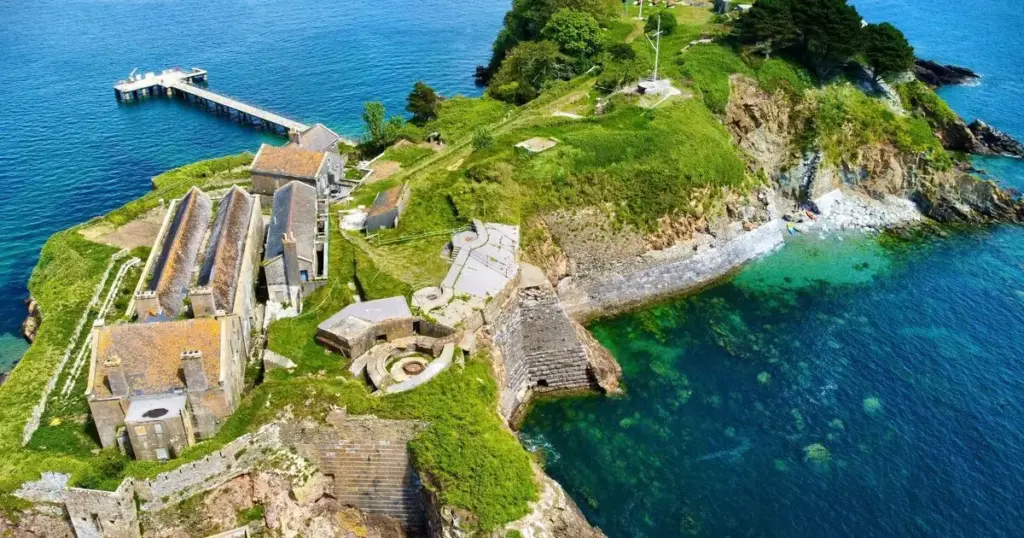
Nestled within the sheltered waters of Plymouth Sound off the south coast of England, the historic and strategically vital Drake’s Island has once again been placed on the open market. Priced at a staggering £2 million—a steep discount from its previous £6 million asking price in 2018—this 6.4-acre private island represents one of the most unique and complex heritage-development opportunities in the United Kingdom.
Boasting over 30,000 square feet of disused, centuries-old military structures, the property combines a storied 400-year maritime past with modern planning potential. Currently managed by receivers Kirker & Co on behalf of Plymouth Sound Properties Ltd, and marketed by London-based real estate advisory firm Carter Jonas, the island comes complete with existing planning permission for a luxury 43-bed hotel conversion.
Beyond its commercial viability as a high-end hospitality destination or an ultra-exclusive private residence, Drake’s Island is a living monument to British naval history. From serving as the launchpad for Sir Francis Drake’s historic 1577 circumnavigation of the globe to playing a critical defense role during the English Civil War and the twentieth-century World Wars, the island offers an unmatched canvas for investors willing to blend heritage preservation with contemporary luxury real estate development.
Detailed Chronology: From Tudor Outpost to Modern Enigma
The history of Drake’s Island is inextricably linked to the military fortunes of Great Britain and the maritime dominance of Plymouth. Its evolution spans more than four centuries, transitioning from a religious sanctuary and strategic artillery post to a vital defensive fortress and, ultimately, a dormant historical asset.
The Tudor Era and Sir Francis Drake (16th Century)
Long before it bore the name of England’s most celebrated sea captain, the island was known as St Michael’s Island, housing a small religious chapel. However, its strategic value soon overshadowed its spiritual use. By the late 1500s, as tensions grew between England and Catholic Europe, the crown recognized the island’s potential to control the entrance to Plymouth Sound.
In 1577, the island earned its place in global history books when Sir Francis Drake assembled his fleet and set sail from its shores to begin his legendary circumnavigation of the world aboard the Golden Hind. Recognizing the island’s supreme tactical advantage, Queen Elizabeth I subsequently authorized the fortification of the landmass to protect the burgeoning naval port from foreign invasion.
The English Civil War and Royalist Sieges (17th Century)
During the English Civil War (1642–1651), Drake’s Island became a crucial flashpoint between Royalist and Parliamentarian forces. Plymouth steadfastly declared for Parliament, while much of the surrounding Devon and Cornwall countryside leaned Royalist.
The island, equipped with newly mounted artillery batteries, played a pivotal role in the defense of the town. It withstood prolonged blockades and bombardments by Royalist forces, serving as a secure anchorage and supply route for Parliamentarian ships. The fortifications built during this turbulent era laid the structural groundwork for the military compound that would dominate the island for the next three centuries.
Victorian Expansion and World War Defense (18th–20th Centuries)
As military technology evolved, so too did the defenses of Drake’s Island. During the Victorian era, fears of a French invasion prompted a massive overhaul of Britain’s coastal fortifications. The island was heavily re-engineered, featuring subterranean tunnels, ammunition stores, barracks, and heavy gun emplacements designed to repel ironclad warships.
This defensive posture remained vital well into the twentieth century. Throughout World War I and World War II, the island operated as an active military installation, housing anti-aircraft batteries and searchlight stations to protect the vital naval dockyards of Devonport. Military personnel manned the fortifications around the clock, cementing the island’s status as a forbidden, highly secured military zone.
Decommissioning and Modern Ownership Shifts (1960s–Present)
In the 1960s, the Ministry of Defence finally deemed the island redundant for modern military strategy and handed ownership back to the Duchy of Cornwall. For decades, public access was strictly prohibited, wrapping the island in an aura of mystery.
In 2018, the island was put on the market for £6 million and subsequently acquired by businessman Morgan Phillips through Plymouth Sound Properties Ltd. Phillips harbored ambitious plans to restore the historic structures, establish a dedicated museum and heritage center, and revitalize the island for cultural tourism.
A major milestone was achieved in 2020 when Drake’s Island welcomed its first public visitors in over thirty years, hosting a series of exclusive guided tours to raise vital funds for St Luke’s Hospice. However, financial and logistical headwinds ultimately stalled the comprehensive redevelopment, leading to the appointment of receivers Kirker & Co and the current £2 million distress-priced listing handled by Carter Jonas.
Supporting Context & Metrics
Evaluating Drake’s Island requires an understanding of its unique physical attributes, infrastructural challenges, and economic potential. Below is an overview of the key metrics defining the asset:
Metric Category
Detail / Specification
Asking Price
Offers in excess of £2,000,000
Land Area
Approximately 6.4 acres
Built Space
c. 30,000 sq ft of disused historic and military accommodation
Current Planning Consent
Approved for a 43-bed luxury hotel conversion
Previous Valuation (2018)
£6,000,000
Location
Plymouth Sound, South Coast of England (minutes from the mainland)
Key Historical Associations
Sir Francis Drake (1577), English Civil War, Victorian Fortifications, WWII Defense
Tourism and Commercial Streams
According to historical marketing prospectuses and regional development studies, Drake’s Island possesses diverse revenue-generating capabilities. Past commercial ventures—undertaken on a limited or temporary basis—demonstrated robust demand for:
Guided Heritage Tours: Capitalizing on military history enthusiasts and local tourism.
Location Filming: Providing an authentic, atmospheric backdrop for television and film productions.
Corporate Retreats and Adventure Days: Leveraging the exclusivity of a private island setting just minutes from a major urban center.
Cultural Events and Theatre: Utilizing open-air spaces and historic parade grounds for unique artistic performances.
Official Statements and Expert Analysis
The listing has generated significant buzz within the UK and international real estate markets, highlighting the rarity of purchasing an entire fortified island with pre-approved commercial planning.
Ali Rana, Head of National Investment at Carter Jonas, emphasized the exceptional nature of the offering in an interview with The Independent:
"Drake’s Island is one of the most remarkable development and regeneration opportunities to come to the UK market in recent years. With planning consent already secured for a hotel and a setting shaped by centuries of history, it offers investors an exceptional platform to create a truly landmark destination."
Rana further elaborated on the exclusivity of the asset:
"Opportunities to acquire an entire private island are exceptionally rare, and rarer still, one that lies just minutes from the mainland, combines more than 400 years of history with over 30,000 sq ft of historic buildings, and offers the potential to create one of Britain’s most extraordinary private homes. We expect interest from UK and international investors, hoteliers and private buyers alike."
Property analysts note that while the £2 million price tag appears remarkably accessible for an island of this scale, prospective buyers must factor in substantial capital expenditure. Restoring 30,000 square feet of damp, protected, and structurally complex 16th- to 19th-century military masonry—surrounded entirely by marine environments—will require millions of pounds in specialized engineering and heritage restoration expertise.
Future Outlook: What Lies Ahead for Drake’s Island?
As Carter Jonas opens the bidding for offers of £2 million and above, the future of Drake’s Island hangs in the balance. Several potential trajectories exist for the property depending on the identity and vision of the eventual buyer:
The Luxury Hospitality Route: The most straightforward path involves exercising the existing planning permission to build a high-end 43-bedroom boutique hotel. Positioned within Plymouth Sound, such a resort could cater to the booming UK staycation market and affluent international travelers seeking unique heritage experiences.
The Ultra-Exclusive Private Estate: Given the option to utilize the extensive square footage for residential purposes, a high-net-worth individual could transform the fortress into one of the most secure, private, and historically significant coastal retreats in Northern Europe.
A Mixed-Use Cultural Hub: A consortium of heritage trusts, regional developers, and hospitality operators could pool resources to create a sustainable model combining public access museums, educational facilities, and boutique commercial ventures, ensuring the island remains accessible to the British public.
Ultimately, Drake’s Island remains a sleeping giant in Plymouth Sound. Whether it awakens as a glamorous luxury hotel, a billionaire’s secluded sanctuary, or a preserved monument to maritime heritage, its next chapter will undoubtedly shape the cultural and economic landscape of the English south coast for decades to come.