Executive Overview
In the fast-paced landscape of modern endurance athletics, a pervasive myth continues to dominate public discourse: the belief that marathon running requires a monastic, joyless lifestyle defined by 5:00 AM wake-up calls, grueling unassisted mileage, and an absolute rejection of comfort. We are conditioned to picture the serious runner as someone operating on an ultra-strict regimen, immune to fatigue, social obligations, and the simple pleasures of sleeping in.
Hong, a Berlin-based designer, flight attendant, and veteran endurance athlete, completely shatters this archetype. Once firmly self-identified as "not a runner," Hong is now actively preparing for her seventh marathon. Yet her approach to training is a masterclass in modern lifestyle integration, proving that high-performance endurance and absolute personal comfort do not have to be mutually exclusive. Balancing an eclectic international career in the aviation industry with creative design work, a vibrant social life, and a deep appreciation for Berlin’s cultural scene, Hong manages a nearly daily fitness routine centered around one non-negotiable principle: she likes to keep things cozy.
This in-depth feature explores Hong’s weekly training regimen, breaking down how a modern professional navigates the complexities of high-mileage preparation without sacrificing mental well-being, community connection, or spontaneity. From singing mid-run to manage breath control to leveraging the supportive energy of Berlin’s local running collectives, Hong’s journey offers a refreshing blueprint for everyday athletes looking to scale new heights without losing their love for the sport.
Detailed Chronology: A Week in the Life of a Marathon-Bound Multitasker
To understand how Hong maintains her momentum across a demanding training block, one must look at the granular details of her week. Far from a rigid spreadsheet of identical workouts, her schedule is a dynamic ecosystem of movement, recovery, culture, and community.
Monday: Rhythm, Play, and Pacing
The week begins with the dual pressures of Hong’s professional life. Splitting her time between graphic design and working as a flight attendant means her schedule is volatile, demanding immense mental and physical adaptability. To maintain consistency, she relies heavily on an auditory anchor: her running playlist.
"I don’t always listen to music when I run," Hong notes, "but when I feel unmotivated, it’s an absolute lifesaver."
Her musical curation—often featuring an energetic mix of disco, house, and techno—serves as the primary catalyst for pushing past initial resistance. However, Hong’s Monday runs are defined just as much by self-awareness as they are by external drive. When fatigue sets in and breath control slips, she employs an unconventional, highly effective tactic: she starts singing out loud.
"It forces me to slow down and get my breathing back under control," she explains with a smile. "The run instantly becomes much more fun, and I notice people smiling as I jog past them, singing to myself."
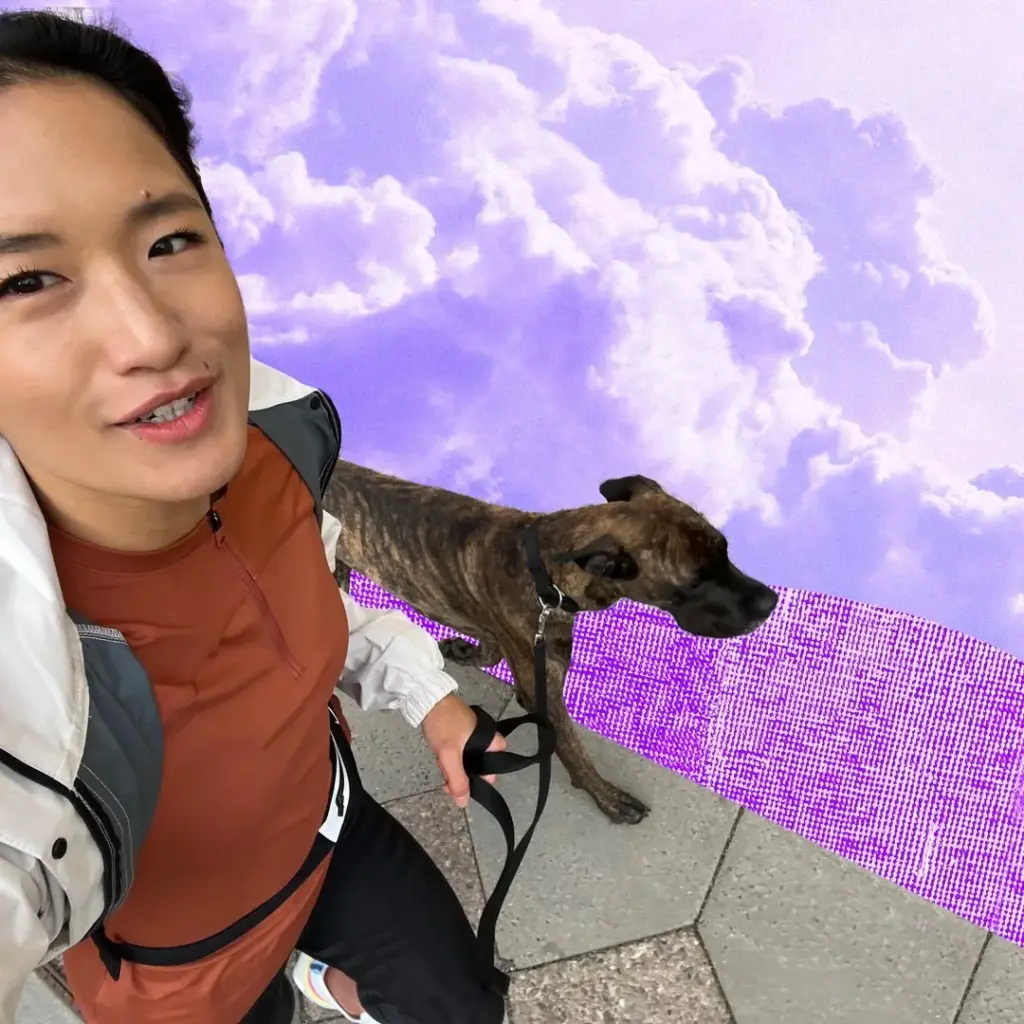
Adding to Monday’s dynamic, Hong frequently borrows Mia, her friend’s high-energy dog, providing a symbiotic running partnership. "Mia has so much energy, and it’s fun to race her. In the beginning, she pulls me; in the end, I pull her. I might not be as fast as her, but when it comes to endurance, I win."
Tuesday: Cross-Training and Injury Mitigation
Marathon training is rarely just about running; structural integrity is the silent pillar of any successful endurance block. Tuesday marks Hong’s transition away from pavement and onto the yoga mat. Recognizing that repetitive impact requires robust physical support, she pairs her yoga practice with targeted strength training and scheduled physiotherapy sessions.
This holistic framework is the secret to her longevity in the sport. By building a solid muscular foundation and prioritizing physical maintenance, Hong ensures she can safely step outside her comfort zone during high-intensity runs without running a high risk of injury. Furthermore, this multi-disciplinary approach prevents the debilitating post-workout burnout that plagues many novice runners, allowing her to recover effectively and return to her running shoes within 24 to 48 hours.
Wednesday: Cultural Integration and Active Recovery
Recovery is an active component of Hong’s training architecture, treated with the same respect as a track interval or a long run. Because her career as a flight attendant frequently takes her away from home, she fiercely protects her time in Berlin to nurture her social connections.
Rather than holing up at home to rest her legs passively, Hong opts for cultural stimulation. On Wednesdays, she frequently visits local art galleries and exhibitions with friends. This balance between physical rest and mental engagement ensures that her training block never feels like a cage, keeping psychological burnout at bay.
Thursday: Pushing Limits at the Track
While comfort is a foundational philosophy for Hong, race preparation inevitably demands moments of intense physical confrontation. Thursday is track workout day—a high-intensity session designed to test speed thresholds and aerobic capacity.
"Some people think marathoners bounce out of bed at 5:00 AM and effortlessly knock out 20 kilometers," Hong says. "In reality, I sometimes need an extra dose of motivation too."
To bridge the gap between hesitation and execution, footwear plays a critical role. During these punishing track sessions, Hong turns to gear engineered to absorb shock and return energy, such as the Nike Invincible 3. "I love wearing them because they give me a secure feeling on any surface, and I’m obsessed with the bouncy sole."
By leaning into supportive, high-performance gear, she successfully tackles her speed intervals, treating the track not as a place of punishment, but as a controlled environment to challenge her mental boundaries.
Friday: Social Recharge and Reflection
Following Thursday’s punishing track session, Friday is designated as a low-impact recovery day. Aside from a gentle restorative yoga flow, Hong keeps physical exertion to a minimum. She uses the time to catch up with friends, explore more of Berlin’s thriving art scene, and make the most of her fleeting days on home soil before her next flight roster begins.
Saturday: The Ritualistic Long Run and Urban Sightseeing
Saturday morning signals the arrival of Hong’s standard training route: a picturesque, varied loop along the Landwehrkanal. This route offers a changing tapestry of terrain—asphalt, packed dirt, grass, and occasional patches of mud—which naturally engages stabilizing muscles in the ankles and core.
With an engaging podcast playing in her ears or simply tuning into the ambient, bustling soundscape of Berlin, Saturday runs are meditative. "I love watching the people around me," she reflects.
True to her philosophy of rewarding effort, the run always concludes with a celebratory ritual: a fresh cup of coffee and a light snack from a local market stall in Kreuzberg, cementing the run as a holistic sensory experience rather than a mechanical chore.
Sunday: Community Mileage and the Ultimate Reward
Sunday brings the crown jewel of Hong’s weekly training calendar: the long run executed in tandem with her running community, the Joy Run Collective. Navigating the crisp air of Berlin’s Tiergarten park on extended routes requires careful planning and thermal regulation.
"Because of the longer duration and the cold, I want to be well prepared, so I bundle up," she notes.
The psychological benefit of group running cannot be overstated; sharing miles with like-minded peers transforms a daunting double-digit distance into an accessible shared adventure. The morning invariably concludes with a post-run social gathering—most notably, a long-awaited group brunch hosted by a community member specializing in homemade dumplings.
"I thought about those dumplings all week long," Hong laughs, illustrating that deep culinary rewards are an entirely valid and effective psychological training tool.
Supporting Context & Metrics: The Physiology of Sustainable Endurance
Hong’s trajectory from a self-proclaimed non-runner to a seasoned marathoner preparing for her seventh 42.2-kilometer race sheds light on broader shifts in modern athletic culture. The global running boom, accelerated over the past decade, has transitioned away from the grueling, exclusionary "no pain, no gain" dogma of the late 20th century toward a more sustainable, holistic paradigm.
The Science of "Comfort-First" Training
Sports science increasingly supports Hong’s intuitive approach to balancing comfort with high performance. Research in psychophysiology demonstrates that perceived exertion is deeply tied to psychological comfort. When athletes integrate elements they genuinely enjoy—whether it is curated musical playlists, running with a dog, socializing, or anticipating a post-run pastry—the brain releases dopamine and endogenous opioids, which mitigate the subjective experience of physical fatigue.
Furthermore, Hong’s incorporation of cross-training (yoga, strength conditioning, and physiotherapy) aligns with contemporary injury-prevention protocols. According to orthopedic studies, recreational distance runners experience annual injury rates ranging from 19% to 79%, with the knee and lower leg being the most common sites of overuse trauma. By dedicating multiple days a week to non-impact cross-training and mobility, Hong fortifies her kinetic chain, ensuring structural resilience that outlasts the repetitive pounding of asphalt.
Official Statements and Personal Philosophy
Reflecting on her four-year evolution in the sport, Hong offers profound insights into how distance running rewrites personal identity.
"I started running four years ago. At 30, I am healthier and fitter than I ever was in my twenties. But running is so much more than physical training. As a runner, I’ve gained immense self-confidence because I now know how hard I can push myself, even when I’m feeling a bit low."
This perspective challenges the conventional metrics of athletic success. For Hong, the victory does not lie merely in a race-day finishing time, but in the psychological resilience forged along the way.
"I’ve learned that consistency and comfort do not have to exclude one another. I can set new boundaries for myself and still feel completely at ease while doing it. Next stop: my 7th marathon."
Future Outlook: Redefining the Modern Endurance Athlete
As Hong looks ahead to her seventh marathon start line, her journey serves as a compelling case study for the future of endurance sports. The modern athlete is increasingly unwilling to sacrifice professional ambition, creative expression, social relationships, and mental peace at the altar of athletic achievement.
By refusing to choose between a demanding career as a designer and flight attendant and the rigorous demands of marathon training, Hong demonstrates that sustainable excellence is built on flexibility, self-compassion, and community. Her routine proves that you do not need to wake up hating your alarm clock to conquer 42 kilometers; sometimes, all you need is a great pair of shoes, a brilliant playlist, a loyal dog, and something delicious waiting for you at the finish line.
Hong’s 3 Essential Tips for Maximizing Running Enjoyment:
- Prioritize Footwear: Invest in supportive, comfortable, and responsive shoes (such as the Nike Invincible 3) that give you a secure, energized feeling across varied terrain.
- Curate Your Soundtrack: Build an inspiring, high-energy playlist (spanning disco, house, and techno) to pull you through moments of low motivation.
- Establish Post-Run Rituals: Pair scenic, engaging routes with a deliberate social element or a delicious culinary reward to turn every workout into an experience to look forward to.