Executive Overview
For the vast majority of modern professionals, the humble chair is an implement of sedentary confinement. It is the architectural anchor for hours spent navigating spreadsheets, consuming digital media over dinner, or binge-watching streaming services. However, a growing faction of physical therapists and personal trainers are repositioning this ubiquitous piece of furniture from a symbol of physical stagnation into an accessible, highly effective apparatus for core conditioning.
Far from being a mere convenience, incorporating chair-based exercises into a daily routine offers unique biomechanical advantages. By elevating the hands or feet, standard abdominal movements—such as planks, mountain climbers, and push-ups—become significantly more accessible for beginners, individuals with mobility limitations, or those who prefer to avoid floor-based workouts. Furthermore, a stable chair provides critical tactile feedback and structural support, enabling exercisers to engage deep stabilizer muscles, such as the transversus abdominis, with precision.
According to fitness experts, these movements can be seamlessly integrated as quick movement snacks between virtual meetings or strung together to form a comprehensive, full-body circuit. This article explores the physiological mechanics of chair-based core training, details five expert-approved movements, and outlines a progressive framework for building enduring midsection stability without ever leaving your home office.
Detailed Chronology and Evolution of Functional Seated Fitness
The integration of household furniture into physical training is not an entirely novel concept, but its validation through modern biomechanics represents a significant shift in functional fitness. Historically, calisthenics and bodyweight conditioning relied almost exclusively on the floor or specialized gymnasium infrastructure. This rigid dichotomy—gym equipment versus unstructured home environments—often created barriers to entry for populations facing time constraints, joint pain, or spatial limitations.

The Shift Toward Accessible Functional Movement
Over the past decade, the fitness industry has undergone a democratization phase, accelerated by remote work culture and the proliferation of home-based routines. Trainers began recognizing that traditional floor-based abdominal work often presents hidden hurdles: wrist strain during planks, lower back discomfort during unsupported crunches, and an outright aversion to working out on uncleaned residential flooring.
Fitness professionals began experimenting with elevation. By shifting the center of gravity and reducing the load placed on upper extremities and the lumbar spine, standard bodyweight movements were rendered universally executable.
- Phase One: Rehabilitation and Mobility. Initially, chair-assisted movements were confined to physical therapy clinics, utilized primarily for geriatric populations or post-operative patients recovering core and lower-extremity strength.
- Phase Two: The Home-Office Integration. As remote work expanded, wellness advocates realized that prolonged sitting creates a specific neuromuscular disconnect—the hip flexors shorten while the glutes and deep core stabilizers go dormant. Chair exercises emerged as an immediate, friction-free antidote to "sitting disease," allowing desk-bound workers to stimulate dormant muscle fibers without changing into athletic gear or deploying heavy equipment.
- Phase Three: Advanced Biomechanical Optimization. Today, trainers utilize chairs not merely as a modification tool for beginners, but as a deliberate mechanism to increase core activation through unstable or elevated angles, challenging single-leg stability and rotational control in ways traditional floor work cannot easily replicate.
Supporting Context, Mechanics, and Metrics
To understand why chair-based ab exercises are so effective, one must examine the anatomy of the core and the biomechanical principles of load distribution.
Anatomy of the Core and the Transversus Abdominis
The core is far more than the superficial rectus abdominis—the aesthetic "six-pack" muscles. It functions as a complex, cylindrical muscular corset designed to protect the spine and transfer force efficiently between the upper and lower body. Key components include:

- The Transversus Abdominis (TA): The deepest layer of the abdominal wall. It acts like a natural weightlifting belt, compressing the abdomen and stabilizing the lumbar spine.
- The Obliques (Internal and External): Situated along the sides of the torso, these muscles facilitate trunk rotation and lateral flexion.
- The Erector Spinae and Multifidus: Deep back muscles that work in tandem with the abdominals to maintain upright posture.
Becca Revier, a personal trainer and Pilates instructor at Life Time Lakeville in Minnesota, emphasizes the role of the chair in teaching proper core engagement. Through drills such as the seated transversus abdominis (TA) bracing exercise, the chair offers tangible, physical feedback. When an individual sits upright with correct posture, the boundaries of the chair encourage structural awareness, making it easier to isolate and fire up deep stabilizing fibers rather than relying on momentum or superficial muscle groups.
The Physics of Elevation and Load Reduction
When performing standard abdominal planks or push-ups on the floor, the exerciser must manage a significant percentage of their total body weight against gravity. For novices or those recovering from shoulder or wrist injuries, this load can force poor mechanics, leading to lumbar hyperextension (arching the lower back) and neck strain.
By elevating the hands onto a stable chair:
- The Load Decreases: The angle of inclination shifts a portion of the body weight toward the lower extremities, reducing stress on the shoulder girdle and wrists.
- Form is Protected: A higher hand placement makes it mechanically simpler to maintain a neutral pelvis and draw the navel inward, preserving the integrity of the plank position.
- Tactile Boundaries Prevent Cheating: The physical presence of the chair enforces range-of-motion boundaries, preventing momentum-driven movements that bypass true muscular engagement.
Official Guidelines and Expert Recommendations
Integrating chair-based exercises safely requires adherence to strict equipment and structural standards. Fitness professionals universally underscore the importance of environment and execution.

The Golden Rule: Choose the Right Chair
Before attempting any movement detailed in this guide, equipment safety must be verified. Katie Pierson, a Montana-based personal trainer, issues a definitive warning regarding furniture selection:
"You definitely want a chair that’s going to keep you where you need to be. Your rolling swivel chair is definitely NOT the smart choice here."
An unstable, rolling, or folding chair introduces catastrophic risk vectors, including sliding, tipping, or unexpected structural collapse under dynamic loads. Exercisers must exclusively utilize a heavy, stationary dining or office chair positioned firmly against a wall or on a non-slip rug.
Programming and Volume Guidelines
For individuals looking to integrate these movements into their daily lives, flexibility is key.

- The "Movement Snack" Approach: Perform individual exercises as isolated sets in between work tasks or Zoom meetings to break up prolonged sedentary blocks.
- The Circuit Approach: Combine all five movements into a cohesive, full-body resistance circuit.
- Volume Recommendation: Pierson suggests initiating the routine with 3 sets of 8 to 10 repetitions per exercise, gradually scaling up volume as baseline muscular endurance and core strength improve over weeks and months.
Comprehensive Guide: Five Chair Exercises to Sculpt and Stabilize Your Core
Below are five expert-approved chair exercises designed to target every angle of the midsection while accommodating various fitness levels.
1. The Elevated Push-Up
- Primary Focus: Full-body stabilization, deep core, chest, and shoulders.
- Execution: Place your hands firmly on the edges of a stable, stationary chair seat, slightly wider than shoulder-width apart. Step your feet back into a plank position, keeping your body in a straight line from your head to your heels. Bend your elbows to lower your chest toward the chair, then press back up to the starting position.
- Trainer Insight: "Okay, so the elevated push-up is technically a full-body exercise, but it’s basically a dynamic plank, which means there’s a strong emphasis on the abs," says Revier. As you execute the pressing motion, your core works overtime to keep the spine rigid. Pierson advises keeping a neutral pelvis—avoiding both excessive arching and rounding of the lower back—while drawing the belly button in and up to maximize core recruitment.
2. The Elevated Mountain Climber
- Primary Focus: Dynamic core stability, hip flexors, and cardiovascular endurance.
- Execution: Maintain your hand placement on the chair seat in a plank position. Keeping your core braced and shoulders pulled down and away from your ears, drive your right knee forward toward your chest. Return the right foot to the starting position and immediately repeat with the left knee.
- Trainer Insight: This dynamic movement challenges your stabilizing muscles to resist rotational forces. Revier stresses the importance of form: "Focus on pulling your shoulders down and back… and draw your bellybutton in as you drive your knee to your chest. You should feel a mini crunch in your abs every time your leg comes up." Crucially, ensure your hips remain level and stationary; preventing side-to-side rocking is the primary mechanism for activating the transversus abdominis.
3. The Chair Squat
- Primary Focus: Glutes, quadriceps, and postural core engagement.
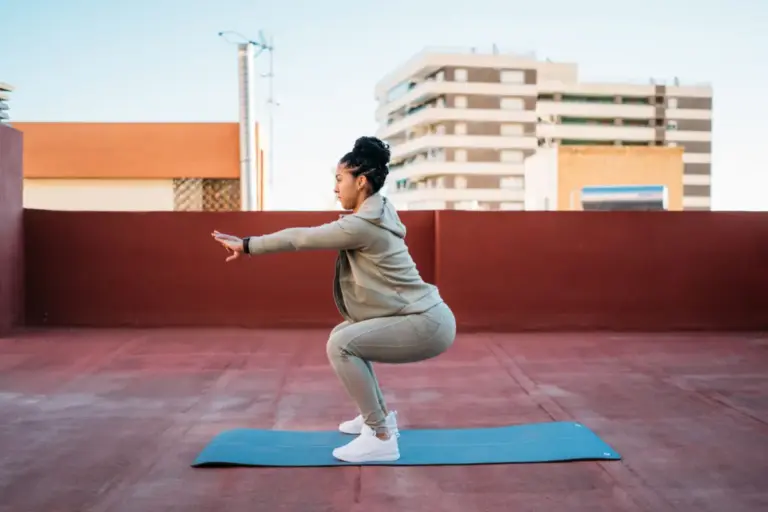
- Execution: Stand facing away from the chair, feet shoulder-width apart. Hinge at your hips, bending your knees to lower your buttocks down until they lightly tap the chair seat, then drive through your heels to return to standing.
- Trainer Insight: While primarily a lower-body exercise, squats demand significant isometric core contraction to maintain an upright, proud torso. The chair serves as an invaluable form coach, forcing you to push your hips backward rather than letting your weight drift forward over your toes. To optimize core activation, Revier suggests focusing your gaze forward at eye level (as if watching a television screen) rather than looking down at your feet: "That’s going to help you keep your chest elevated and help you engage that transverse abdominis."
4. The Single-Leg Squat to Chair
- Primary Focus: Advanced unilateral leg strength, balance, and deep core stabilization.
- Execution: Begin seated on the chair. Lift one foot slightly off the floor, extending it forward. Keeping your weight in the grounded foot, engage your core and push up to a standing position on a single leg. Lower yourself back down with control, aiming for a soft landing on the seat.
- Trainer Insight: This advanced variation tests your lateral stability. "You probably naturally want to tip over if you’re just in that single leg stance, but your core has to work to help you stay upright," explains Revier. Despite its advanced nature, utilizing the chair provides a built-in safety net: "It’s a lot safer to sit down into a chair rather than just doing a squat in space."
5. The Alternating Cross Crunch
- Primary Focus: Obliques (side abdominal muscles) and deep rotational stability.
- Execution: Sit tall near the edge of the stationary chair with your feet flat on the floor and hands lightly placed behind your head or across your chest. Engage your core, lift your right knee toward your torso while simultaneously rotating your torso to bring your left elbow toward that knee. Return to the starting position and alternate sides.
- Trainer Insight: This seated movement specifically isolates the obliques. To maximize the contraction, focus on exhaling completely as the elbow meets the opposing knee, squeezing the side of your torso to drive the movement rather than pulling violently on your neck with your hands.
Future Outlook: The Integration of Ergonomic Fitness into Modern Workspaces
As corporate culture continues to grapple with the long-term health consequences of sedentary office jobs—ranging from chronic lower back pain to metabolic deceleration—the paradigm of workplace wellness is undergoing a quiet revolution. The traditional mandate to simply "sit up straight" is being replaced by active, movement-integrated approaches.
Fitness experts predict that the future of home-office design will increasingly blend ergonomics with functional fitness infrastructure. Rather than viewing exercise and work as two completely isolated spheres of daily life, individuals are learning to leverage everyday items like chairs, desks, and walls as proactive tools for musculoskeletal health.
By reclaiming the chair as an instrument of strength rather than a vessel for passivity, desk-bound workers can combat the postural degradation of modern life one rep at a time. Whether utilized for a quick set of elevated push-ups between conference calls or a rigorous single-leg squat circuit at the end of the day, chair-based ab training proves that effective core conditioning requires neither expensive gym memberships nor vast square footage—just a stable seat, proper biomechanics, and a commitment to movement.