By Noora Mykkanen
Published September 25, 2026 | Updated September 25, 2026
Executive Overview
A devastating aviation disaster unfolded in the southwestern region of the Democratic Republic of Congo (DRC) on September 25, 2026, when a military transport aircraft plummeted into a residential neighborhood and erupted into a fierce fireball. The crash, which occurred in the town of Kenge located within Kwango province, resulted in the deaths of all 13 individuals on board.
Among the victims were high-ranking military officials, including General Likulia Bakumi, the army’s auditor general, alongside other senior defense personnel and civilians. The flight—which had originated in the city of Kikwit and was en route to the national capital of Kinshasa—was forced to attempt an emergency diversion following a severe technical malfunction. Tragically, due to the complete absence of a proper landing strip or dedicated airfield in Kenge, the pilot was left with virtually no safe options, steering the stricken aircraft toward an open residential plot on a hillside.
The incident has once again cast a harsh spotlight on aviation safety standards within the DRC—a vast nation heavily reliant on air travel due to chronically underdeveloped road infrastructure. As local authorities, emergency responders, and government aviation bodies launch formal investigations into the mechanical failures that precipitated the disaster, grieving families and a shaken nation are left grappling with the profound loss of prominent military leadership and civilian lives alike.
Detailed Chronology: The Final Flight of the Military Transport
Departure and In-Flight Malfunction
The ill-fated journey began earlier in the day on September 25, 2026, as the military aircraft took off from the bustling city of Kikwit. The flight was scheduled to land at N’djili International Airport in the capital city of Kinshasa, a routine transit route for military and governmental officials crisscrossing the vast expanse of the Central African nation.
However, shortly after achieving cruising altitude, the aircraft encountered sudden and severe technical difficulties. While official preliminary reports have not yet detailed the exact nature of the mechanical failure, the severity of the onboard issue forced the flight crew to make an immediate, unscheduled change of course. The pilot opted to divert toward Kenge, a town in Kwango province situated roughly midway between Kikwit and Kinshasa, in a desperate bid to find a flat, open space to touch down before total system failure occurred.

The Desperate Descent Over Kenge
As the aircraft approached the airspace above Kenge, the gravity of the situation became starkly apparent. According to local officials and aviation monitors tracking the incident, Kenge lacks any formal landing strip, runway, or commercial aviation infrastructure capable of handling a distressed twin-engine transport plane.
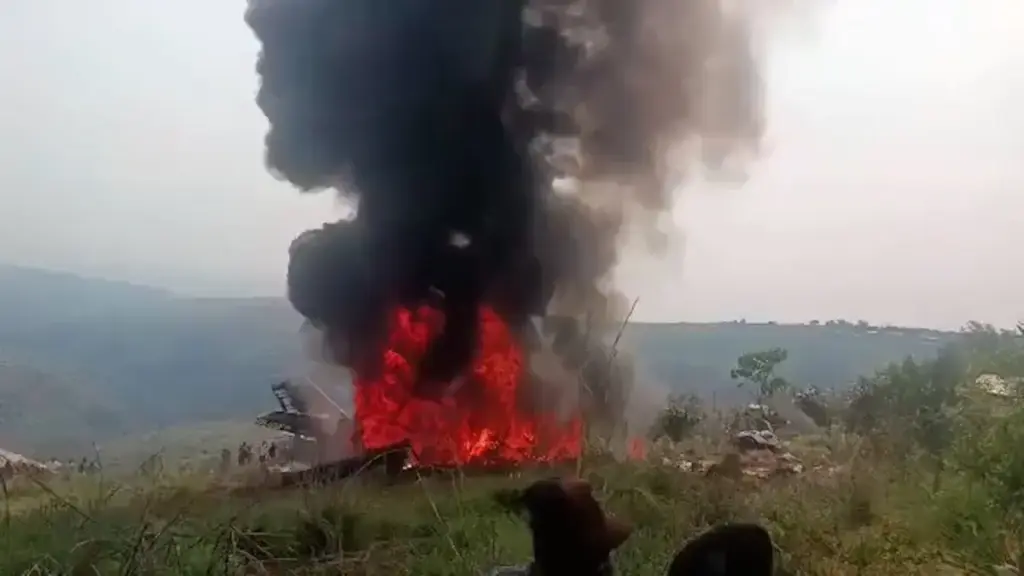
Eyewitnesses on the ground reported hearing a sputtering, low-flying aircraft struggling to maintain altitude before it suddenly banked sharply toward a hillside residential plot. Video footage subsequently shared across social media platforms depicted thick plumes of black smoke and roaring flames billowing into the sky from the impact zone.
According to Remy Saki Bokinda, the vice governor of Kwango province, the pilot executed a heroic yet ultimately futile effort to avoid populated residential buildings. With no runway available, the plane slammed directly into a residential plot on the Kenge hillside, instantly bursting into a catastrophic fireball that engulfed the entire fuselage.
Immediate Aftermath and Recovery Efforts
Local residents were first on the scene, rushing heroically toward the blazing wreckage in frantic, largely helpless attempts to pull survivors from the inferno. However, the intensity of the post-crash fire proved insurmountable for immediate bystanders.
Emergency responders and provincial authorities arrived shortly thereafter, facing a scene of absolute devastation. According to Vice Governor Bokinda, the catastrophic nature of the explosion and ensuing fire meant that 12 of the 13 occupants were burned beyond recognition inside the wreckage. The pilot’s body, discovered just outside the mangled framework of the aircraft, was respectfully recovered and transported on a stretcher as grim-faced onlookers watched from the perimeter.
Supporting Context & Metrics: Aviation Perils in the DRC
The Infrastructure Deficit
The tragedy in Kenge highlights a grim, systemic reality: the Democratic Republic of Congo remains one of the most perilous places in the world for aviation. Spanning an area roughly the size of Western Europe, the DRC is the second-largest country on the African continent. Yet, its geography—characterized by dense equatorial rainforests, winding major river systems, and rugged terrain—presents immense challenges for overland transportation.

Decades of conflict, underinvestment, and institutional corruption have left the country’s road network in a state of profound disrepair. Paved highways connecting major economic hubs are sparse, leaving vast expanses of the country accessible only by air, riverboats, or arduous off-road trekking. Consequently, a heavy reliance is placed on small aircraft, aging cargo planes, and military transports to move people, goods, and government officials across the nation.
Safety Records and Global Scrutiny
Despite accounting for a mere fraction of global air traffic—estimated at roughly 0.1%—the DRC has historically shouldered a disproportionate share of the world’s fatal aviation accidents.
- Regulatory Challenges: Civil aviation authorities in Kinshasa have historically struggled to enforce rigorous safety inspections, maintenance schedules, and flight-hour limits on aging fleets.
- Aging Fleets: Many aircraft operating within the region are older models, often acquired second- or third-hand from international carriers, requiring meticulous maintenance that can be hampered by supply chain bottlenecks and economic constraints.
- Lack of Ground Infrastructure: As demonstrated by the tragedy in Kenge, numerous regional towns and administrative centers lack basic aviation amenities such as paved runways, automated weather observation systems, and dedicated emergency rescue services, turning routine mechanical diversions into high-stakes gambles with survival.
Official Statements and Institutional Impact
Government and Provincial Reactions
The loss of high-ranking military officials has sent shockwaves through Kinshasa’s defense establishment. The presence of General Likulia Bakumi—the army’s auditor general and a towering figure within the nation’s military justice system—elevates the incident from a regional transportation accident to a major national security and institutional crisis.
In statements provided to international wire services, Kwango province Vice Governor Remy Saki Bokinda expressed profound sorrow over the tragedy, confirming the identities of several key passengers. Alongside General Bakumi, the manifest included a military major, a captain, additional defense personnel, and several civilian passengers whose names are being withheld pending full notification of next of kin.
International aviation monitoring groups, such as Aviation et al, quickly mobilized information regarding the incident, confirming that the aircraft involved was an L-410 type regional transport that had suffered critical technical difficulties en route.
Launch of Formal Investigations
The Government Aviation Accident Investigation Board has officially opened a comprehensive inquiry into the crash. Investigators are tasked with reconstructing the final moments of the flight, analyzing flight data recorders (if recoverable), examining maintenance logs from Kikwit, and interviewing air traffic control personnel who handled the aircraft prior to its diversion.

Experts note that the investigation will likely scrutinize not only the root mechanical failure that initiated the emergency, but also the broader protocols surrounding emergency routing in regions lacking adequate airfields.
Future Outlook: Lessons and Imperatives for Change
As the families of the 13 victims mourn and the nation processes the profound loss of General Bakumi and his fellow passengers, pressure is mounting on the Congolese government to enact long-overdue structural reforms within the aviation sector.
While tragic incidents like the Kenge crash frequently ignite temporary public outcry and promises of modernization, civil aviation advocates argue that piecemeal measures are no longer sufficient. Meaningful reform must encompass:
- Investment in Ground Assets: Constructing emergency landing strips and basic aviation refueling and safety infrastructure in strategic regional hubs outside of Kinshasa and Lubumbashi.
- Fleet Modernization: Accelerating the retirement of aging aircraft and implementing stringent, transparent airworthiness certifications for all military and commercial carriers operating within Congolese airspace.
- Enhanced Pilot Training: Expanding simulator training and emergency diversion protocols to better equip flight crews facing catastrophic mechanical failures over inhospitable terrain.
Until such systemic transformations are realized, the skies above the Democratic Republic of Congo will remain shadowed by risk, reminding a resilient populace of the heavy price paid for traversing a nation bound by vast distances and formidable natural barriers.