Executive Overview
In the late 1990s, the British pop landscape was saturated with manufactured exuberance, squeaky-clean harmonies, and the algorithmic predictability of early chart assembly. Amidst the Spice Girls phenomenon and the chart dominance of acts like B*witched, Steps, and Boyzone, a different kind of sound was quietly being formulated in a North London music studio.
Enter Keisha Buchanan, Mutya Buena, and Siobhan Donaghy: three teenagers who, in 1998, began congregating after school not to build a commercial brand, but to explore the poetic architecture of songwriting. Mentored by visionary producer Cameron McVey—known for his work with Massive Attack, Portishead, and Neneh Cherry—the trio forged a distinct musical identity. It was built on honied, atmospheric harmonies, moody minor chords, and a raw, unapologetic British R&B sensibility that yielded their landmark, Brit Award-nominated debut album, One Touch, and the effortless earworm “Overload.”
Yet, the trajectory of the original Sugababes lineup became one of the most tumultuous sagas in modern British pop history. Decades of high-profile line-up changes saw every original member depart by 2009, replaced by a revolving door of performers until the brand bore little resemblance to its genesis.
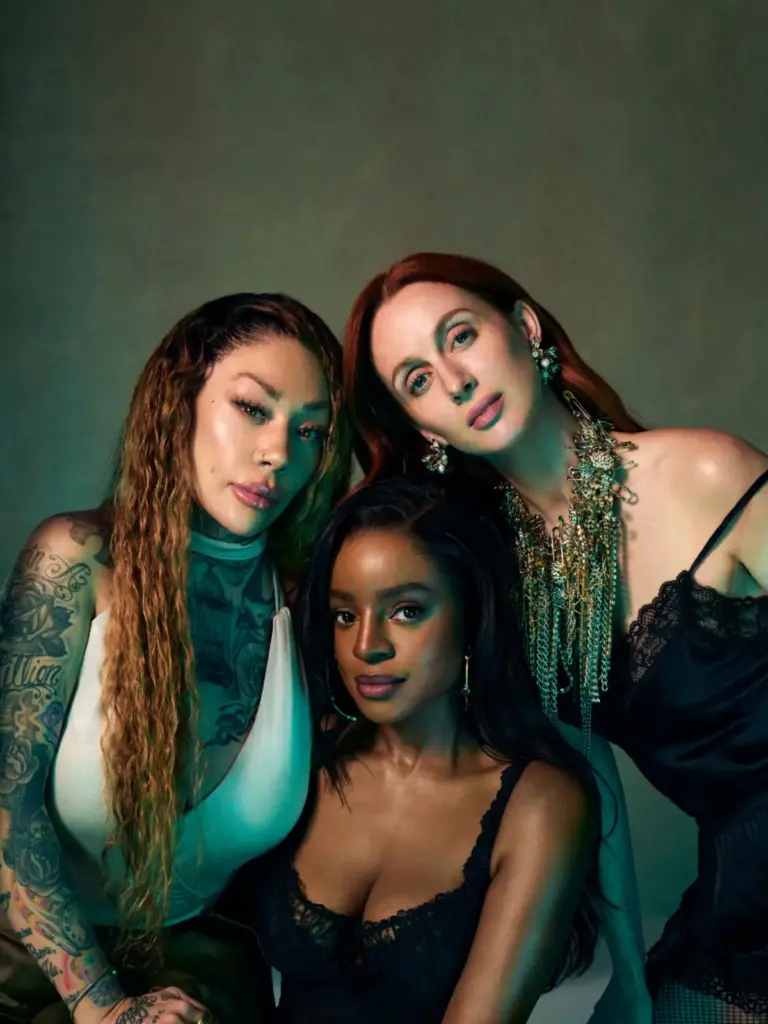
Now, nearly three decades after their initial formation, the original trio—Buchanan, Buena, and Donaghy—is staging a definitive homecoming. In an exclusive revelation to British Vogue, the group has announced a brand-new, self-titled studio album set for release early next year. It marks only their second full-length project under their original name and lineup since 2000’s One Touch. This comeback is more than a nostalgia trip; it is a hard-fought reclamation of identity, intellectual property, and artistic legacy by three women who refused to let their narrative be written for them.
Detailed Chronology: From Schoolyard Studio to Corporate Battles and Triumphant Reunions
To understand the weight of the upcoming Sugababes record, one must trace the winding, often arduous path the trio has traversed since their inception.
1998–2001: The Genesis and the Anti-Girl Band
Formed when the members were just 13 years old, the Sugababes were never molded in the traditional pop-factory tradition. “I think we were probably about 13,” Keisha Buchanan recalls. “For me, it was like a form of poetry. I didn’t know it was songwriting at the time.”
Working alongside Cameron McVey, they cultivated an aesthetic that intentionally resisted the glossy, high-energy cheerfulness of their contemporaries. “It wasn’t glossy, it was very rough around the edges,” Buchanan notes. “We weren’t these grinning Cheshire cats… We were very much ‘the girl band that you were allowed to like’.” Even so, Buchanan admits that the moniker never quite fit: “Even to this day, I don’t see us as a girl band at all.”
2002–2009: The Erosion and Dissolution of the Lineup
The early commercial success of One Touch gave way to internal friction and compounding interpersonal strains. The lineup began to fracture in 2002 when Siobhan Donaghy departed during a promotional tour, subsequently replaced by former Atomic Kitten member Heidi Range.
The churn continued in 2005 when Mutya Buena left the group—later opening up publicly about her struggles with postnatal depression—making way for Amelle Berrabah. Finally, in 2009, the last remaining founding member, Keisha Buchanan, exited amid what she described as a “breakdown in communication,” clearing the path for UK Eurovision entrant Jade Ewen to step in. By this stage, the Sugababes had transformed into a corporate entity completely detached from the North London teenagers who birthed it.

2011–2022: The MKS Era and the Fight for the Name
Refusing to let their foundational work be erased, Buchanan, Buena, and Donaghy quietly reunited around 2011, initially performing and releasing music under the moniker MKS (Mutya Keisha Siobhan). Their 2022 release, The Lost Tapes, comprised tracks recorded in the early 2010s that had languished in unreleased limbo.
Behind the scenes, however, a much more grueling battle was taking place: the fight to legally reclaim the trademarked name "Sugababes."
“Where do we start?” Buchanan laughs when asked about the legal war. “I had the rights to the name from old contracts, and there was a lot of tricky things going on behind the scenes and, pretty much, I had to take on a few giants in order for that to happen… It wasn’t easy. There were a lot of things that went on financially.”
What makes Buchanan most proud is that they executed this coup entirely without industry backing. “What I really admire about our journey is that we were doing things when there was no support, even by the industry. There was no management. No one saying ‘Girls, you’ve got to do this’.”
When asked about whether they received encouragement from the various iteration members who carried the Sugababes torch in their absence, Buchanan pauses diplomatically before breaking the ice with a smile: “It’s all love. We just wish everyone the best.”
2022–Present: Glastonbury Mania and the New Horizon
The turning point for the public’s re-embracing of the original lineup arrived with their monumental performances at the Glastonbury Festival in 2022 and 2024. The crowds were so historically massive that festival organizers were forced to shut down certain access points to prevent a stampede.
“It was insane. It was very overwhelming. I think we all came off kind of in shock,” Siobhan Donaghy remembers, noting that the sheer volume of the screaming audience drowned out her own monitors. Mutya Buena adds, “I just remember being in a really big leather jacket, and feeling like I was gonna faint because of the heat. I came off literally feeling like I had lost my hearing.”
Now, with full ownership of their name, a critically adored live reputation, and a fresh recording contract, the trio stands on the precipice of their most unified artistic statement yet.
Supporting Context & Metrics: Sound, Production, and Cultural Resonance
The upcoming 12-track self-titled album, Sugababes, represents a masterclass in sonic cohesion. Eschewing the hyper-modern gloss of contemporary algorithmic pop, the record features deliberately retro-inspired physical packaging and cover art reminiscent of classic late-90s HMV window displays.

Musically, the record traverses a uniquely British sonic landscape, defying neat genre categorizations:
- UK Garage: Evident on tracks like “Modern Love.”
- Trip-Hop & R&B: Showcased in the syrupy harmonies and moody production of songs like “Weeds.”
- Dance-Pop: Highlighted on the distortion-heavy lead single, “Ghost.”
Dissecting "Ghost"
Released today, lead single “Ghost” serves as both a thematic anchor for the album and a window into the band’s enduring creative chemistry. Siobhan Donaghy explains the deeply personal origins of the track:
“It came from something that happened to me with my first love. He essentially ghosted me before we even had the terminology for it. I remember joking at the time that in some ways it would have been easier if he’d died—which is obviously incredibly dramatic, but there’s something strange about grieving someone who’s still out there.”
Musically, the group deliberately sought a scuzzy, unpolished finish. Rather than opting for over-produced studio perfection, they leaned into looseness to capture character. “We weren’t consciously trying to make something that sounded like an old Sugababes record,” Donaghy reflects, “but once the three voices are on something with that slightly raw, soulful quality, I think it naturally starts to feel like us.”
Demographic Reach and Multigenerational Appeal
What continues to baffle industry observers is the demographic makeup of the modern Sugababes audience. While nostalgic millennials who purchased One Touch on cassette form a large contingent of their base, Gen Z listeners have adopted the group as bonafide indie-pop icons.
This cross-generational resonance stems from the authenticity of their narrative. As Donaghy observes:
“I don’t think the three of us have ever had the easiest time, whether in our lives or in this industry. Even just looking at what happened to our band, and how we’ve been able to come back together is a triumph. I like to think that some people have that person in their life who’s maybe not in their life anymore. And they could maybe look at the three of us and go… anything’s possible. You can turn it around, you can make things better.”
Official Statements & Personal Reflections
Speaking over Zoom from their respective homes—interrupted briefly by Donaghy’s need to rush off to her son’s rugby match, and punctuated by Buena’s quiet cool in a vintage 90s hip-hop tee featuring Lauryn Hill, Tupac, and Erykah Badu—the trio exudes a hard-earned peace.
When asked whether they still see their teenage selves in one another, Buchanan offers a perceptive meditation on time and growth:

“I do feel like we are just elevated versions of our teen selves. A lot of things are the same as they were, but a lot of things have changed… Our personal lives have been very, very different from each other. That’s great for our writing because when we’re able to come together, it is from different perspectives.”
Mutya Buena echoes this sentiment with characteristic levity:
“I mean, I still look at myself as quite young. It doesn’t feel like as many years as it’s been. I find it quite refreshing to always keep going out with new material and performing with the girls.”
Reflecting on their early touring days as MKS—marked by backstage rum punches and high-spirited hijinks—Buchanan laughs, “Oh, we were having a ball of a time! We had to slow it down a little bit because you could forget your lyrics sometimes.” Buena cackles in agreement: “I was wasted.”
Today, the energy is more grounded, balanced with an acute awareness of their privilege. “It doesn’t go over our heads that we are very blessed to be in this position,” Buchanan says softly. “Our gratitude is definitely high, because we know what it takes.”
Future Outlook: Empowering a New Generation
As the Sugababes prepare to release their self-titled album early next year and embark on subsequent touring cycles, their mission statement has evolved from teenage self-expression to a broader cultural empowerment.
The music industry has historically been prone to discarding female artists past a certain arbitrary age threshold, but Buchanan views the group’s current trajectory as a direct refutation of those archaic rules:
“I think sometimes, in the industry, they can cap you at a certain point—but we are living proof that dreams still come true. We are essentially showing people that, at any age, at any point, you can restart, you can look fabulous—because, honey, nothing’s cracking, you know? You can bounce back from any situation, so don’t limit yourself. I love that about the messaging. I hope that people look at us and feel empowered by our story.”
Nearly three decades after three North London schoolgirls sat in a local studio experimenting with poetry and chords, the Sugababes are finally steering their own ship. Armed with their original name, their foundational chemistry, and a collection of songs that bridges their storied past with a vibrant future, they are not merely staging a comeback—they are reclaiming their rightful throne.