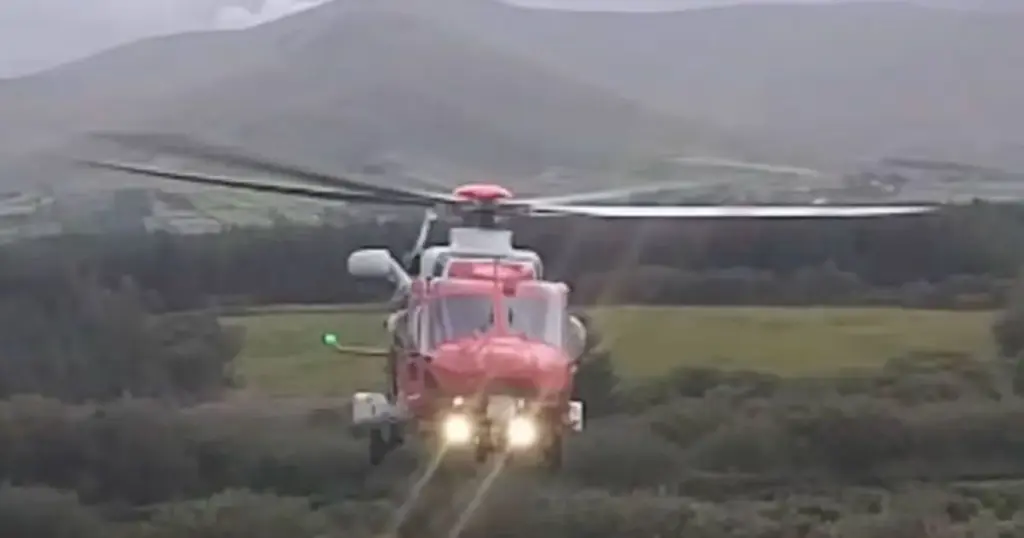
COUNTY KERRY, IRELAND — In a dramatic and multi-agency emergency response that highlighted both the unpredictable nature of domestic animals and the critical efficiency of Ireland’s rural emergency networks, a young child was rushed to hospital following a severe incident involving a family pet in South Kerry. The event, which occurred on Wednesday evening, prompted an immediate, cross-functional mobilisation of air and ground rescue services, including the diversion of a high-readiness search-and-rescue helicopter.
Authorities have confirmed that the child sustained serious, albeit non-life-threatening, injuries during what officials have officially classified as a "freak incident." Thanks to the swift and composed intervention of the child’s parents—who successfully administered crucial initial first aid before emergency services arrived—alongside the rapid coordination of the Iveragh Coast Guard, Garda Síochána, and National Ambulance Service personnel, the situation was stabilized before it could escalate further.
Both the child and the family pet are currently reported to be in good health following medical evaluation and treatment. While local authorities have elected to withhold specific details regarding the exact nature of the incident to protect the privacy of the young casualty and their family, the event has once again cast a spotlight on the vital interplay between rural community resilience, familial preparedness, and elite emergency response infrastructure in isolated regions of the Irish countryside.
Detailed Chronology of Events
The unfolding emergency began late Wednesday afternoon in the scenic yet geographically challenging terrain of South Kerry. According to operational logs released by local emergency services, the routine of an ordinary evening was shattered when an unexpected interaction between the child and the family pet resulted in trauma requiring immediate professional medical intervention.
Initial Response and Parental Intervention
Recognising the severity of the wound, the child’s parents were immediately thrust into an intensely high-stress environment. However, rather than succumbing to panic, the parents maintained remarkable composure. They immediately initiated basic first-aid protocols, expertly managing the injury to minimize blood loss and trauma while simultaneously placing an emergency call for help. Coast Guard officials would later single out this decisive parental action as a critical factor in the successful outcome of the rescue operation.
The Diverting of Rescue 115
At approximately the same time, the Irish Coast Guard’s Shannon-based search-and-rescue helicopter, universally known by its call sign Rescue 115, was airborne and actively engaged in a routine training exercise in the nearby area of Dingle, County Kerry.
Upon receiving distress coordinates from the South Kerry incident, air traffic control and mission commanders acted with exceptional speed. Recognizing the urgency of the situation and the remoteness of the rural location, Rescue 115 command immediately aborted the training mission. The heavy-lift helicopter altered its flight path, banking south toward the Iveragh Peninsula to provide advanced trauma support.
Ground Coordination: Iveragh Coast Guard and Gardaí
Simultaneously, members of the Iveragh Coast Guard unit were paged and mobilized to the scene. Operating as local first responders equipped for both coastal and inland medical support, the coast guard unit arrived rapidly to secure the area and assess the young patient.
Local officers from the Garda Síochána also attended the scene, managing local traffic access points and ensuring a clear, unobstructed corridor for incoming medical transport vehicles.
Upon landing, the flight paramedics and advanced crew members from Rescue 115 joined forces with the Iveragh Coast Guard team. Together, they provided hands-on medical intervention, expertly treating and bandaging the child’s serious wounds directly at the scene.
Handover to the National Ambulance Service
Shortly after the initial stabilization phase, a vehicle from the Health Service Executive (HSE) National Ambulance Service arrived at the location. Following a seamless handover of care, the child was transferred into the back of the HSE ambulance. Accompanied by specialized medical personnel, the young casualty was transported under priority conditions to a regional medical facility for definitive surgical and pediatric assessment.
Once the handover was complete and the patient was safely en route to the hospital, Rescue 115 lifted off once more to resume its interrupted training exercise—bringing a dramatic and tightly coordinated regional response to a successful operational close.
Supporting Context & Metrics: Rural Emergency Response in Ireland
The successful outcome of Wednesday’s operation underscores the sophisticated, highly integrated framework governing emergency medical services (EMS) in rural Ireland. Incidents occurring in isolated regions like South Kerry frequently present unique logistical challenges, where rapid response times can mean the difference between minor medical management and catastrophic outcomes.
The Geography of South Kerry and Access Challenges
The Iveragh Peninsula is characterized by rugged coastlines, winding country boreens, and mountainous terrain. While visually stunning, these geographic realities can significantly delay ground-based emergency transit times from major urban hospitals such as University Hospital Kerry in Tralee or Cork University Hospital.
To counteract these barriers, Ireland relies heavily on a multi-tiered emergency architecture that merges:
Voluntary and Community First Responders: Local units such as the Iveragh Coast Guard, who often possess localized geographic knowledge and rapid deployment capabilities.
Aviation Assets: The Irish Coast Guard search-and-rescue helicopter fleet, operated under contract byCHC Ireland, which provides critical airborne critical-care capabilities across challenging terrain.
National Ambulance Service (HSE): Dedicated pre-hospital emergency care providers capable of managing transport and advanced en-route clinical stabilization.
The Vital Role of Air Ambulances and Search-and-Rescue (SAR)
Helicopter Emergency Medical Services (HEMS) and SAR assets are frequently called upon across Ireland to bridge the tyranny of distance. Rescue 115, based out of Shannon Airport, is one of four primary Sikorsky S-92 search-and-rescue helicopter bases stationed strategically around the Irish coast (alongside Dublin, Sligo, and Waterford).
While primarily tasked with maritime rescues, cliff scaling, and offshore medical evacuations, these air assets routinely assist ground emergency services during inland medical emergencies where time-critical intervention or rapid transport is paramount. The ability to dynamically divert assets mid-training—as occurred during the Dingle exercise on Wednesday—demonstrates the operational flexibility and high-readiness state of Ireland’s aviation rescue crews.
Official Statements and Community Commendations
The handling of the incident drew widespread praise from emergency services personnel, who emphasized both the professionalism of the responding agencies and the extraordinary cool-headedness of the family involved.
Iveragh Coast Guard Official Statement
In an official statement released via social media and local media outlets such as CorkBeo, an Iveragh Coast Guard spokesperson detailed the sequence of events while emphasizing the freak nature of the accident:
"Iveragh Coast Guard were called this evening to an incident involving a child who suffered a serious but thankfully non-life-threatening injury involving the family pet. For the privacy of the child and family, we won’t go into further details. The casualty was treated and bandaged at scene, with Rescue 115 paramedics taking care of the casualty until the HSE Ambulance arrived and took over care and transport to hospital."
The spokesperson reserved special praise for the child’s parents, whose swift actions prevented the situation from deteriorating further:
"Most importantly, well done to the parents who, despite an extremely frightening situation, kept calm, provided the basic first aid correctly and made the all-important call for help. We hope the young casualty makes a full and speedy recovery."
The unit also extended its gratitude to the aviation team:
"A huge thanks to the Rescue 115 crew, who were just beginning a training mission when the call came in and quickly diverted from Dingle to assist us. Once the HSE Ambulance had taken over, Rescue 115 continued on to complete their training mission."
Medical and Pet Status Updates
Crucially, official follow-up reports confirmed that the pet involved in the incident was neither subjected to punitive measures nor considered dangerous. Representatives confirmed that the event was entirely accidental—a true "freak incident"—and that both the child and the family pet are currently in good health as the young patient recovers at home following medical evaluation.
Future Outlook & Preventative Insights
While Wednesday’s incident ended on a positive note, events of this nature invariably prompt broader conversations among pediatricians, animal behaviorists, and emergency responders regarding domestic safety and child-pet interactions.
Understanding Pet Dynamics in the Family Home
Domestic pets—particularly dogs and cats—are deeply ingrained in family life across Ireland and the United Kingdom, offering immense emotional and developmental benefits to children. However, animal behavior experts consistently emphasize that even the most docile, well-trained family pets possess natural instincts and boundaries that, when inadvertently crossed, can lead to unpredictable reactions.
Common catalysts for domestic animal incidents involving children include:
Inadvertent Startling: Disturbing a pet while it is sleeping, eating, or caring for offspring.
Over-Excitation: High-energy play environments where animal boundaries are misunderstood or pushed past tolerance thresholds.
Pain-Induced Reactions: Unintentional physical pressure applied to an injured, aging, or sore animal.
Best Practices for Child-Pet Safety
Pediatric and veterinary organizations strongly advocate for proactive educational measures within households with young children and pets:
Supervision: Ensuring that interactions between young children and pets are always actively supervised by a responsible adult.
Body Language Education: Teaching children to recognize signs of canine or feline stress, such as tail-tucking, stiffening posture, excessive yawning, or lip-licking.
Safe Spaces: Establishing dedicated, undisturbed areas (such as a crate or specific room) where pets can retreat when they require quiet time away from household activity.
First-Aid Preparedness: As demonstrated by the parents in South Kerry, maintaining up-to-date knowledge of basic pediatric first aid and knowing exactly when and how to access emergency services remains a cornerstone of household safety.
Conclusion
The rapid resolution of the South Kerry emergency stands as a testament to the seamless collaboration between Irish civilian emergency responders, highly trained aviation crews, and calm, prepared parents. As the young child continues a full recovery surrounded by family, the incident serves as both a reminder of the unpredictable nature of domestic animal interactions and an inspiring example of community-wide emergency preparedness in action.