Executive Overview
The global entertainment calendar’s relentless autumn cycle has officially reached its fever pitch. September marks a dizzying operational whirlwind for the world’s most recognizable A-list talent, who routinely trade the sun-drenched canals of Venice for the cinematic hustle of Toronto, before dashing down to Manhattan for high-stakes front-row appearances and exclusive industry galas. Yet, amidst this transatlantic migration of private aviation and Delta One cabins, the second Monday in September remains permanently encircled on the industry calendar for one singular purpose: television’s biggest night, the Primetime Emmy Awards.
The 2026 Emmy Awards red carpet arrived against a backdrop of shifting fashion paradigms. While early autumn fashion weeks established a craving for subdued luxury and wearable structure, television’s premier evening offered an intriguing counter-narrative. The prevailing motif of the night heavily favored sleek, structural column gowns—a classic silhouette that occasionally risks slipping into monotonous predictability. However, the true arbiters of style at the 2026 ceremony rejected safety in favor of calculated disruption.
The standout attendees who captured critical acclaim didn’t just wear clothes; they engineered moments. They bypassed traditional expectations, trading predictable monochrome for striking, saturated jewel tones, cascading layers of hyper-reflective crystals, and avant-garde silhouettes that pushed contemporary tailoring to its absolute limits. From unexpected brand partnerships to boundary-pushing menswear and one unforgettable piece of performance art disguised as evening wear, the 2026 Emmy Awards red carpet proved that modern television stars are just as formidable in the styling suite as they are on our screens.
Detailed Chronology: The Evening’s Defining Fashion Moments
The arrivals procession at the 2026 Emmy Awards played out as a masterclass in modern red carpet curation. The list of nominees read like an editorial dream team—a roster defined by fresh cultural touchstones and perennial style icons. Below is the definitive chronological breakdown of the evening’s most talked-about looks, dissecting the sartorial choices that defined television’s biggest night.
Elle Fanning in Ralph Lauren
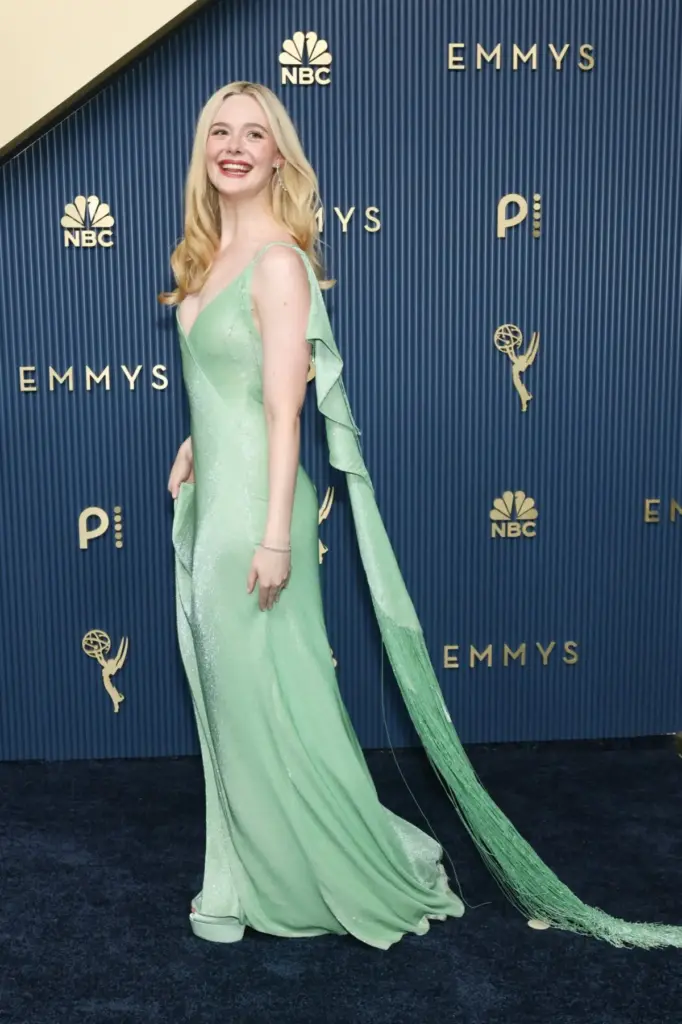
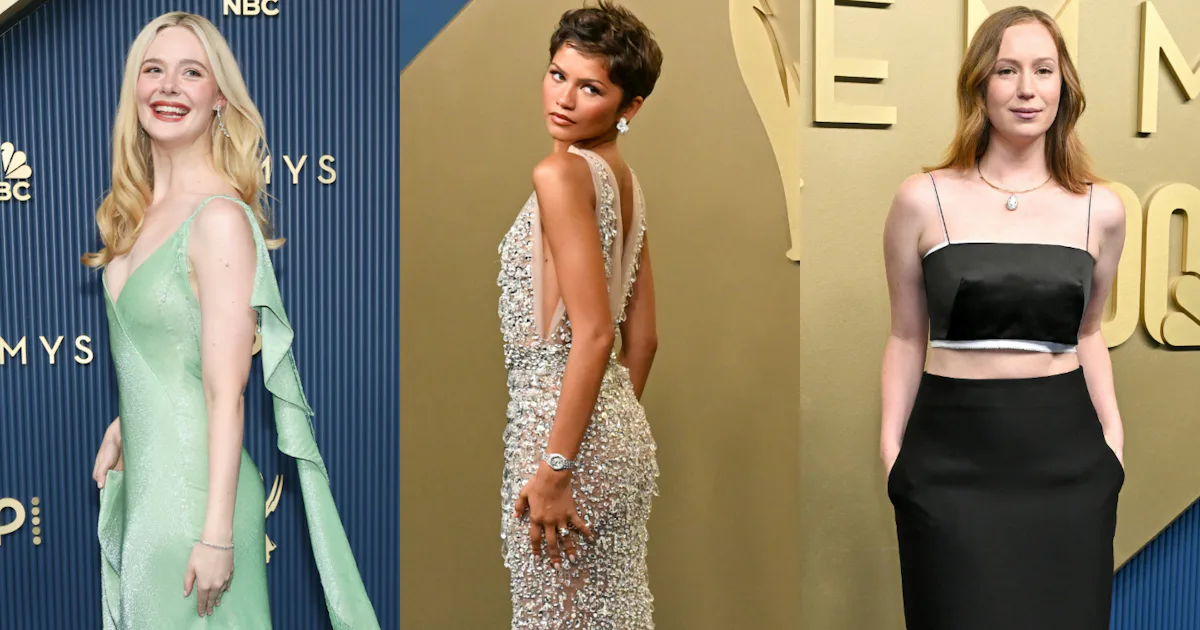
If human sunshine had a designated sartorial signature, it would undoubtedly belong to Elle Fanning. Unsurprisingly, the actor delivered yet another masterclass in red-carpet enchantment. Bypassing standard seasonal trends, Fanning appeared in a bespoke jade silk chiffon gown by Ralph Lauren. The garment, distinguished by a subtle, fluidly cascading fringed train, stands as a rare triumph of modern evening wear—striking the elusive balance between weightless movement and structural integrity. Styled with effortless, soft waves, a subtle taupe lip, and a smattering of Cartier high jewelry, Fanning once again proved her status as an enduring vision of classic Hollywood glamour adapted for the contemporary era.
Sarah Pidgeon in Chanel
Given her widely praised, critically acclaimed portrayal of Carolyn Bessette-Kennedy in the FX series Love Story, industry watchers anticipated that Sarah Pidgeon might lean heavily into ’90s minimalist chic on the carpet. Instead, the fashion darling flipped the script entirely. Wearing a custom lilac creation from Chanel, Pidgeon decisively signaled her allegiance to color and high-concept romance. The dress functioned as a complete stylistic ecosystem, arriving pre-adorned with delicate detailing. Pidgeon accentuated the look with precise, measured doses of Chanel High Jewelry on her fingers and neck, cementing her burgeoning reputation as a designer’s ultimate muse.
Mark Ronson in Celine
Menswear on the red carpet frequently defaults to safe, uninspired tailoring or overly eccentric theatricality. However, producer and musician Mark Ronson managed to completely subvert this dynamic through his partnership with Celine. Donning pieces from Michael Rider’s latest menswear collection—widely regarded as the freshest, most culturally relevant offering on the market—Ronson showcased a masterclass in proportion. The jacket, characterized by slightly unconventional and daringly modern proportions, fit with bespoke precision. Paired with a relaxed, wide-leg trouser, the ensemble successfully bridged the gap between high-fashion editorial and red-carpet accessibility, avoiding the dreaded look of a lost Broadway usher.
Nicole Kidman in Chanel
Commanding the carpet with the absolute authority of a veteran industry titan, Nicole Kidman arrived to celebrate her Apple TV+ triumph, Margo’s Got Money Troubles. Showing up in a breathtaking, feather-accented corset by Chanel, Kidman offered a subtle, knowing nod to her iconic cinematic past (reminiscent of the theatricality of Moulin Rouge!) while remaining thoroughly anchored in the present. The look served as a potent reminder of why Kidman remains pop culture’s most magnetic, sought-after muse of 2026, effortlessly combining theatrical drama with uncompromising luxury.
Zendaya in Prada
Placing Zendaya on a best-dressed list is an exercise in stating the obvious—akin to discovering standard cutlery in your kitchen. Yet, when the execution reaches this stratospheric level of perfection, omission is simply not an option. Showcasing a striking new pixie cut that instantly dominated social media discourse, Zendaya paired her cropped silhouette with gleaming Mikimoto diamonds and a custom Prada gown. The architectural precision of the dress, combined with her innate poise, guaranteed her an undisputed spot at the pinnacle of the evening’s style hierarchy.
Hannah Einbinder in Calvin Klein Collection
In a sea of heavy embellishments and voluminous ballgowns, minimalism remains a high-wire act. Hannah Einbinder executed this balance flawlessly in a custom look by Calvin Klein Collection. The ensemble derived its effortless success from a masterclass in contrast: crisp white paneling juxtaposed sharply beneath a sleek black satin crop top. Elevated by the inspired addition of a dramatic pendant necklace featuring a massive teardrop diamond, Einbinder’s look was simultaneously glamorous, refreshingly unpretentious, and aggressively modern—striking the exact emotional note required for contemporary American minimalism.
Louisa Jacobson in Tom Ford
Haider Ackermann’s tenure at Tom Ford has injected a lethal dose of raw, unapologetic sex appeal into the legacy brand. Who better to weaponize this aesthetic than Louisa Jacobson? Demonstrating a brilliant command of gender-fluid tailoring, Jacobson dominated the carpet in a razor-sharp ensemble defined by elongating lines and uncompromising structure. The look was punctuated by a subtle yet striking brooch and stud combination, while pointed-toe footwear provided the finishing touch to a masterclass in confident, high-fashion edge.
Supriya Ganesh in McQueen
For those harboring an affinity for ethereal, fairytale romanticism, Supriya Ganesh’s choice was the singular exception to the evening’s rule of sleek geometry. Wearing Alexander McQueen, Ganesh captivated onlookers in an ice-blue creation that complemented her complexion with breathtaking precision. The awards-show beauty styling was executed with surgical restraint, enhancing her natural features without ever risking the dress’s delicate architectural integrity.
Julia Garner in Loewe
Proving the timeless adage that less is frequently more, Julia Garner delivered a definitive lesson in modern simplicity. Adorned in a Loewe knotted halter-neck dress, Garner demonstrated that when a silhouette is inherently correct, it requires no extraneous additions or over-styling to achieve maximum impact. The dress flowed with architectural ease, relying on immaculate draping and impeccable fabrication.
Charles Melton in Louis Vuitton
Executing a classic men’s tailoring mandate without slipping into tired, dated tropes (such as overly restrictive slim-fit trousers or distracting novelty accessories) is increasingly rare. Charles Melton achieved this rare feat in Louis Vuitton. Wearing a flawlessly proportioned suit that radiated effortless movie-star charisma, Melton proved that traditional menswear, when executed with modern tailoring sensibilities, remains profoundly effective.
Meg Stalter in Full Character
No Emmy Awards red carpet review would be complete without acknowledging the singular, audacious performance art delivered by Meg Stalter. Demonstrating an incomparable sense of humor and nerves of steel, Stalter arrived encased in a shimmering gold body suit, flanked by four-foot wings, and proudly hoisting a life-size model of an atomic Emmy statuette. While awards are ultimately handed out inside the venue, Stalter single-handedly secured the evening’s most viral, unforgettable cultural artifact.
Supporting Context & Metrics: The Economics of Emmy Fashion
The red carpet is no longer merely a glamorous prelude to an awards ceremony; it is a multi-billion-dollar global marketing engine. In the hyper-digitized landscape of 2026, the intersection of television prestige and high fashion generates quantifiable economic impact that brands monitor with intense scrutiny.
Industry data compiled during the fall 2026 awards circuit indicates that a single high-profile placement on a talent like Zendaya or Elle Fanning can yield millions of dollars in earned media value (EMV) within the first 24 hours of publication. Major luxury houses—predominantly conglomerates like LVMH, Kering, and Chanel—allocate significant portions of their annual marketing budgets specifically toward dressing key nominees for the Primetime Emmy Awards.
Furthermore, the rise of streaming-driven television has fundamentally altered the demographic profile of Emmy nominees. Unlike the traditional broadcast era, platforms such as Apple TV+, FX, and Max command global audiences that skew younger, more digitally engaged, and highly responsive to niche luxury brands. This shift explains why houses like Celine, Loewe, and Calvin Klein are increasingly dominating a carpet historically reserved for traditional red-carpet stalwarts. The modern Emmy viewer does not just want to see elegance; they want to see directional, zeitgeist-defining design that mirrors contemporary cultural conversations.
Official Statements & Industry Reactions
The strategic machinations behind the scenes of the 2026 Emmys red carpet were defined by intense collaboration between elite stylists, brand executives, and the actors themselves. Speaking on the overarching philosophy guiding this year’s style choices, prominent celebrity stylists offered rare insights into the creative process.
"The directive this year was absolute precision," noted one leading Hollywood stylist who managed multiple top-tier nominees for the event. "We are seeing a distinct fatigue surrounding overly constructed, theatrical costumes that overpower the wearer. The goal for the 2026 Emmys was autonomy—clothes that allow the actor’s personality and recent body of work to take center stage, supported rather than swallowed by the design."
House representatives echoed similar sentiments. A spokesperson for Chanel highlighted the importance of bridging historical house codes with contemporary narrative arcs: "When you dress an artist like Sarah Pidgeon or Nicole Kidman, you are engaging in a dialogue between cinematic legacy and modern cultural influence. The fashion must feel earned, authentic, and completely aligned with the cultural weight of the television projects being celebrated."
Meanwhile, reactions from digital platforms and social media analytics firms confirmed the unprecedented engagement levels generated by the evening’s risk-takers. Algorithms favored unexpected color pairings, architectural tailoring, and moments of unbridled humor—such as Meg Stalter’s satirical statuette homage—proving that modern audiences crave authenticity just as much as they crave perfection.
Future Outlook: The Evolution of Television Style
As the 2026 Emmy Awards recede into the rearview mirror, the cultural ripple effects of the evening’s fashion choices will undoubtedly dictate upcoming retail and ready-to-wear trends. The heavy reliance on structural column gowns, juxtaposed against radical disruptions in menswear and minimalist evening wear, signals a transitional phase in luxury fashion.
Looking ahead to the upcoming awards seasons—culminating in the Oscars early next year—industry analysts predict several key shifts:
- The Death of Predictable Neutrality: Saturated jewel tones, particularly ice blues, rich jades, and vibrant lilacs as seen on Fanning and Pidgeon, are projected to dominate spring/summer collections.
- The Evolution of Modern Menswear: Traditional black-tie dressing is facing an existential reckoning. The success of Mark Ronson and Charles Melton proves that consumers and critics alike are fatigued by uninspired tailoring, clearing the path for relaxed proportions, avant-garde textures, and gender-fluid silhouettes.
- The Integration of Narrative Fashion: The most successful looks of the 2026 Emmys shared a common thread: they told a story connected to the actor’s nominated work. Expect future red carpets to increasingly treat styling as an extension of character development, blurring the lines between promotional tours and high fashion.
Ultimately, the 2026 Emmy Awards red carpet reaffirmed television’s status as a premier cultural titan. By embracing a harmonious blend of architectural elegance, risk-taking minimalism, and irreverent humor, the entertainment industry’s finest proved that style, much like great television, is at its best when it refuses to play by the rules.