Executive Overview
Television’s fall schedule is reliably crowded with high-concept dramas, yet few arrivals carry the narrative weight or generational pedigree of NBC’s new series, Line of Fire. More than a year after Peter Krause dramatically exited his long-running, universally beloved role as Firefighter Captain Bobby Nash on ABC’s 9-1-1—a character he inhabited for eight glorious, pressure-cooker seasons—the veteran actor is making his highly anticipated return to network television.
Krause, whose indelible television footprint includes canonical roles in Parenthood, Six Feet Under, and Sports Night, steps back into a patriarchal leadership position, anchoring a sprawling ensemble cast in a world where federal law enforcement and domestic family melodrama violently collide.
Created, written, and executive produced by Joshua Safran (Gossip Girl, Quantico, Smash), Line of Fire aims to bridge a critical gap in contemporary television: the intersection of the case-of-the-week procedural and the serialized, white-knuckle soap opera. Safran is joined in the executive producer suite by Jenna Bush Hager, whose authentic, lived-in experiences as a First Daughter uniquely flavor the series’ political subplots and institutional realism.
Featuring a stacked ensemble that includes Hope Davis, Sam Waterston, and Campbell Scott, the series centers on the Hollingsworth clan—a fractured family deeply embedded across various tiers of American law enforcement.
Early critics have been granted access only to the first two episodes of the freshman season, prompting immediate industry debate over whether its labyrinth of twists, high-concept political conspiracies, and deeply tangled interpersonal relationships can sustain a long-term network run. Yet, buoyed by Safran’s distinctive tonal mix of high-stakes scandal, domestic comedy, and razor-sharp dramatic tension, Line of Fire presents itself as an ambitious swing for NBC. It asks viewers to suspend their disbelief, embrace the soapy chaos, and invest in a dynasty of badge-carrying professionals whose greatest threats may just come from across the dinner table.
Detailed Chronology & Narrative Mechanics
The Setup: An Inciting Incident in the Dead of Night
The pilot episode of Line of Fire wastes zero time establishing its high-stakes operational framework. In the opening shot, a U.S. Marshal—played by a high-profile pilot guest star to whom viewers are wisely advised not to grow too attached—approaches an unassuming suburban home under the cover of darkness. Posing as an innocuous Uber Eats delivery worker, the operative rings the doorbell, setting off a kinetic chain reaction that fundamentally shatters the illusion of safety surrounding the show’s central figures.
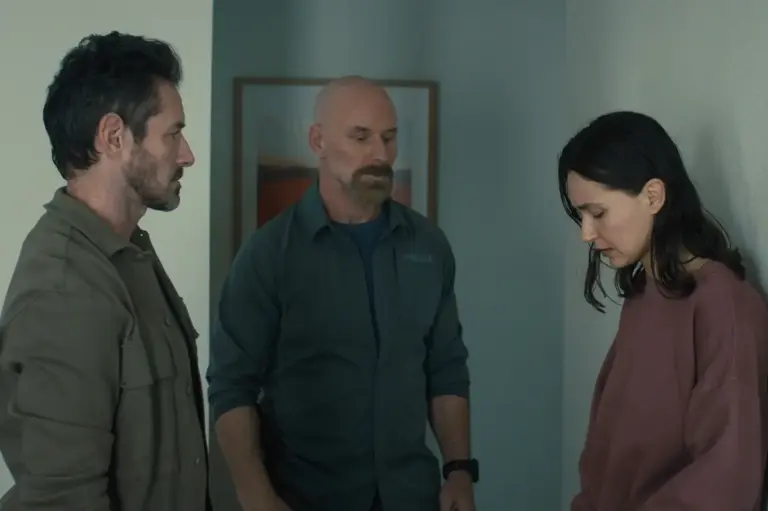
This explosive sequence serves as the narrative springboard for the Hollingsworth family dynamic. At the center of the turbulence are estranged couple Mike Hollingsworth (Peter Krause), a hardened Secret Service agent, and Jane Hollingsworth (Hope Davis), a fierce U.S. Marshal. Though professionally accomplished and visibly still harboring lingering romantic tensions, Mike and Jane are separated by a gulf of unspoken grievances. Their mysterious estrangement forms one of the foundational slow-burn mysteries of the series, running parallel to an immediate, deadly federal case that abruptly pivots in an intensely personal direction by the end of the pilot.
The Bureaucratic Web and Interlocking Jurisdictions
What sets Line of Fire apart from standard-issue procedurals is the way personal and professional boundaries systematically dissolve for the Hollingsworth children, all of whom have followed their parents into the perilous world of government service:
- Clare Hollingsworth (Kat Cunning): An incisive, no-nonsense FBI agent whose sharp operational instincts frequently put her at odds—and in alignment—with her mother’s federal mandate.
- Mike “Micah” Hollingsworth Jr. (Tommy O’Brien): A junior Secret Service agent working desperately to step out from his father’s long shadow, all while skating on thin ice ethically and professionally.
- Russell “Russ” Hollingsworth (Taylor Bloom): A sharp Department of Justice (DOJ) agent tasked with navigating the legal gray areas where federal oversight meets raw political survival.
As an elusive, highly skilled assassin targets federal agents across the mid-Atlantic, Mike Sr. becomes consumed by an unshakable suspicion: former President Thomas Barnes (Sam Waterston) is the ultimate target. While Mike races to unearth institutional vulnerabilities, his son Micah is simultaneously compromising his security clearance and career by engaging in a clandestine, high-risk romance with Sydney (Savannah Lee Smith), the fiercely independent daughter of current President Kayana (Chris Chalk).
Adding jet fuel to an already volatile domestic fire, U.S. Senator Terry—portrayed with veteran gravitas by Campbell Scott, who also happens to be Jane’s current romantic partner—enters the fold, threatening to completely upend whatever fragile equilibrium remains within the Hollingsworth household.
Supporting Context & Metrics: Where Does Line of Fire Fit in TV Landscapes?
The "Procedural Soap" Blueprint
In a press release detailing his vision for the series, creator Joshua Safran offered a vivid shorthand for what audiences can expect from Line of Fire. "Think of it as Six Feet Under meets The Fugitive, if the fugitive were hunting Tommy Lee Jones instead of the other way around," Safran wrote. He further defined the show’s genre-hybrid DNA:
"It’s a procedural soap, in a way that you can both binge its serialized mystery and juicy relationship dramas, while also enjoying its case-of-the-week structure. My hope is that an audience raised on Desperate Housewives, Parenthood, and This Is Us might find comfort here."
This deliberate tonal alchemy pulls from multiple television traditions. On one hand, it honors the time-tested broadcast formula of serialized law enforcement dramas like Blue Bloods or The Blacklist. On the other hand, it leans heavily into the melodramatic, high-gloss political romances reminiscent of Scandal, Quantico, and classic First Daughter cinematic tropes found in films like Chasing Liberty and First Daughter.
Navigating Early Skepticism: The Precedent for Big Swings
Because critics were limited to previewing only the first two episodes prior to the premiere, premature industry chatter has focused heavily on whether the show’s labyrinthine plotting risks collapsing under its own weight. The pilot’s massive, status-quo-shattering twist has drawn both intrigue and skepticism.
However, television history suggests that serialized procedurals with audacious narrative swings frequently require an adjustment period. Consider NBC’s cultural juggernaut This Is Us, which anchored its entire multi-season run on a jaw-dropping premiere twist that fundamentally re-contextualized the family dynamic. Similarly, Peter Krause’s previous home, 9-1-1, spent ten seasons regularly demanding that its audience suspend disbelief, turning earthquakes, tsunamis, and blimps crashing into skyscrapers into weekly watercooler television through sheer commitment to its characters and casting charisma.
If Line of Fire can anchor its gravity-defying geopolitical conspiracies in the grounded, messy emotional reality of its familial relationships—particularly the father-son tension between Krause and O’Brien—it possesses the essential ingredients to weather early structural skepticism and carve out a long-term home on the network.
Official Statements & Creative Vision
The creative synergy behind Line of Fire represents a unique convergence of Hollywood showrunning pedigree and real-world executive perspective. Joshua Safran, whose fingerprints are all over some of the most culturally defining serialized dramas of the 21st century, engineered the series to function on two distinct narrative tracks: immediate, high-octane action for casual viewers, and deep, multi-layered psychological mysteries for dedicated binge-watchers.
Jenna Bush Hager’s involvement as an executive producer introduces a layer of authentic verisimilitude that separates the show’s depiction of the Secret Service and White House politics from standard fictional tropes. Drawing loosely from her own formative years spent navigating the fishbowl of the First Family, Bush Hager’s influence is most acutely felt in storylines like Micah and Sydney’s forbidden romance, capturing the claustrophobia, constant threat assessment, and emotional isolation intrinsic to life orbiting the Oval Office.
Furthermore, the casting of prestige heavyweights like Sam Waterston and Hope Davis signals to the industry that NBC views Line of Fire not merely as a disposable seasonal filler, but as a potential multi-season anchor. Waterston brings the institutional authority of decades spent in television law enforcement and legal drama (Law & Order), while Davis provides an icy, multifaceted counterweight to Krause’s earnest, world-weary paternalism.
Performance Standouts to Watch
While the marquee names draw initial eyeballs, the early episodes of Line of Fire suggest that its future longevity will rest squarely on the shoulders of its younger ensemble cast.
- Tommy O’Brien as Mike “Micah” Hollingsworth Jr.: O’Brien captures the harrowing desperation of a young man caught in a generational slipstream. Micah is ambitious, deeply flawed, and burdened with a martyr complex that mirrors his father’s. The friction points in the father-son dynamic between Krause and O’Brien provide the emotional core of the series’ law enforcement procedural elements.
- Kat Cunning as Clare Hollingsworth: Cunning brings a magnetic, sharp-edged intensity to the role of the FBI agent daughter. Unafraid to challenge institutional authority or call out her parents’ hypocrisies, Clare emerges as a fierce investigator whose moral compass is constantly tested by her familial loyalties.
- Peter Krause as Mike Hollingsworth Sr.: It is undeniably comforting to watch Krause occupy a familiar yet distinct patriarchal role. Moving away from the stoic crisis management of Bobby Nash, Krause infuses Mike Sr. with a simmering paranoia, romantic regret, and exhaustion that grounds the show’s more hyperbolic political conspiracies.
Future Outlook & Critical Verdict
Streaming Recommendation: STREAM IT
While evaluating a complex serialized procedural based solely on its opening chapters is inherently a leap of faith, the calculated secrecy surrounding Line of Fire feels entirely intentional. Joshua Safran has engineered a narrative puzzle box designed to frustrate, entice, and reward viewers who stick around for the long haul.
What is already clearly established is that Line of Fire delivers a soapy, adrenaline-fueled rollercoaster ride that refuses to coast on its pedigree. By blending high-stakes national security threats with deeply messy domestic politics, inter-agency professional rivalries, and forbidden romances, NBC has curated a prime-time soap opera that feels both nostalgic and aggressively modern.
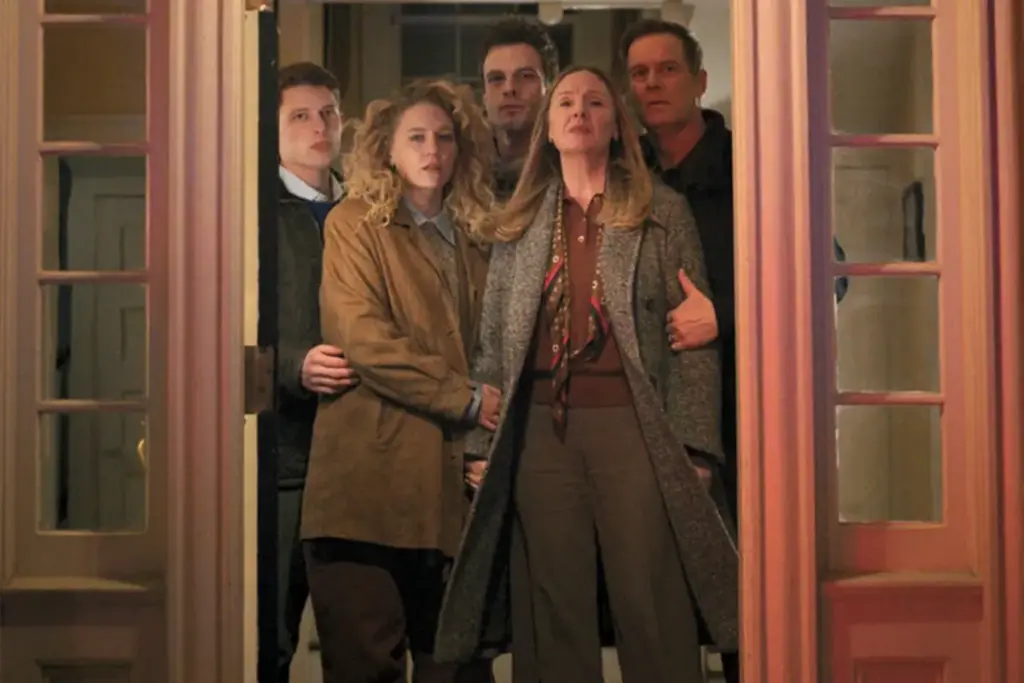
As the shaken Hollingsworth family stands in the opening episodes’ parting shot—gazing out from the shattered threshold of their former home at a sea of flashing police cruisers—it becomes evident that the rules of engagement have permanently changed. The federal agents guarding the nation are now the ones running for their lives, and the secrets buried within the family tree are toxic enough to bring down an administration.
For fans of prestige soap, complex family dramas, and high-stakes network thrillers, Line of Fire is well worth climbing aboard. The questions are piling up, the targets are locked in, and the Hollingsworths are officially back in the line of fire.