Executive Overview
In the closing chapter of Netflix’s Monster: The Lizzie Borden Story, series creator Ian Brennan delivers one of the most audacious, emotionally jarring, and controversial finales in recent television history. Blurring the lines between historical fact, meta-commentary, true-crime exploitation, and feminist revisionism, the eighth episode pulls off a structural tightrope walk. It opens and closes with the harrowing, tragic execution of serial killer Aileen Wuornos, using her story as a thematic bookend to frame the long, winding, and ultimately liberated afterlife of Lizzie Borden.
Throughout its run, Ryan Murphy and Ian Brennan’s Monster anthology has challenged audiences to look directly into the abyss of American infamy, asking viewers to empathize with notorious figures without condoning their atrocities. Yet, in The Lizzie Borden Story, the creative team pushes this mandate to its absolute breaking point. By drawing a direct, unbroken line between the 19th-century suffrage movement and the state-sanctioned execution room of the late 20th century, the series transforms a notorious double-murder mystery into a sprawling indictment of the patriarchy.
This review explores the intricate structural mechanics, the socio-political messaging, the meta-textual self-critiques, and the polarizing artistic choices that define the finale of Netflix’s most ambitious Monster installment to date.
Detailed Chronology: Unpacking the Finale’s Structural Journey
The eighth episode of The Lizzie Borden Story does not follow a linear narrative trajectory; instead, it operates as a thematic hall of mirrors, utilizing deliberate stylistic anachronisms and emotional whiplash to destabilize the viewer.
The Aileen Wuornos Bookend
Brennan makes the striking directorial choice to anchor the finale in the tragedy of Aileen Wuornos. Utilizing vintage VHS-style filters to mimic old-school news magazine broadcasts and Court TV segments—complete with a memorable cameo by Ryan Murphy regular Ari Graynor as a relentless reporter—the episode drops the viewer straight into Wuornos’s trial, conviction, and death.
In unflinching close-ups, Wuornos testifies about being brutally assaulted and raped by a man who claimed to be a serial killer himself. Cruelly, before she can even finish recounting her trauma, the narrative cuts abruptly to the judge sentencing her to death. It is a calculated, brutal edit designed to simulate the cold mechanical dismissal of a woman’s pain by a patriarchal justice system.
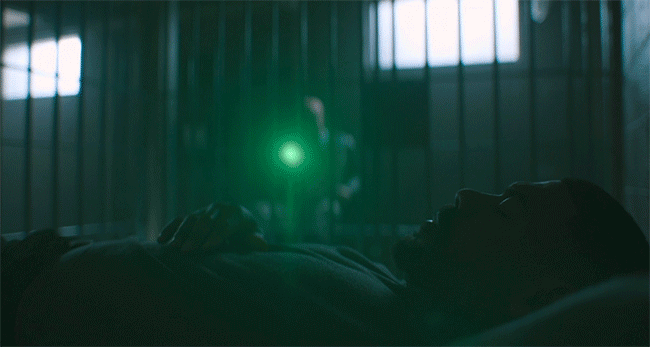
Later, as she faces lethal injection to the haunting strains of Natalie Merchant’s “Carnival,” Wuornos is enraged and defiant. She rails against the systemic failures that kept exculpatory evidence regarding one of her victim’s violent histories out of her trial. She leaves this world vowing to ask the Lord "what the hell is going on around here."
Lizzie’s Limbo and the Burden of Infamy
Between Wuornos’s trial and her execution, the episode tracks the surreal twilight of Lizzie Borden (played with complex vulnerability). Having escaped legal punishment—making her a unique anomaly among the Monster protagonists—Lizzie struggles to find peace.
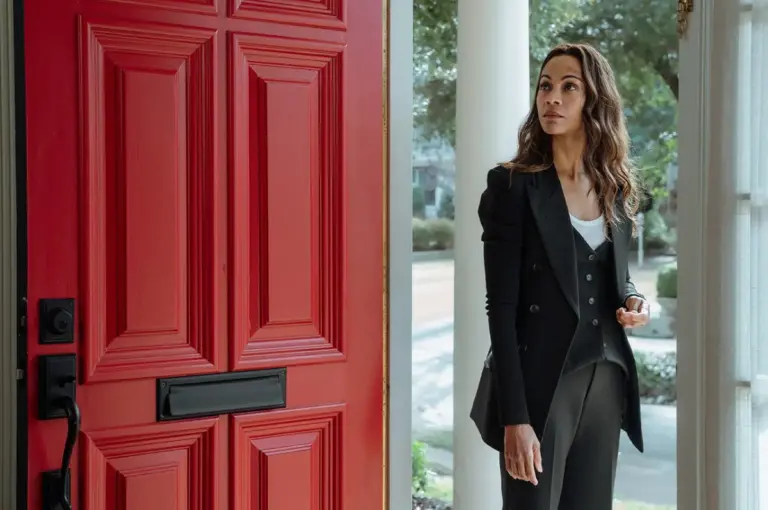
Her life of luxury, patronizing actress Nance O’Neill and turning her sprawling estate into an animal sanctuary, fails to bring her fulfillment. Her sister, Emma, descends into severe substance abuse, crippled by the silent torture of living with a sibling she knows murdered their parents. Meanwhile, Bridget Sullivan drifts through a miserable, frontier-style existence in Montana that feels ripped straight from The Revenant.
Lizzie’s notoriety dogs her every step. Obnoxious children don her likeness for Halloween, and vapid, wealthy tourists treat her home like a roadside attraction, interrogating her about the identity of the real killer (with a nod to xenophobic scapegoating of the era). Lurid, exploitative bestsellers distort her history—a thinly veiled jab by Brennan at his own sensationalized true-crime enterprise.
Reconciliation and Suffrage
Realizing that her gilded cage is a prison of its own making, Lizzie undergoes a spiritual and social awakening. Bridget abandons her miserable "tradwife" existence in the West, extracts a rare confession from her domineering husband about men’s deep-seated fear of "strong women," and moves back in with Lizzie.
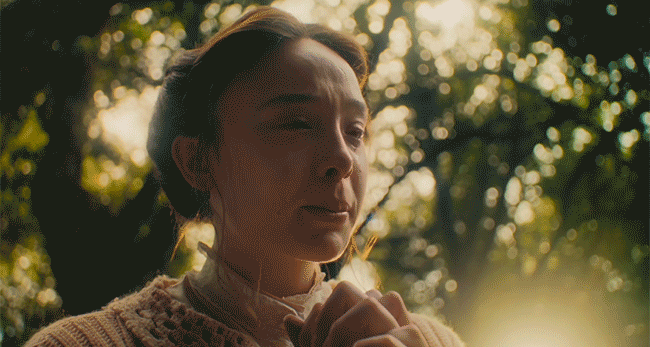
With Bridget’s emotional encouragement, Lizzie confronts her past, praying outdoors in the sunlight for forgiveness from God, her father, and her stepmother. In a moment of transcendent grace, she feels that forgiveness granted.
Cleansed of her spiritual burden, Lizzie and Bridget pivot from animal rescue to political activism. They pour their vast resources into the women’s suffrage movement, actively helping secure the right to vote for white American women. The movement triumphs, activists pop champagne, and Lizzie and Bridget live openly as a lesbian couple.
The Closing Circle
The music subtly mutates back into Natalie Merchant’s "Carnival," bridging the century-spanning narratives. The camera cuts back to Aileen Wuornos’s death chamber. The curtain that opened on Lizzie’s toy piano in episode one finally closes on a corpse. The show is over. The audience, having sat in the gallery to watch a state-sanctioned execution, is forced to recognize that the death penalty is just another theatrical production staged by the patriarchy.
Supporting Context & Metrics: The Meta-Narrative of Monster
To fully appreciate the weight of the finale, one must examine the broader cultural and meta-textual metrics of the Monster franchise.
| Season Focus | Protagonist / Subject | Legal Outcome | Central Thematic Inquiry |
|---|---|---|---|
| Season 1 | Jeffrey Dahmer | Convicted / Deceased | Institutional neglect, homophobia, and sensationalized evil. |
| Season 2 | Menendez Brothers | Convicted (Disputed) | Familial abuse, systemic power imbalances, and media trials. |
| Season 3 | Lizzie Borden | Acquitted | Gender autonomy, myth-making, and the architecture of notoriety. |
The Unique Position of Lizzie Borden
Unlike Dahmer or the Menendez brothers—and crucially, unlike Aileen Wuornos—Lizzie Borden was legally acquitted of the brutal hatchet murders of her father and stepmother. This historical reality places The Lizzie Borden Story in a distinct category within the Monster universe. Lizzie is a ghost walking among the living, a woman who beat the state at its own game, only to find that the societal cage constructed around her was just as inescapable as a prison cell.
The Aileen Wuornos Connection
Wuornos’s inclusion serves as a direct critique of how society categorizes female violence versus male violence. Wuornos bitterly resents being lumped in with Jeffrey Dahmer, recognizing that her crimes were born of desperate self-defense and survival within a predatory world, whereas serial killers driven by pure sadism are often granted a morbid, romanticized mythos by the true-crime industrial complex.
By placing Wuornos’s execution at the bookends of a story about a woman who likely did commit murder and got away with it, Brennan highlights the capricious, deeply gendered nature of American justice.
Official Statements & Creative Vision
Ian Brennan and Ryan Murphy have consistently defended the Monster anthology against accusations of exploitation, framing their work as an empathetic exploration of human brokenness rather than a celebration of bloodshed. In interviews surrounding the release of the anthology’s third chapter, the creative team emphasized that the goal is not to exonerate or vilify, but to interrogate the cultural machinery that creates "monsters" in the first place.
"We are not asking the audience to cheer for atrocities," production notes indicate regarding the psychological framing of the series. "We are asking them to sit in the uncomfortable reality that monsters are human beings manufactured by broken homes, societal neglect, and systemic oppression. If we cannot look at that ugliness without turning away, we can never hope to dismantle it."
The finale’s invocation of the 19th Amendment is designed to force viewers to confront the continuum of women’s liberation. The same society that denied women basic political autonomy until 1920 was the one that drove women like Aileen Wuornos to the margins, ultimately strapping them to gurneys to be executed by the state.
Future Outlook: Where Does the Monster Franchise Go From Here?
As Netflix’s Monster continues to cement its status as one of the platform’s most dominant and polarizing anthology series, the Lizzie Borden chapter establishes a high-water mark for narrative ambition—and narrative risk.
- Broadening the Scope: By moving away strictly from 20th-century male serial killers into historical mysteries and figures of contested guilt (such as Borden), the anthology has proven it can bend its format to tackle broader thematic canvases, including class, sexuality, and women’s liberation.
- The True-Crime Reckoning: As public fatigue over exploitative true-crime media grows, Monster’s self-referential critique—mocking bestselling lurid paperbacks and tourist ghouls—signals an awareness of the genre’s ethical pitfalls. Future seasons will likely have to navigate this tightrope with increasing sophistication.
- The Emotional Toll on Viewers: As critic Sean T. Collins noted, watching the curtain close on Wuornos while Fiona Apple’s devastating track "I Know" plays over the credits leaves an emotional mark that lingers long after viewing. Future installments of Monster will be measured against this finale’s ability to merge raw historical tragedy with grand social commentary.
Ultimately, Monster: The Lizzie Borden Story asks its audience to inhabit a space of profound discomfort. It reminds us that we live in the deep, troubled gap between the hard-won victories of the suffrage movement and the cold, clinical cruelty of execution chambers. Whether viewers find this ambitious synthesis to be a masterpiece of modern television or a bridge too far, one thing is certain: when the curtain finally falls on the Monster carnival, nobody leaves the tent unchanged.