For decades, the unwritten commandment of distance running and endurance hiking has remained deceptively simple: log more miles. Week after week, enthusiasts across the globe lace up their running shoes or strap on their hiking packs with a singular, escalating objective—push the distance further, faster, and longer than the previous workout.
Yet, sports scientists, physical therapists, and elite endurance athletes are increasingly sounding the alarm against this linear approach to training progression. Continuously increasing workout distance without a foundational shift in structural conditioning is rarely the smartest route to athletic longevity. In the best-case scenario, linear mileage accumulation hits a frustrating performance wall, plunging the athlete into a plateau where aerobic and muscular fitness stalls completely. In the worst-case scenario, the human body breaks down under the relentless, repetitive trauma of overuse injuries, sidelining runners with shin splints, plantar fasciitis, IT band syndrome, and stress fractures.
According to Sam Tomlinson—a seasoned personal trainer, ultramarathon runner, and ambassador for the international running platform realbuzz—the definitive antidote to the mileage trap is not running less, but strengthening smarter. Tomlinson argues that endurance training alone, while phenomenal for cardiovascular capacity, fails to deliver the dynamic resistance required to cultivate the localized strength and joint control necessary to tolerate punishing terrain and high-mileage blocks.
Drawing from his recent grueling completion of the Ultra-Trail Snowdonia by UTMB—where he covered 100 kilometers with 6,500 meters of elevation gain in a staggering 26 hours—Tomlinson has distilled his survival and performance strategy into a targeted, six-move lower-body strength routine. Designed to be executed at home or in the gym using minimal equipment (a set of dumbbells and a resistance mini-band), this evidence-backed routine targets the exact muscular vulnerabilities that derail runners and hikers worldwide.
Detailed Chronology: Breaking Down the Endurance Paradigm
To understand why traditional mileage-heavy training models are failing modern endurance athletes, one must look at the physiological timeline of a typical running or hiking injury.
Phase 1: The Honeymoon of Linear Progression
When an individual first takes up distance running or serious hiking, the body adapts rapidly. Cardiovascular improvements occur within weeks: resting heart rates drop, stroke volume increases, and overall stamina surges. Encouraged by these early gains, the athlete naturally adopts an "add-a-mile" philosophy. If a 5-mile run felt good this week, surely a 6-mile run will yield better results next week. During this phase, connective tissues—tendons, ligaments, and fascia—can superficially keep pace with the muscular demands, masking underlying weaknesses.
Phase 2: The Onset of Neuromuscular Fatigue
As mileage climbs past moderate thresholds, cumulative fatigue sets in. The repetitive impact forces of running (which can reach up to three times an individual’s body weight per stride) begin to expose latent joint instability. Muscles that govern pelvic alignment and knee tracking—most notably the gluteus medius and deep hip stabilizers—begin to fatigue prematurely. When these stabilizing muscles fail, secondary compensation patterns emerge. The knees begin to cave inward (valgus collapse), the pelvis drops with each stride, and the lower legs absorb a disproportionate amount of sheer force.
Phase 3: The Plateau or the Breakdown
At this critical juncture, the athlete typically experiences one of two outcomes. Either their metabolic efficiency plateaus, rendering further distance gains stagnant despite Herculean efforts, or chronic overuse injuries manifest. Micro-tears in tendons outpace the body’s natural capacity for cellular repair. Joint surfaces in the knees and hips bear excessive friction. Without a structural intervention to reinforce the kinetic chain, the runner enters a frustrating cycle of recurring injuries, forced rest, and diminished performance capacity.
Supporting Context & Metrics: The Anatomy of Tomlinson’s Protocol
To interrupt this destructive cycle, Tomlinson relies on a precise, biomechanically balanced lower-body strength protocol. Rather than mirroring the randomized lifting routines found in traditional bodybuilding, every movement in Tomlinson’s regimen directly addresses a specific physiological demand encountered during running and hiking strides.
The Mechanics of the Routine
The 25-to-35-minute routine is intentionally structured into three supersets (Blocks 1, 2, and 3), pairing bilateral (two-legged) compound movements with unilateral (single-legged) stability work.
Bilateral Power Builders: Exercises like the Heels-Elevated Goblet Squat and the Romanian Deadlift target the larger, primary movers of the lower body—the quadriceps, glutes, and hamstrings. Elevating the heels during goblet squats alters the center of gravity, allowing for a more upright torso and deeper knee flexion, directly translating to the quad engagement needed when ascending steep hiking inclines.
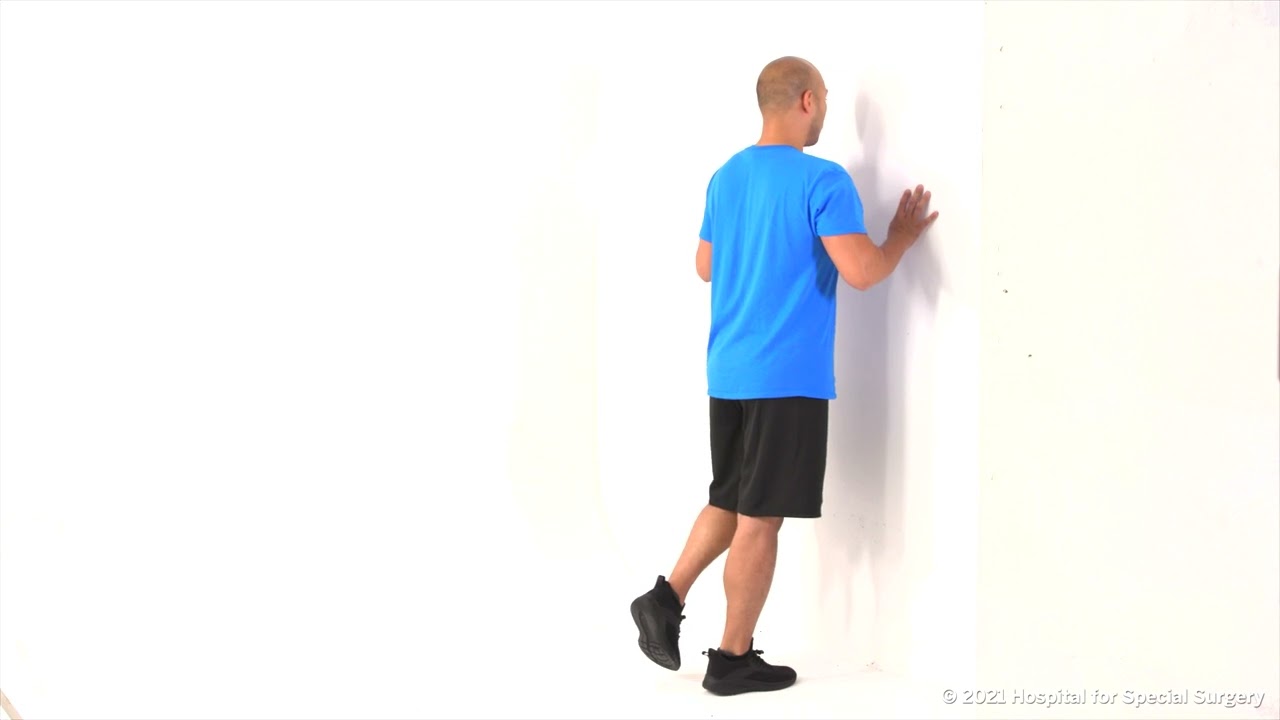
Unilateral Force Absorption: Running and hiking are inherently single-leg sports; at any given moment during a stride, 100% of the body’s force is managed by one limb. Moves like the Reverse Lunge, Single-Leg Calf Raise, Single-Leg Hip Thrust, and Single-Leg Bridge train the neuromuscular system to repeatedly absorb and produce force through a single leg in isolation.
Pelvic and Knee Stability: The integration of Banded Lateral Walks isolates the gluteus medius. This crucial muscle controls the external rotation and abduction of the hip, ensuring that the pelvis remains level and the knees track cleanly over the toes when the foot strikes the ground—even when profound fatigue sets in during the final miles of a long run.
Elastic Energy Return: The Calf Raise directly addresses the calf complex and the Achilles tendon. During every running stride, the Achilles acts as a biological spring, storing and returning vast amounts of elastic strain energy. Strengthening this complex improves propulsion economy and shields the lower leg from tendinopathy.
Prescription and Progression Metrics
Frequency: Start by executing the routine once per week on a dedicated running rest day or immediately following a short, easy shakeout run to keep the legs fresh. As recovery capacity and tissue tolerance adapt, gradually increase frequency to twice per week.
Structure: Perform each exercise block three times, completing Exercise A and Exercise B back-to-back with minimal rest, then taking a 1-to-2-minute recovery break before moving to the next block.
Load Management: Ensure progressive overload by slowly increasing dumbbell weights or incorporating isometric pauses at the bottom of movements as strength improves.
Official Statements and Expert Insights
To gain further clarity on how strength training integrates with ultra-endurance racing, Fit&Well spoke directly with ultramarathon veteran Sam Tomlinson regarding his preparation for the grueling Ultra-Trail Snowdonia.
"Running alone can develop excellent endurance, but it rarely provides enough resistance to build the strength and control needed to tolerate higher mileage and tougher terrain," Tomlinson explains.
Reflecting on his monumental 100km trek across the peaks of Snowdonia, he notes: "I recently completed my strongest ultra to date, and being consistent with this type of leg strength work played a major part in how well my body handled the demands of the event."
Tomlinson emphasizes that strength training should not be viewed as an optional accessory for runners, but rather as an essential form of structural insurance. By fortifying joints and tendons off the trail, runners create a robust physical envelope capable of absorbing the immense mechanical loads imposed by nature and distance.
Future Outlook: Redefining the Modern Endurance Athlete
As sports science continues to evolve, the antiquated divide between "cardio athletes" and "strength athletes" is rapidly dissolving. The modern endurance paradigm recognizes that maximal aerobic capacity (VO2 max) and high lactate thresholds are virtually useless if an athlete’s structural framework breaks down at mile 18 of a marathon or hour 10 of a mountain trek.
Looking forward, training methodologies for runners and hikers are shifting decisively toward injury prevention, movement efficiency, and neuromuscular durability. Incorporating targeted, low-equipment strength protocols like Sam Tomlinson’s six-move routine represents a paradigm shift in how athletes approach longevity. By stepping off the pavement and into the gym—or onto the living room floor with a resistance band and a pair of dumbbells—endurance enthusiasts can break free from the stagnation of the mileage trap, conquer more demanding terrain, and run stronger for decades to come.