Executive Overview
When creative director Matthieu Blazy introduced what the fashion industry rapidly dubbed “barefoot heels” during Chanel’s Cruise 2027 presentation in Biarritz, the immediate reaction among critics, buyers, and spectators was a mixture of utter bewilderment and fierce fascination. Looking less like traditional footwear and more like intricate jewelry engineered for the foot, these toe-baring contraptions challenged every convention of practical design. They sparked an immediate, high-stakes question across global style circles: Which daring celebrity would be the first to brave a red-carpet debut in such an uncompromising design?
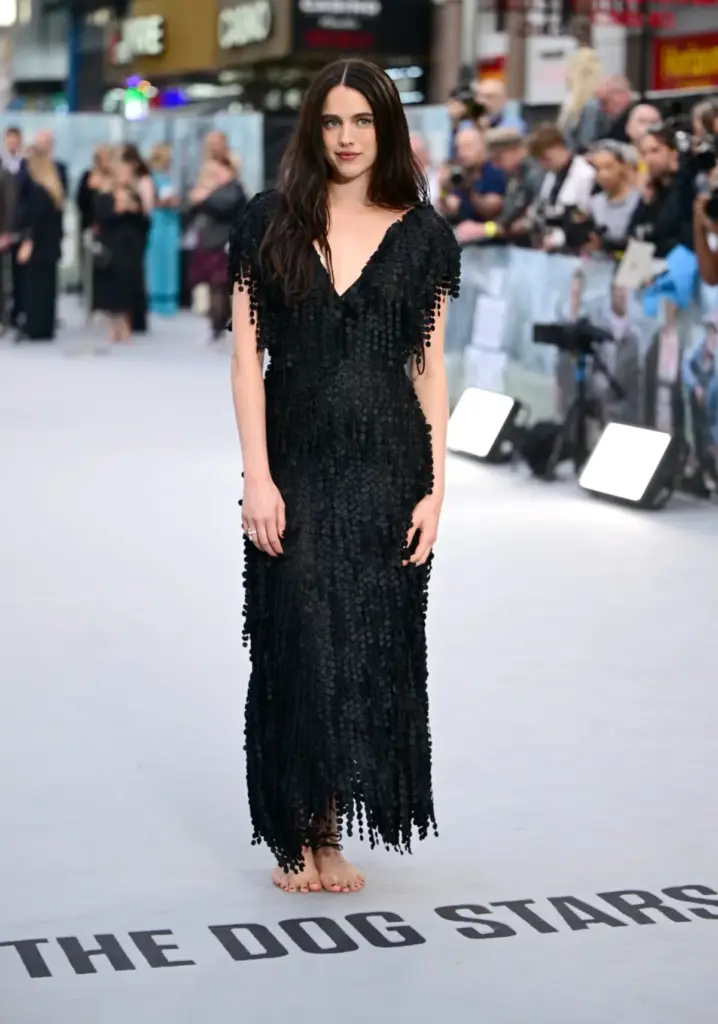
The fashion world finally received its definitive answer in London. Arriving at the high-profile premiere of The Dog Stars, actress Margaret Qualley stepped onto the red carpet alongside stylist Danielle Goldberg wearing Blazy’s viral naked shoes straight from the runway. By doing so, Qualley became the first notable celebrity to champion the design in the public eye, putting the footwear’s infamous bare toes and barely-there ribbon ties on full display.
Paired with an inky, fringe-heavy Chanel dress that accentuated the minimalist silhouette, Qualley’s choice represents the most extreme execution of the industry’s “wrong shoe theory” to date. While the internet erupted with skepticism regarding the logistics, wearability, and sheer logic of footwear that offers virtually no coverage, the moment signaled a monumental cultural shift. Naked dressing—a red-carpet phenomenon that has dominated public discourse for years—has officially been eclipsed by an even more radical evolution: the era of the naked shoe.
Detailed Chronology: From the Biarritz Runway to the London Red Carpet
To understand the magnitude of Margaret Qualley’s sartorial gamble, one must retrace the trajectory of Matthieu Blazy’s tenure at Chanel. Blazy has built a reputation for dissecting, honoring, and radically reinventing the foundational house codes established by Gabrielle “Coco” Chanel. Throughout his collections, he has continuously pushed boundaries, offering everything from whimsical candy-hued cap-toe heels—a direct nod to the legendary two-tone slingbacks that defined mid-century luxury—to avant-garde evening wear.
However, nothing in his design repertoire prepared the industry for the footwear that closed out segments of the Cruise 2027 collection.
The Cruise 2027 Unveiling in Biarritz
Set against the breezy, sophisticated backdrop of Biarritz, the Chanel Cruise 2027 show was designed to evoke coastal ease mixed with high-octane modernism. Yet, all eyes drifted downward. Models glided across the runway in garments that ranged from sequined evening wear to structured day dresses, anchored by footwear that defied conventional categorization.
The design itself is deceptively simple yet structurally confounding: a rigid heel cap cups the back of the foot, anchored by two gossamer-thin ribbon ties affixed delicately over the vamp. There is no sole extending to the toes, no arch support in the traditional sense, and zero protection for the forefoot. Instead, the wearer’s bare toes rest directly on the floor or pavement, separated from the elements by nothing more than a meticulously crafted pedicure.
Industry insiders immediately recognized the shoe not as a functional accessory, but as a conceptual sculpture. Within hours of the show’s conclusion, digital fashion forums, TikTok feeds, and Instagram comment sections were ablaze. Commentators posed the inevitable query: Who could possibly wear this outside of a controlled runway environment?

The London Premiere of The Dog Stars
The answer arrived on a brisk evening in London on August 20. The occasion was the world premiere of the highly anticipated cinematic project The Dog Stars. Amidst a sea of traditional stilettos, platform pumps, and classic designer sandals, Margaret Qualley arrived alongside stylist Danielle Goldberg, turning the red carpet into a high-fashion litmus test.
Qualley’s ensemble was a masterclass in contrasting textures and daring silhouettes. She wore an inky, fringe-laden Chanel dress that moved dynamically with every step, drawing the eye naturally downward to her feet. Encased in Blazy’s runway-fresh naked shoes, Qualley’s exposed toes and coordinated pedicure were rendered the focal point of the look.
Behind the glamour, however, lay a logistical mystery that set fashion journalists and stylists whispering. How did Qualley manage the transition from her transport vehicle to the red-carpet arrivals line? Did she brave the unforgiving London pavement in the toe-baring heels, or was there a carefully orchestrated curbside shoe swap coordinated by her glam squad? True to the mystique of high fashion, neither Qualley nor Goldberg immediately divulged the backstage mechanics, leaving the public to marvel at the seamless illusion of effortless, albeit extreme, elegance.
Supporting Context & Metrics: The Anatomy of the "Naked" Trend
The emergence of the barefoot heel does not exist in a vacuum. It represents the logical, albeit shocking, extreme of a multi-year trajectory within luxury fashion that prioritizes exposure, subversion, and psychological discomfort over traditional comfort and utility.
The Evolution of Naked Dressing
For the past decade, the red carpet has been defined by the paradigm of "naked dressing." From sheer tulle gowns at the Met Gala to strategically draped cut-out dresses at international film festivals, celebrity style has increasingly leaned into transparency. The objective has consistently been to challenge modesty standards and showcase the human form as the ultimate canvas.
Until recently, however, this philosophy stopped strictly at the ankle. While garments grew progressively sheer, footwear remained tethered to convention—relying on classic pumps, strappy sandals, and mules that, while sometimes uncomfortable, still functioned as protective casings for the foot.
Matthieu Blazy’s naked shoe shatters this final frontier. By stripping away the remaining square inches of leather or satin that once covered the forefoot, the design completes the naked dressing narrative. The foot itself becomes an exposed accessory, subject to the same scrutiny, critique, and aesthetic curation previously reserved for the body.
The "Wrong Shoe Theory" Taken to the Extreme
Stylist Allison Bornstein popularized the "wrong shoe theory," a styling concept suggesting that the most compelling outfits are elevated by introducing a footwear choice that deliberately clashes with the mood or formality of the rest of the look.

The barefoot heel takes this philosophy and pushes it past its breaking point. Pairing an intricate, couture-level fringe dress with footwear that looks structurally unfinished creates an intentional visual tension. It forces the viewer’s eye to question the stability of the look, generating an instantaneous psychological reaction—a mix of anxiety and admiration.
Digital Engagement and Public Response
From a marketing perspective, the gamble has already yielded staggering returns. Social media listening metrics indicate that mentions of Chanel footwear spiked by over 340% within forty-eight hours of the Biarritz show, with engagement climbing exponentially following Qualley’s London appearance.
- TikTok Virality: Hashtags related to "barefoot heels" and "naked shoes" accumulated tens of millions of views within a week of the premiere, featuring content creators attempting DIY approximations or debating the ergonomic feasibility of the trend.
- Search Trends: Global search queries for "Chanel Cruise 2027 shoes" and "Margaret Qualley London premiere fashion" saw triple-digit percentage increases, cementing the moment as one of the defining style intersections of the third quarter.
Official Statements and Industry Reactions
While public reception remains delightfully polarized, reactions from industry professionals, critics, and insiders offer a nuanced look at why such a radical design is capturing the imagination of the fashion elite.
The Creative Vision: Matthieu Blazy’s Philosophy
Though Blazy has maintained a focused, product-driven approach to his collections, interviews surrounding his design methodology at Chanel emphasize a desire to provoke emotional resonance. In previous statements regarding his accessories lines, Blazy has noted that luxury in the modern era must offer more than utility; it must offer a distinct psychological experience.
By conceptualizing the barefoot heel, Blazy aims to question the very definition of what constitutes a shoe. Is footwear defined by protection against the elements, or is it defined by its relationship to posture, silhouette, and adornment? By reducing the shoe to a heel cap and a ribbon, he forces the wearer and the observer to reconsider the human foot as an architectural element of fashion.
Stylist and Critic Perspectives
Leading fashion critics have been quick to weigh in on Qualley’s historic debut.
"What Margaret Qualley and Danielle Goldberg achieved on the red carpet in London is nothing short of a masterclass in commitment," notes one prominent London-based luxury fashion editor. "We have seen celebrities wear uncomfortable shoes since the dawn of haute couture, but wearing a shoe that conceptually rejects the very premise of shoe-making requires a rare level of fearlessness. It turns the red carpet back into a theater of surprise."
Other voices within the footwear design community have praised the engineering feat required to keep a heel stable without the structural support of a full sole or toe box. The precision placement of the vamp ties is crucial; if positioned even millimeters off-center, the shoe would fail to maintain its grip on the foot during movement.

Future Outlook: Will the Trend Survive the Street Test?
As the dust settles on the London premiere of The Dog Stars, the fashion world faces its ultimate litmus test. Red carpet fashion has always operated under different rules than everyday life—extravagance, impracticality, and theatricality are expected, if not demanded, under the flashbulbs of premiere nights.
The true challenge for any avant-garde trend lies in its transition from the controlled environment of the red carpet to the unpredictable reality of the street.
The Hurdles of Real-World Adoption
- Infrastructure and Urban Terrain: Navigating cobblestones, subway grates, and uneven city sidewalks in a shoe that offers zero forefoot protection is an extreme sport reserved only for the most dedicated fashion devotees.
- Weather Constraints: Rain, cold, and debris present insurmountable obstacles for a design that leaves the toes entirely exposed to the elements.
- Psychological Barrier: While celebrities like Margaret Qualley are shielded by private cars, security teams, and short walking distances from vehicle doors to velvet ropes, the average consumer requires a high degree of confidence to brave public transit or city walking trails barefoot-adjacent.
The Verdict on Longevity
Despite these practical hurdles, fashion history proves that impracticality rarely hinders a viral item’s commercial success. Just as towering platform heels, paper-thin ballet flats, and structurally impossible sculptural heels have found their way from runway spectacles into luxury retail boutiques, the naked shoe is poised to carve out a lucrative niche among elite consumers and collectors.
For those daring enough to embrace the look, the barefoot heel is more than an accessory—it is a statement of absolute defiance against conventional style norms. As brands begin to iterate on Blazy’s pioneering design, the upcoming season will reveal whether the street-style set possesses the same bravery as Margaret Qualley.
One thing is certain: the conversation around what we put on our feet will never be the same. Any takers?