Executive Overview
It is another sweltering summer evening in London. The capital is caught in the iron grip of a continental heatwave, and sweat glistens on foreheads, necks, and the backs of legs as commuters navigate the subterranean labyrinth of the Tube.
"Thank fuck Wembley has air-con," a young woman mutters to her companion.
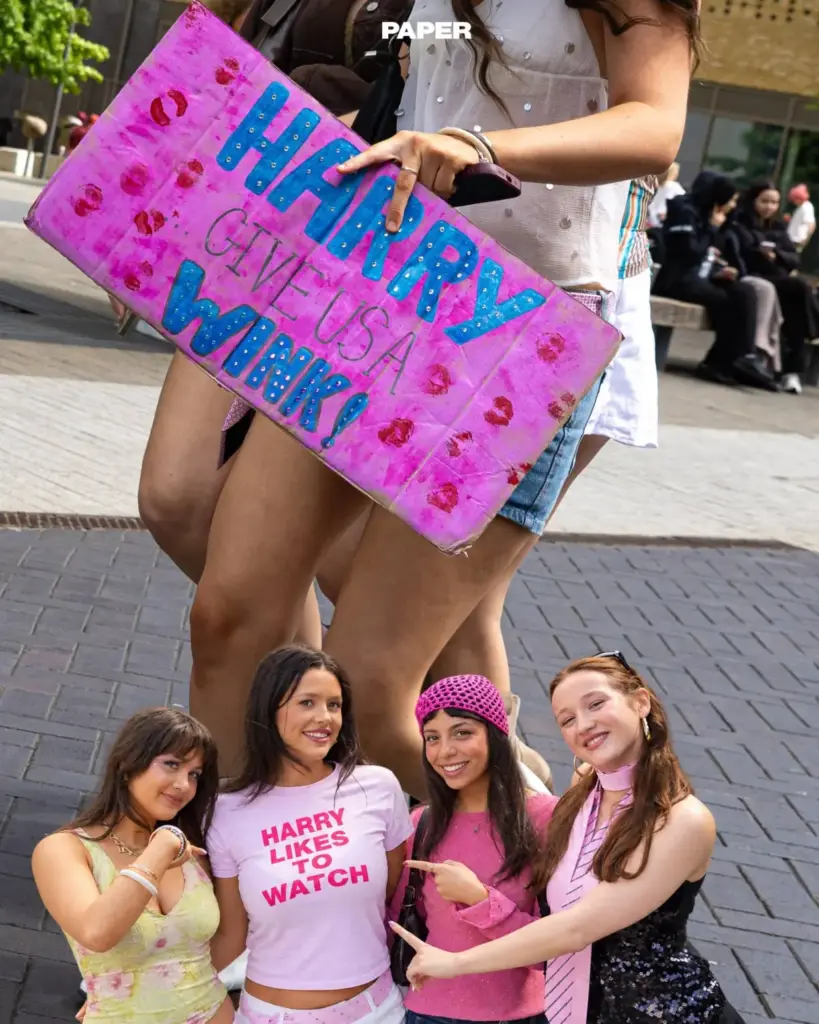
She hasn’t stated her destination, yet her trajectory is blindingly obvious. The pink cowboy hat perched atop her head and the matching, shedding feather boa draped around her shoulders serve as an unmistakable beacon. She is heading to Wembley Stadium for a sold-out concert by Harry Styles. Inside the carriage—and indeed, across the entire Underground line—nearly every passenger is gussied up in the exact same thematic uniform.
For veterans of the live music scene, stepping onto the platform in standard concert attire—say, a pair of worn-in leather boots and a denim mini-skirt—suddenly feels profoundly archaic. By modern standards, these traditional choices no longer meet the unspoken dress code of the Big Live Pop zeitgeist.
Welcome to the era of cult concert dressing. Across the globe, from the sprawling arenas of North America to the massive festival grounds of Europe, live music has evolved far beyond a simple exchange of songs for ticket sales. Today, attending a pop concert requires a masterclass in immersive styling, where audiences spend hours assembling elaborate costumes, trading handmade trinkets, and turning themselves into walking, breathing extensions of the artist’s aesthetic universe.
Far from being a superficial trend driven by vanity or the pursuit of celebrity validation, this phenomenon represents a profound sociological shift. For a generation shaped by digital isolation and pandemic-era disruptions, dressing in uniform is no longer about trying to catch an idol’s eye. Instead, it is a deliberate, joyful act of community-building—a tribal ritual designed to establish a sense of belonging in a fractured world.
Detailed Chronology: The Evolution of the Pop Concert Wardrobe
To understand how concert fashion reached its current hyper-theatrical zenith, one must trace the evolution of fan culture over the past decade. The transformation did not happen overnight; rather, it was accelerated by a post-pandemic hunger for shared physical spaces and the hyper-curated aesthetics of social media.
Phase 1: The Era of the Parasocial Object of Desire (Pre-2020)
In previous decades—typified by the height of boyband mania, Directioners, and Beliebers—fan fashion was largely projectionist. Teenage girls and young women dressed with an aspirational gaze. Outfits were designed to be attractive, eye-catching, and subtly tailored to appeal to the male or female pop star on stage. The underlying fantasy, heavily romanticized in platforms like Wattpad fanfiction, was one of individual recognition: What if he or she notices me in the front row? Wardrobes consisted of elevated streetwear, concert tees paired with skirts, and subtle nods to an album era, but individual visibility remained the primary objective.
Phase 2: The Post-Pandemic Rebirth and Aesthetic Decrees (2022–2023)
When live music roared back to life following COVID-19 lockdowns, the collective psychological need for connection collided with pent-up creative energy. Artists and their management teams quickly recognized this hunger and began actively steering the aesthetic landscape of their tours.
In the summer of 2023, Beyoncé’s monumental Renaissance World Tour elevated concert dressing to a near-mandatory royal decree. When the icon officially requested that her "Hive" dress in silver to celebrate Virgo season—her birth month—the response was staggering. Stadiums transformed into shimmering, metallic sea-scapes of chrome corsets, futuristic sunglasses, and custom-tailored mirrors. Fans weren’t dressing to attract Beyoncé’s attention; they were dressing to prove their allegiance to the collective kingdom she had built.
Phase 3: The Era of Hyper-Specialization and Ritualistic Exchange (2024–Present)
By 2024, Taylor Swift’s record-shattering Eras Tour codified this shift into an international movement. The concert experience became a choose-your-own-adventure game defined by rigorous categorization. Fans no longer wore generic stylish clothes; they mapped their wardrobes to specific albums (Fearless gold fringe, Reputation snakes, Lover pastels).
Simultaneously, a throwaway lyric from Midnights—“So make the friendship bracelets, take the moment and taste it”—birthed a multi-million-unit cottage industry of bead-swapping rituals. Fans spent days laboring over tiny plastic beads, treating the process with the devotional zealousness of monastic artisans, before trading them with complete strangers in stadium concourses.
By 2025 and 2026, this momentum bled into virtually every corner of the pop ecosystem. Charli XCX’s Brat tour turned neon lime-green into a global urban uniform, complete with blunt bangs, white ribbed tanks, and rave shades—often worn by audiences even when the artist herself eschewed elaborate costuming. Even legacy acts and unconventional performers like Pitbull saw fans mobilizing around specific visual tropes, ensuring that a bald cap and sunglasses became the ultimate passport to party unity.
Supporting Context & Metrics: The Economics and Psychology of Fandom Fashion
The rise of cult concert dressing is underpinned by significant economic investments and deep-seated psychological drivers. Concerts are no longer budgeted solely around ticket face values, travel expenses, and standard venue merchandise; they now factor in substantial expenditures dedicated entirely to "the fit."
The Economics of the Costume
- The Secondary Market Boom: Platforms like Etsy, Depop, and Amazon have seen staggering spikes in search terms related to specific tour aesthetics months before a tour kicks off. Phrases like "custom Eras tour outfit" and "Renaissance silver corset" generate millions of dollars in independent creator revenue.
- Merchandise Diversification: Beyond traditional tour t-shirts and hoodies, official and fan-made accessories—ranging from $20 feather boas and heart-shaped sunglasses to bespoke LED cowboy hats—have become dominant revenue streams.
- The "One-Wear" Dilemma: Driven by TikTok and Instagram grid aesthetics, a significant portion of concertgoers curate looks explicitly for social media documentation, raising conversations around fast-fashion consumption and sustainability within modern fandoms.
The Psychology of Belonging
From a sociological perspective, this trend serves as a powerful antidote to modern isolation. According to cultural psychologists, Generation Z and younger millennials—many of whom experienced formative high school and college years disrupted by remote learning and social distancing—exhibit a profound craving for tangible community spaces.
When a young fan dons a sequined mini-dress inspired by Taylor Swift’s Midnights or wraps themselves in a feather boa for Harry Styles, they are engaging in a form of visual signaling. It communicates safety, shared language, and immediate camaraderie. In a stadium holding 80,000 people, the costume eliminates social anxiety. You are never an outsider when everyone around you is wearing the exact same badge of honor.
Official Statements and Industry Insights
Cultural critics, fashion historians, and live music executives have weighed in on how audience participation has permanently altered the concert landscape.
Dr. Elena Vance, Professor of Cultural Sociology at the University of London, notes:
"We are witnessing the democratization of performance. Historically, the barrier between the artist on stage and the audience on the floor was absolute—they performed, you watched. Today, the audience has co-opted the stagecraft. The crowd is no longer just a passive consumer base; they are the living, breathing set design. By dressing in uniform, they externalize their internal emotional investment, transforming a commercial concert into a secular pilgrimage."
A veteran live-tour production manager, speaking anonymously about arena logistics, observes:
"The visual energy inside these venues has fundamentally changed over the past five years. Ten years ago, you looked out at a sea of mixed street clothes. Now, walking out to do a soundcheck and seeing thousands of people meticulously dressed to a specific thematic prompt is breathtaking. It alters the performers’ energy, too. Artists feed off that collective commitment; it turns a standard tour stop into an immersive event where everyone feels like they are part of the inner circle."
Indie fashion designer Maya Lin, whose handmade rhinestone cowboy hats went viral during the 2024 summer tour circuit, adds:
"People are willing to spend hundreds of dollars on an outfit they may only wear once because the value isn’t in the garment’s utility—it’s in the memory and the connection it buys them. When a stranger walks up to you on a crowded stadium concourse, compliments your jacket, and trades you a bracelet, that moment of human warmth validates every penny and hour spent gluing rhinestones."
Future Outlook: Where Does Concert Culture Go From Here?
As the live music industry continues to break box office records, the phenomenon of cult concert dressing shows no signs of abating. Instead, it is evolving into a permanent expectation of the live entertainment experience.
- Hyper-Personalized Tour Guidelines: Expect future pop tours to actively release visual "lookbooks" or mood boards ahead of time, blurring the line between high fashion houses and fan-led DIY culture.
- Sustainable Fandom Swaps: As ecological scrutiny increases, communities are already organizing local "Eras" and "Brat" clothing swaps, ensuring that the desire for elaborate costuming can be met without contributing to textile waste.
- The Expansion Across Genres: While pop and hip-hop have dominated this wave, rock, country, and even electronic music scenes are beginning to adopt hyper-thematic dress codes, proving that the desire for collective identity transcends musical genres.
Ultimately, while skeptics might roll their eyes at the commercialization of modern fandom—pointing out the irony of mass-produced plastic boas and the pressure to buy yet another specialized outfit—the heart of the movement remains remarkably pure.
For a generation navigating an anxious, hyper-digitized world, the stadium floor has become a sanctuary. In donning those feathers, sequins, and neon shades, fans are not dressing to be noticed by an idol; they are dressing to be seen by each other. And in doing so, they have turned the simple act of going to a concert into something truly revolutionary.