Executive Overview
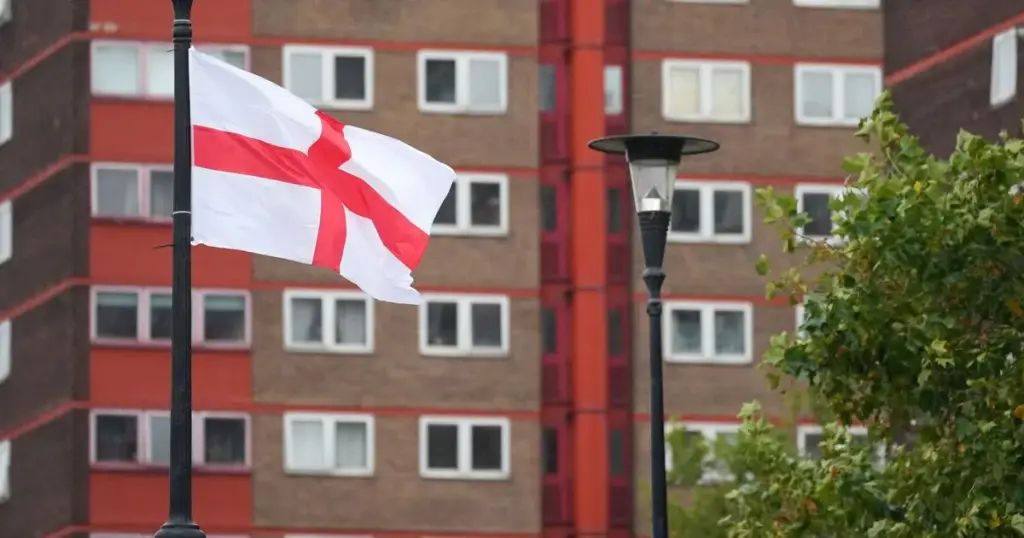
A simmering cultural and political flashpoint across England has reached a new head following decisive action by local authorities to strip unauthorized national flags from public street furniture. Leicestershire County Council—under the leadership of Reform UK—has confirmed the removal of dozens of Union Jacks and St George’s crosses from lampposts throughout the region, citing structural safety concerns and the deteriorated condition of the displays.
The nationwide proliferation of flags, which began accelerating in the summer of 2024 and has continued to spread through residential neighborhoods, high streets, and rural junctions, has exposed deep fractures in communities across the United Kingdom. While grassroots activists and proponents champion the unauthorized displays as an authentic, grassroots expression of national pride and identity, critics, local officials, and parliamentarians argue that the tattered banners project exclusion, blight public infrastructure, and heighten social tensions against the backdrop of broader debates surrounding immigration and community cohesion.
This comprehensive report examines the complex layers of the flag controversy. We explore the conflicting viewpoints of local residents, the policy positions of political parties ranging from Reform UK to the Labour Party, the logistical and legal safety frameworks governing public highways, and the wider sociological implications of patriotism on public property in modern Britain.
Detailed Chronology: From Grassroots Wave to Local Government Intervention
The modern wave of public flag-flying did not emerge overnight; rather, it evolved as a decentralized grassroots phenomenon that caught local authorities largely unprepared.
Summer 2024: The Movement Takes Root
In the summer months, residents across various English towns and cities began noticing an upsurge in Union Jacks and St George’s crosses affixed to civic infrastructure. Utilizing plastic cable ties and improvised mounting materials, individuals and unverified local groups hoisted the flags onto lampposts, traffic light poles, and utility structures. Organizers of the movement framed it as an organic celebration of British identity, timed with various national events, sports tournaments, and a general desire to reclaim public spaces for traditional symbols.
Late 2024 to Mid-2026: Escalation and Visual Deterioration
As the months progressed, exposure to the unpredictable British climate—heavy rain, high winds, and intense UV rays—began to take its toll on the fabric banners. What started as crisp, vibrant displays rapidly deteriorated. Frayed edges, sun-bleached colors, and rain-soaked textiles dangling precariously from roadside poles transformed the aesthetic landscape of neighborhoods.
At the same time, political lines hardened. In constituencies like Loughborough, local representatives began receiving a rising volume of correspondence. While some residents expressed immense pride at the sight of the national flags, others—particularly members of diverse minority communities—reported feeling alienated and intimidated.
August 2026: The Leicestershire Crackdown
The flashpoint crystallized in late August 2026, when Leicestershire County Council initiated targeted operations to remove degraded and unauthorized flags from lampposts across multiple districts, including scheduled sweeps in areas such as Whitwick. The council invoked standard highways maintenance and safety protocols, arguing that unapproved items attached to electrical and structural street furniture posed distinct risks to motorists and pedestrians alike.
Supporting Context & Metrics: Infrastructure, Aesthetics, and Public Sentiment
To understand why local authorities are stepping in, it is essential to examine the intersection of highway legislation, municipal liability, and public sentiment.

Highways Safety and Legal Liabilities
Under UK highways legislation, local councils maintain a statutory duty of care to ensure that public roads and associated infrastructure remain safe and unobstructed. Lampposts and street furniture are engineered to bear specific load limits (such as wind resistance on standard street signs or approved seasonal festive lighting).
When unauthorized individuals attach heavy fabric banners—which absorb water and act as sails in high winds—the structural integrity of the lamppost can be compromised. Furthermore, poorly secured cable ties or metal wire can degrade, causing flags to detach entirely and obscure motorists’ visibility, wrap around road signs, or entangle cyclists and pedestrians.
The Divergence of Public Sentiment
Public opinion surrounding the street flags remains sharply divided, reflecting broader ideological schisms across the UK:
- The Patriotic Argument: Proponents argue that displaying the national flag fosters community spirit, honors British heritage, and asserts a visible sense of belonging in public spaces. Many express frustration that municipal authorities target patriotic displays while turning a blind eye to commercial advertising or graffiti.
- The Cohesion and Inclusivity Argument: Conversely, critics argue that the unregulated placement of flags—often orchestrated by specific political or activist factions—can be deliberately territorial. Civil society groups and community leaders have pointed out that in racially diverse neighborhoods, the sudden saturation of nationalist symbols can be perceived as an exclusionary boundary marker rather than an inclusive celebration.
Official Statements and Political Perspectives
The controversy has drawn commentary from across the political spectrum, highlighting sharp disagreements over how national symbols should be managed and displayed.
The Labour Perspective: Balancing Pride and Condition
Loughborough Labour MP Jeevun Sandher has been at the forefront of addressing constituent concerns regarding the flag displays. Speaking to the Local Democracy Reporting Service (LDRS), Mr Sandher clarified his stance, emphasizing that while national symbols hold value, their current unregulated execution leaves much to be desired.
"I do not want to see flags hanging tattily from lampposts," Mr Sandher stated, renewing his calls for local authorities to clear away neglected banners.
Crucially, Mr Sandher drew a distinction between appropriate civic celebration and the makeshift roadside displays:
"Flags should be flown proudly from designated flagpoles, rather than being improvised with cable ties on utility poles. Furthermore, a significant number of my constituents have expressed that these unmanaged displays feel unwelcoming, making them uncomfortable in their own communities at a time when we should be striving for unity."
The Reform UK Perspective: Support for Patriotism, Caution on Maintenance
As the governing administration of Leicestershire County Council, Reform UK officials have walked a fine line between validating constituent patriotism and upholding local governance standards.

Joseph Boam, a Reform UK county councillor for the area, acknowledged the dual nature of the debate in his comments to the LDRS:
"I’m very much in favour of the flags, but not in favour of the ones that are ripped apart and look a mess."
Mr Boam advocated for a more structured approach rather than a blanket prohibition, suggesting that worn flags should ideally be replaced with pristine, well-maintained banners rather than simply scrubbed from the public realm entirely.
Local Authority Policy Statement
A spokesperson for Leicestershire County Council reiterated the legal and operational framework guiding their recent actions:
"We will take down flags when they are unsafe or in very poor condition. We routinely ask members of the public not to attach anything to lampposts or any other road equipment for safety reasons. Our priority must remain the structural integrity of our highway infrastructure and the safety of all road users."
Future Outlook: Navigating Identity and Public Space
As local councils across England grapple with similar dilemmas, the debate over lamppost flags is unlikely to fade away. The controversy serves as a microcosm of a larger national conversation about identity, regulation, and the shared use of public space in twenty-first-century Britain.
Potential Policy Shifts
Looking ahead, local authorities may be forced to draft clearer, proactive policies regarding public decorations. Potential solutions being discussed in various municipal chambers include:
- Designated Civic Flagpoles: Establishing official, council-maintained flagpoles in town centers where national flags can be flown safely and with proper protocol during national holidays and sporting events.
- Stricter Enforcement Guidelines: Implementing zero-tolerance policies for unauthorized attachments on highway assets, paired with rapid-removal timetables to prevent visual blight.
- Community Consultation Frameworks: Engaging local faith and community groups to establish consensus guidelines on public displays that balance freedom of expression with community cohesion.
Ultimately, the friction between grassroots patriotism and municipal safety highlights the delicate balance required to govern diverse and passionate communities. Whether local councils will succeed in harmonizing these competing demands remains one of the defining local governance challenges of the decade.