Executive Overview
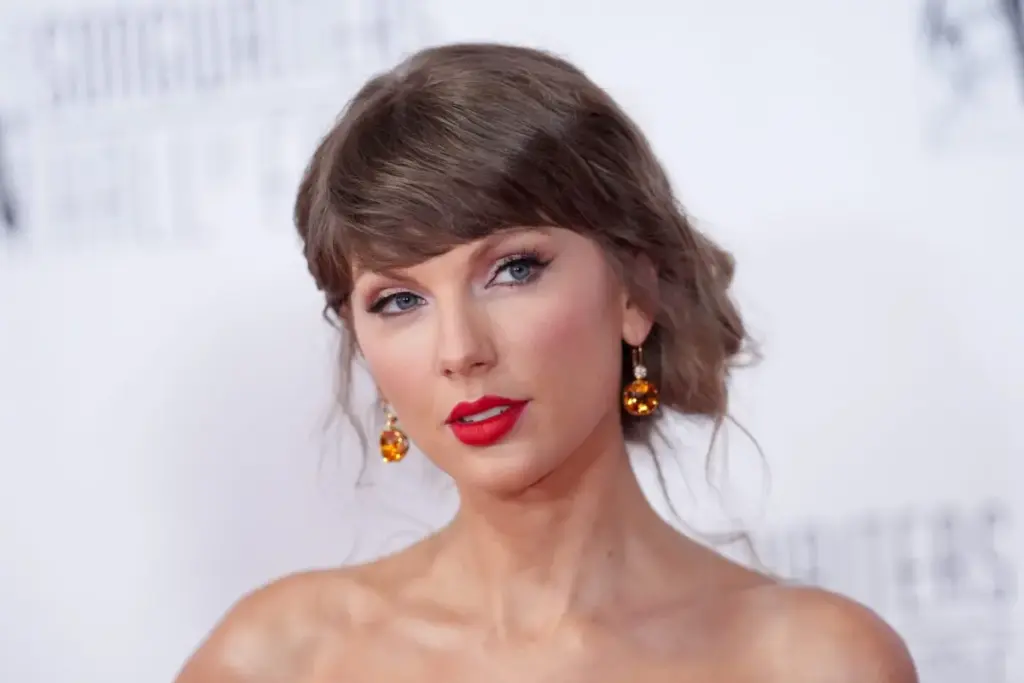
Pop culture moves fast, but few cultural phenomena receive the micro-analytical scrutiny of Taylor Swift’s physical aesthetic. Over the past two decades, every sartorial choice, accessory, and follicular shift has been dissected by millions of dedicated fans. Recently, however, a new wave of speculation has swept through global entertainment circles. Following recent appearances in England—culminating in public photographs taken at a high-profile wedding—Swift has debuted a noticeably shorter haircut, featuring a dramatic, deep side part that leaves her famous fringe swept aside.
For the global Swiftie community, this is not merely a styling choice; it is widely interpreted as the definitive opening salvo of a notoriously difficult beauty milestone: growing out her bangs.
Since 2012, Swift’s signature blunt fringe has been a foundational pillar of her visual identity. It has weathered multiple musical eras, international stadium tours, intense public scrutiny, and countless red-carpet appearances. To witness her systematically moving away from this trademark look suggests that a broader, generational shift in her personal aesthetic is underway.
Yet, this transformation highlights a surprisingly universal human experience. Regardless of one’s net worth, status, or access to the world’s most elite glam squads, the arduous, awkward process of growing out a fringe is a universally humbling trial. This report examines the historical context of Swift’s hair transformations, analyzes the recent photographic evidence, details the timeline of her potential transition away from bangs, and explores the expert-backed realities of navigating the grueling "grow-out" phase.
Detailed Chronology: A History of Swift’s Signature Styles
To understand the magnitude of Swift’s current hair evolution, one must trace the trajectory of her hairstyles across her prolific discography. Her hair has long served as a visual metonym for her musical reinventions, signaling tonal shifts from country-pop sweetheart to global synth-pop icon, alternative folk storyteller, and stadium-touring auteur.
The Origin of the Fringe: The Red and 1989 Eras (2012–2015)
Prior to 2012, Swift’s hair was defined by its naturally curly, golden texture, occasionally straightened for red-carpet events, but largely left unconfined by a heavy fringe. That changed dramatically when she debuted heavy, straight-across bangs for a seminal Vogue magazine photo shoot.
This new styling choice instantly caught on with fans and critics alike, setting the tone for her transition into pure pop. When she released her blockbuster fourth studio album, Red, in late 2012, the bangs were firmly established as her trademark. She carried this look forward into her monumental 2014 pop crossover, 1989. The era was initially defined by bouncy, voluminous blowouts with a heavy, eye-grazing fringe, establishing an aesthetic of effortless, retro-leaning Manhattan chic.
The Bob and "Bleachella": 1989 to Reputation (2016)
As the 1989 era peaked, Swift introduced the first major structural change to her silhouette: she chopped her long locks into a sharp, blunt bob at the 2016 Grammy Awards, maintaining a textured, side-swept fringe.
Months later, at the 2016 Met Gala themed "Manus x Machina: Fashion in An Age of Technology," Swift shocked the industry by stepping onto the carpet with platinum-blonde, grunge-inspired bleached hair, a dark lip, and an edgy Louis Vuitton cutout dress. This brief, rebellious period—affectionately dubbed "Bleachella" by her fanbase—fractured expectations of her traditional aesthetic and laid the groundwork for the moody, vindictive sonic landscape of her 2017 album, Reputation. During the Reputation era, her hair grew darker, featuring messier, piece-y bangs and textured waves that matched the album’s themes of public reclamation.

The Pandemic Naturalism: Lover, Folklore, and Evermore (2019–2021)
During the rollout of 2019’s pastel-drenched Lover album, Swift experimented with colorful dip-dyes and lighter blonde highlights, though her reliable bangs remained a constant anchor.
However, the global lockdowns of 2020 prompted a dramatic return to organic roots. Abandoning frequent heat-styling and heavy salon treatments, Swift leaned into her natural blond-brown hair color and embraced a much curlier, untamed texture. This cottagecore aesthetic defined her sister albums, Folklore and Evermore. While the styling was softer and more rustic, the bangs persisted, serving as a nostalgic security blanket through a period of immense global uncertainty.
Supporting Context & Metrics: The Signs of a Gradual Exit
While Swift’s fringe has weathered more than a decade of trends, sharp-eyed observers note that the first intentional hints of a planned exit date back several years. The evolution away from a traditional, heavy, straight-across fringe has been slow, methodical, and strategically executed.
The 2023 Renaissance Premiere Shift
The first undeniable indicator that Swift was testing the waters of a bang-free future occurred in late 2023. Attending the London premiere of Renaissance: A Film by Beyoncé, Swift opted for an updo that swept her bangs completely out of the way. Rather than sporting her usual front-facing fringe, the hair was parted and styled back, revealing her forehead entirely. Fan forums and style blogs immediately lit up with speculation, noting how radically different her face structure appeared without the framing device she had relied on for eleven years.
The June 2026 Gala Appearance
The timeline accelerated significantly in June 2026. While attending the prestigious 55th Annual Songwriters Hall of Fame Induction and Awards Gala, Swift debuted a distinctly modified look. Rather than wearing her bangs blunt and forward, she styled them into a sweeping, deep side part that cascaded across her forehead.
Hairdressers and beauty editors immediately recognized this specific styling technique as the classic "first defense" mechanism utilized when someone begins growing out a short fringe. A deep side part allows longer bangs to blend seamlessly into the rest of the hair shafts, hiding awkward transitional lengths.
The Recent English Wedding Debut
The speculation reached a fever pitch over the weekend when paparazzi and attendee photos emerged of Swift attending a high-profile wedding in the English countryside. Her hair was visibly shorter by several inches—approaching a crisp, sophisticated lob (long bob)—and her bangs were pushed deep to the side.
For beauty analysts, this represents the classic post-transition chop. When growing out a fringe, hair often becomes uneven, heavy at the sides, and wispy in the middle. Cutting the rest of the hair shorter to match the length of the growing bangs is a tried-and-true salon strategy to reset the overall shape of the cut. Paired with a major life milestone like a close friend’s wedding—or, as fans eagerly theorize, general post-wedding lifestyle shifts—Swift appears ready to officially close the book on her decade-long fringe era.
Official Statements and Industry Expert Perspectives
While Taylor Swift herself has yet to issue a formal press release regarding her follicular choices (as is typical for the privacy-conscious pop star), celebrity hairstylists and beauty experts have weighed in on the mechanics and psychological weight of transitioning away from a signature look.

According to prominent editorial stylists, maintaining a heavy fringe for over a decade creates a distinct neural and visual imprint on both the wearer and the public. "When a celebrity is synonymous with a specific structural element like a fringe, changing it requires immense structural planning," notes veteran editorial stylist Marcus Vance. "You can’t just wake up one day and decide to grow them out without a transitional phase. It takes anywhere from six to twelve months of strategic cuts, clever pinning, and texturizing products."
Furthermore, beauty psychologists point out that hair transformations often mirror psychological milestones. "A major cut or style evolution is rarely just about hair," says behavioral psychologist Dr. Elena Rostova. "For public figures who live their lives in distinct eras, altering a foundational physical feature like a fringe often serves as a physical boundary marker. It closes an old chapter and subconsciously prepares both the individual and their audience for a fresh identity."
Industry insiders suggest that Swift’s glam team—knowing the relentless public scrutiny her appearance faces—has carefully orchestrated this slow-burn transition over the past three years to avoid the internet culture shock that a sudden, drastic cut might provoke.
Future Outlook: The Brutal Road of Growing Out a Fringe
No matter how many billions of dollars are in a bank account, or how many Grammy Awards line a mantelpiece, physics remains undefeated. The universal struggle of growing out a fringe is a humbling, equal-opportunity equalizer.
The Phases of the Grow-Out Struggle
- The Eye-Pokers (Months 1–3): The fringe reaches that annoying length where it constantly dips below the eyebrows, stabbing the corneas and forcing the wearer to constantly blink or blow hair out of their line of sight.
- The Deep Side-Part Era (Months 4–6): This is the exact phase Swift appears to be navigating right now. The hair is too long to stay down as a fringe, but too short to join the rest of the mane. It requires heavy-duty styling products, bobby pins, or accessories (reminiscent of Margot Tenenbaum) to keep it anchored to the temples.
- The Awkward Wing Phase (Months 7–9): The hair hits the cheekbones and jawline, framing the face in bulky, unpredictable wings that refuse to lay flat without extensive heat styling or strategic layering.
- The Blend (Months 10–12): Finally, the hair reaches a length where it can be fully integrated into face-framing layers or tucked neatly behind the ears.
How Celebrities Cope
While everyday individuals must rely on drugstore bobby pins and sheer willpower, global icons like Swift have access to elite workarounds. Temporary extensions can bridge the gap, custom wigs can hide experimental phases during private downtime, and top-tier stylists can continuously alter internal layers to disguise awkward bulk.
Yet, as Swift’s recent English wedding appearance proves, even the most resourced pop stars must eventually face the music and sit in the salon chair for the inevitable transitional chop. Whether she will successfully conquer the grow-out phase or eventually succumb to the eternal siren song of the scissors and trim fresh bangs back in remains to be seen.
For now, the global audience watches closely, proving once again that in the world of Taylor Swift, every single strand tells a story.