For nearly six decades, Susan Sarandon has occupied a rare and formidable space in global cinema: an unapologetic political activist, a risk-taking artist, and an unflinching screen legend whose career defies conventional Hollywood aging. From her Academy Award-winning tour de force in Dead Man Walking to cultural touchstones like Thelma & Louise, The Witches of Eastwick, Little Women, and Feud: Bette and Joan, Sarandon has consistently challenged audience expectations while commanding the screen.
Now, at 79 years of age, Sarandon shows no signs of slowing down. Her relentless creative output matches her lifelong commitment to social and political advocacy—most notably her vocal advocacy for Palestine. As she prepares for the premiere of her latest film, Andrea Pallaoro’s The Echo Chamber, in which she stars as a glamorous singer alongside Alicia Vikander at the prestigious Venice Film Festival, the cultural spotlight once again turns toward her remarkable trajectory.
This comprehensive retrospective explores Sarandon’s journey from her humble beginnings as Susan Tomalin in Queens and New Jersey to her breakthrough performances, tracing her evolution from a wide-eyed ingénue into a cinematic icon who continues to redefine what it means to be a modern Hollywood star.
Detailed Chronology: The Making of an Icon
Formative Years and the Road to Acting
Long before she commanded red carpets and soundstages, Susan Abigail Tomalin was born into a large, Catholic family in Queens, New York, later relocating to New Jersey. As the eldest of nine siblings, Sarandon developed early resilience, resourcefulness, and a quiet authority—traits that would later bleed into her defining screen characters.
Her academic journey led her to the Catholic University of America in Washington, DC, where she studied drama. It was within these hallowed halls that her personal and professional life intersected in a life-altering manner. She met fellow actor Chris Sarandon—who would later achieve fame as Prince Humperdinck in The Princess Bride and earn an Academy Award nomination for Best Supporting Actor in Dog Day Afternoon.
The young couple married and immersed themselves in local theater productions. In 1969, fate intervened when they attended a cattle call audition for John G. Avildsen’s gritty satirical drama, Joe. While Chris missed out on securing a role, Susan caught the casting directors’ eyes. At just 23 years of age, she landed the part of the rebellious, counter-culture daughter of an advertising executive, officially marking her feature film debut and launching an accidental yet meteoric career.
Television Roots and the Cult Phenomenon
Following her cinematic baptism in Joe, Sarandon did not immediately ascend to traditional A-list stardom. Instead, she paid her dues in the trenches of American television. She parlayed her initial film credit into recurring roles on daytime soap operas, notably ABC’s A World Apart and NBC’s Search for Tomorrow. These grueling schedules sharpened her professional discipline, enabling her to transition smoothly into the prestige television movie landscape of the early 1970s, including projects like F. Scott Fitzgerald and the Last of the Belles.
However, the true turning point of her early career arrived in 1975 when she stepped into a laboratory corset and high heels to play the effervescent, wholesome-turned-liberated Janet Weiss in Jim Sharman’s The Rocky Horror Picture Show. Starring alongside Barry Bostwick as Brad and Tim Curry as Dr. Frank-N-Furter, Sarandon injected a sharp, comedic, and wildly liberating energy into the midnight movie phenomenon. The Rocky Horror Picture Show transformed from a commercial misfire into an enduring global cult classic, permanently cementing Sarandon’s place in pop culture lore and signaling her fearlessness when choosing unconventional material.
Critical Acclaim and Cinematic Ascension
With her cult status secured, Hollywood’s most discerning auteurs took notice. The late 1970s and 1980s saw Sarandon transition from a cult favorite to a critical darling. She earned widespread praise for her work in Louis Malle’s romantic crime drama Atlantic City (1980), starring opposite Burt Lancaster, a performance that earned her her first Academy Award nomination for Best Actress.
Her momentum accelerated exponentially throughout the decade. She delivered an iconic, career-defining performance as Annie Savoy in Ron Shelton’s baseball classic Bull Durham (1988), a role that showcased her rare combination of intellectual sharpness, raw sensuality, and sharp comedic timing. From that point onward, there was no looking back.
Supporting Context & Metrics: A Career in Numbers
To understand Sarandon’s enduring impact, one must examine the metrics of her sustained cultural and professional footprint:
A Six-Decade Span: Sarandon’s career covers active, high-profile screen credits spanning nearly 60 consecutive years.
Academy Recognition: She has been nominated for the Academy Award for Best Actress five times (Atlantic City, Thelma & Louise, Lorenzo’s Oil, The Client, and Dead Man Walking), winning the coveted statuette in 1996 for her powerhouse performance as Sister Helen Prejean in Dead Man Walking.
Global Festival Circuit: Her presence at the Venice Film Festival in 2026 underscores a rare longevity that bridges classic 20th-century American cinema with contemporary international auteur-driven projects.
Family Roots: As the eldest of nine siblings, Sarandon’s early life cultivated a leadership mindset that translated directly into her off-screen career as an outspoken political activist and labor advocate.
Official Statements and Industry Reception
The anticipation surrounding Sarandon’s latest cinematic venture highlights the high regard in which she is still held by contemporary filmmakers. Speaking ahead of the premiere of Andrea Pallaoro’s The Echo Chamber at the Venice Film Festival, industry analysts and festival organizers have lauded Sarandon’s ongoing willingness to subvert expectations.
In a recent retrospective statement regarding her career longevity, festival programmers noted:
"Susan Sarandon represents a golden bridge between the risk-taking independent spirit of 1970s American cinema and the modern global arthouse movement. Her ability to command the screen with unwavering authenticity remains entirely peerless."
Critics have similarly praised her transition into complex matriarchal and artistic roles. The Echo Chamber, which pairs Sarandon as a glamorous, aging singer opposite Swedish Oscar-winner Alicia Vikander, is already being heralded as one of the most anticipated dramatic masterclasses of the festival circuit. The project emphasizes Pallaoro’s distinct visual style while giving Sarandon a rich, emotionally layered canvas to explore themes of vanity, mortality, and maternal complexity.
Future Outlook: The Ever-Evolving Icon
As Susan Sarandon steps onto the red carpet in Venice for the premiere of The Echo Chamber, she does so not merely as a nostalgic legacy act, but as a vibrant, working artist operating at the absolute peak of her cultural relevance.
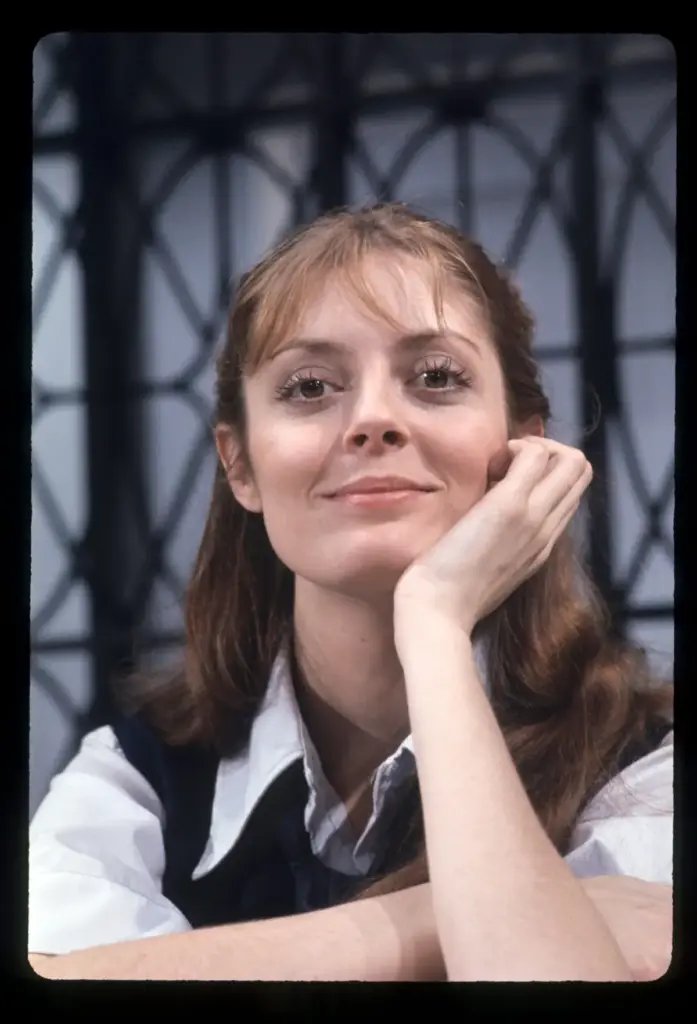
Her ongoing artistic renaissance is matched pound-for-pound by her tireless political activism. Whether she is rallying for labor rights, championing human rights causes, or taking on psychologically demanding roles on stage and screen (such as her recent acclaimed turn in Mary Page Marlowe at London’s Old Vic), Sarandon refuses to be neatly categorized or quietly sidelined by an industry historically prone to discarding women past a certain age.
Looking ahead, Sarandon’s trajectory serves as a blueprint for modern stardom. By treating aging not as an impediment, but as an asset loaded with wisdom, depth, and unapologetic power, she continues to inspire subsequent generations of actors and activists alike. From the soundstages of Queens to the grand canals of Venice, Susan Sarandon’s cinematic story is still being written—proving that true icons never fade; they simply evolve.




%2C%2520Susan%2520Sarandon%2520(Mary%2520Page%2520Marlowe)%2520in%2520Mary%2520Page%2520Marlowe%2520at%2520The%2520Old%2520Vic%2520(2025).%2520Photo%2520by%2520Manuel%2520Harlan%2520(1)%2520(1).jpg)