Executive Overview
The landscape of luxury fashion is undergoing a profound structural shift. For decades, the barrier between the visionary designer and the end consumer was fortified by layers of wholesale buyers, gloss-heavy print magazines, and carefully curated runway presentations. Today, however, that boundary is dissolving. In an era where emotional resonance has officially usurped traditional markers of prestige—such as heritage and raw craftsmanship—designers are searching for novel ways to bridge the gap between their creative ateliers and the digital shopping cart.
Enter visionary designer Willy Chavarria, who is currently contemplating a frontier that pushes the boundaries of artificial intelligence in retail: cloning his own voice to guide shoppers through his collections. While still in its conceptual infancy, the idea imagines an e-commerce ecosystem where customers can browse garments while listening to a hyper-realistic, AI-generated rendition of Chavarria explaining the tactile qualities, cultural origins, and emotional intents behind his designs.
This exploration is not merely a futuristic thought experiment; it is born from tangible commercial success. Through a recent partnership with commerce platform Swap, Chavarria’s brand launched a dedicated AI-powered storefront for his Adidas World Cup collection. The results were startling: a 100% surge in revenue compared to previous collection rollouts, illuminating an insatiable consumer appetite for immersive, digitally mediated storytelling.
As the fashion industry grapples with the demands of an increasingly online consumer base, Chavarria’s experiments offer a compelling blueprint. By marrying high-touch personal storytelling with high-tech computational tools, brands can combat the sterile anonymity of traditional web stores, turning cold transactions into intimate, conversational engagements.
Detailed Chronology: From Concept to Commerce
The journey toward integrating generative AI into Willy Chavarria’s digital ecosystem did not happen overnight. It represents a calculated progression from experimental retail technology to a core pillar of the brand’s direct-to-consumer (DTC) strategy.
The Adidas World Cup Collaboration
The turning point for the brand’s digital strategy arrived in June of this year, coinciding with the launch of Willy Chavarria’s highly anticipated Adidas World Cup collection. Rather than routing shoppers through a standard, static e-commerce grid, the brand collaborated with commerce platform Swap to build a standalone, AI-powered digital storefront.
The launch was executed via targeted multi-channel promotion. Willy Chavarria leveraged its owned media channels—including social media platforms and email newsletters—alongside an AI discovery widget embedded directly into the brand’s main website. This widget acted as a digital concierge, seamlessly funneling curious shoppers away from traditional browsing and into the interactive Swap storefront.
Inside the AI Storefront
Once inside the specialized portal, the user experience diverged dramatically from legacy retail. Consumers were greeted by conversational AI capabilities that allowed them to ask nuanced questions about product availability, fabric weight, styling options, and historical context. Crucially, the platform integrated a virtual try-on (VTO) feature, enabling shoppers to visualize how the garments would drape over their unique body types before committing to a purchase.
The Path to Voice Simulation
Following the success of the Adidas storefront, Chavarria began looking toward the next evolutionary phase of retail interaction: synthetic media and voice cloning. While legacy brands like Ralph Lauren have successfully deployed text-based AI styling assistants—such as the brand’s "Ask Ralph" tool—none have yet integrated the distinct, personal vocal cadence of the founder.
Chavarria’s vision takes this concept to its logical extreme. He envisions an online landscape where clicking on a specific garment, such as a signature oversized button-down or a tailored coat, triggers an AI-generated audio clip of Chavarria himself breaking down the inspiration behind the piece.
"At some point, you may even hear my voice talking," Chavarria noted in a recent interview. "It would sound just like me and speak just like me."
Yet, the designer remains cautiously contemplative about the execution. Whether the system will rely on pre-recorded soundbites triggered by specific actions or a fully dynamic, real-time conversational AI model capable of answering unscripted queries in his exact voice is still being determined. "It’s very weird," Chavarria admitted, acknowledging the psychological hurdle of digital self-replication. "That’s why we haven’t done it yet because I still need to put a lot more thought into it."
Supporting Context & Metrics: Quantifying the AI Impact
To understand why a avant-garde designer like Willy Chavarria is willing to embrace artificial intelligence, one must examine the shifting macroeconomic drivers of the luxury sector, alongside the hard metrics generated by his recent digital deployments.
The Rise of Emotional Desirability
According to a landmark study published by McKinsey & Company earlier this year, emotional connection has climbed to become the single most powerful driver of luxury brand desirability in key global markets, including the United States and China. This metric now eclipses traditional indicators of prestige, such as historical heritage and physical craftsmanship. Particularly in the U.S. market, attributes like raw creativity and cultural relevance dictate whether a brand captures the wallets—and hearts—of modern consumers.
This phenomenon is clearly visible in how creative directors influence market capitalization and consumer interest. When industry heavyweight Jonathan Anderson’s departure from Loewe was announced in early 2025, online searches for the brand spiked by 38% on fashion search platform Lyst almost overnight. Under Anderson’s visionary stewardship, Loewe transformed from a modest European heritage house generating an estimated $269 million in sales in 2014 into a powerhouse pulling in roughly $1.75 billion to $2.34 billion by 2024. The lesson is unequivocal: consumers do not just buy clothes; they buy into the persona, vision, and narrative of the creative force steering the ship.
Hard Data from the Swap Collaboration
While philosophical alignment with AI is one thing, cold hard numbers validate its place on the balance sheet. The data harvested from the Willy Chavarria x Swap Adidas launch reveals compelling performance indicators across key e-commerce metrics:
- Revenue Growth: The collaboration yielded a 2x (100%) increase in total revenue compared to the brand’s previous traditional collection launch, maintaining comparable conversion rates and average order values.
- Order Volume and Value: Over the first six days of the activation, the storefront generated more than 1,000 completed orders, maintaining a healthy average order value (AOV) of $249.
- Traffic Acquisition: Owned media channels proved exceptionally powerful, with direct, owned, and email traffic driving an impressive 81% of total revenue.
- The Power of Virtual Try-On (VTO): While only 376 individual shoppers utilized the virtual try-on feature during the initial launch window, those who engaged were exponentially more likely to buy. VTO sessions boasted a staggering 20% conversion rate to purchase, vastly outperforming the site-wide baseline conversion rate of 0.8%. Ultimately, users of the VTO tool accounted for approximately 7% of all launch-day orders.
- Conversational Signals: Out of 802 distinct conversational touchpoints tracked by Swap during the launch, a commanding 44.8% centered entirely around sizing and fit. Consumers actively queried whether pieces ran true to size, how garments draped compared to the campaign models, and whether materials possessed a relaxed or structured hand-feel.
Official Statements & Industry Perspectives
The convergence of high fashion and generative AI has sparked intense debate across the industry, with technologists and designers alike weighing in on the ethical boundaries, operational hurdles, and creative opportunities presented by this new paradigm.
Willy Chavarria on Intimacy and Transparency
For Chavarria, whose eponymous label is currently stocked in roughly 150 elite retail stores globally in addition to its burgeoning DTC operations, digital platforms represent a vital lifeline to consumers who may not have access to brick-and-mortar flagships. Yet, translating the palpable energy of a physical presentation into a digital browser window has historically proven difficult.
"Our goal as fashion designers is to be as transparent, romantic, personal, and emotional as we can be in the storytelling behind the brand," Chavarria explained. He views generative AI not as a replacement for human touch, but as an expansionist tool that allows him to scale his personal philosophy. "AI allows you to communicate more personally without being there with your customer."
Reflecting on how competitors utilize technology, Chavarria pointed to legacy institutions like Ralph Lauren as a benchmark for immersive storytelling. Imagining a future where a shopper visiting Ralph Lauren’s website could hear the legendary designer himself talk them through the construction of a cashmere sweater, Chavarria smiled: "That’s so fun."
Juan Pellerano-Rendón on Bridging the Digital Divide
From the technological infrastructure side, Juan Pellerano-Rendón, Chief Marketing Officer of Swap, sees generative AI as the ultimate antidote to the persistent friction and uncertainty that plague online apparel retail.
"With a traditional e-commerce experience, you don’t get a feel for how it fits on you, how it may look on your skin tone," Pellerano-Rendón noted, addressing the high return rates that continue to plague online fashion retailers. By deploying conversational agents and instant visual tools, platforms like Swap aim to replicate the intuitive guidance previously restricted to luxury sales associates. "To see the clothing on your person, to say, ‘Do I like this? Do I not?’ I think virtual try-on gives you a quick read."
Furthermore, Pellerano-Rendón emphasizes the value of the qualitative data extracted from AI interactions. Unlike passive analytics—which merely record that a user abandoned a cart or returned an item—conversational AI captures the intent and the doubt. When hundreds of shoppers ask specific questions about fabric weight, stiffness, or thermal properties, brands receive an immediate, actionable diagnostic of what information is missing from their digital product pages.
Future Outlook: The Next Frontier of Immersive Retail
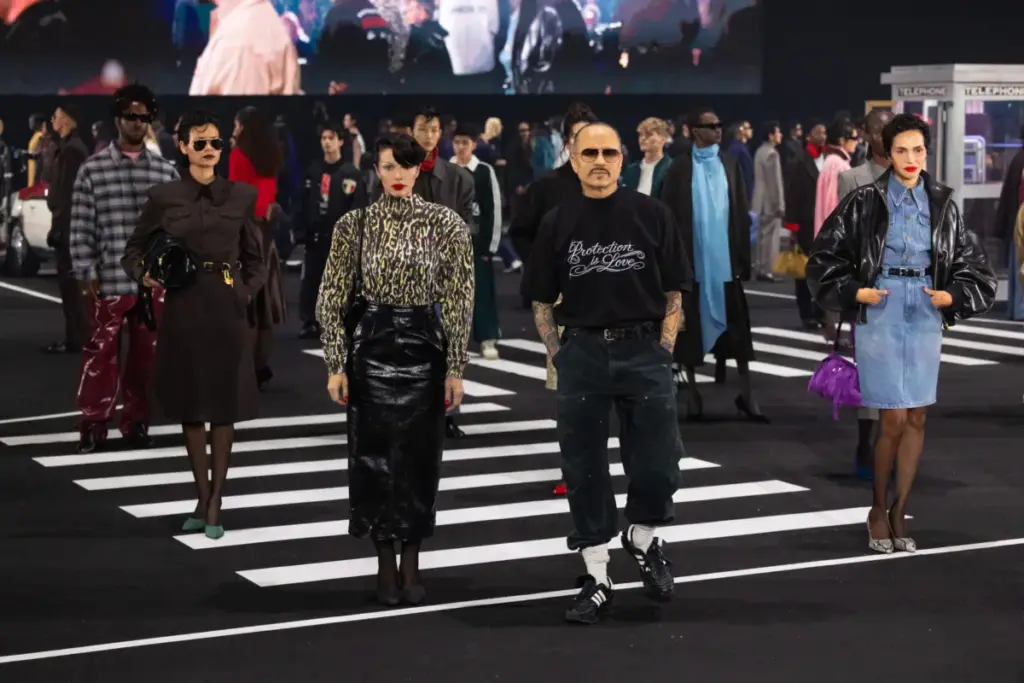
As the fashion industry looks toward the upcoming global menswear calendar—including Willy Chavarria’s next major presentation in Paris this January—the tension between physical spectacle and digital accessibility remains a central theme.
Chavarria is quick to acknowledge that digital storefronts cannot fully replicate the multisensory symphony of a physical runway show. Elements such as environmental lighting, spatial sound design, ambient room temperature, and the electric communal energy of a front-row audience belong strictly to the physical realm. However, he firmly believes that artificial intelligence can serve as a conduit, successfully carrying fragments of that emotional atmosphere across the digital divide and directly onto a consumer’s mobile screen.
The success of the Adidas collaboration has fundamentally altered Chavarria’s internal roadmap for future rollouts. By operating on a separate, dedicated storefront distinct from the main website, the brand proved that creating an isolated, highly thematic digital "world" for a specific capsule collection generates disproportionate consumer engagement and revenue. The designer expects to lean heavily into this modular approach for future creative partnerships and cross-brand collaborations.
More broadly, the implications for the luxury sector are profound. As generative voice models mature and virtual try-on technologies achieve hyper-realistic fidelity, the traditional static product grid will likely go the way of the paper catalog. Consumers will no longer passively scroll through rows of ghost-mannequin photography; instead, they will engage in fluid, multi-modal dialogues with digital avatars modeled after the very minds that birthed the collections.
When asked by industry insiders whether this technology will eventually infiltrate the sacred space of his live runway shows, Chavarria offered a knowing smile, hinting that he already has a conceptual framework mapped out. Whether that means virtual front-rows, AI-narrated digital broadcast streams, or fully synthetic post-show debriefs remains to be seen.
One thing, however, is certain: the era of the distant, silent fashion designer is coming to a close. Through the calculated embrace of artificial intelligence, voices like Willy Chavarria’s are preparing to speak directly, intimately, and continuously to every single customer in the room—no matter where in the world they happen to be sitting.