Executive Overview
When audiences think of Mary Shelley’s seminal 1818 gothic masterpiece Frankenstein, the immediate mental imagery is one of shadows, decaying laboratories, harsh sutures, and monochromatic misery. Yet, in director Yorgos Lanthimos’s cinematic adaptation of Poor Things—based on Alasdair Grey’s celebrated 1992 postmodern novel—the traditional gloom of the reanimation narrative is entirely upended. Instead of drab, industrial utilitarianism, the film explodes onto the screen in a riot of saturated technicolor, avant-garde textures, and anachronistic silhouettes that rewrite the sartorial rules of the late 19th century.
At the center of this visual revolution is protagonist Bella Baxter, brought to life through a breathtaking, fearless performance by Emma Stone. Following a dramatic suicide attempt and a radical, unorthodox brain-transplantation experiment orchestrated by the god-like, disfigured surgeon Godwin Baxter (Willem Dafoe), Bella is essentially an infant inhabiting an adult body. Her journey from a cloistered, language-learning ward of the state to a fiercely independent, sexually liberated traveler navigating the capitals of Europe is one of the most compelling coming-of-age arcs in contemporary cinema.
Crucially, this psychological and intellectual metamorphosis is charted not merely through dialogue or plot developments, but through clothes. Helmed by visionary costume designer Holly Waddington, the wardrobe of Poor Things acts as a dynamic secondary character. Eschewing strict historical accuracy in favor of a wild, chaotic, and organic interpretation of Victorian aesthetics, Waddington’s creations merge 1890s structural signifiers with contemporary street-style sensibilities. The result is a sartorial triumph that mirrors Bella’s expanding consciousness, her rejection of patriarchal constraints, and her ultimate arrival at self-actualization. This report provides an exhaustive examination of the film’s costume design, tracing Bella’s sartorial evolution from a sheltered experiment to a liberated modern woman.
Detailed Chronology: The Sartorial Evolution of Bella Baxter
The narrative arc of Poor Things is meticulously paced, and Holly Waddington’s costume design mirrors this chronological trajectory, shifting alongside Bella’s developing worldview, spatial boundaries, and emotional maturity.
Phase I: The Nursery Years – Structural Innocence and Restraint
When audiences first encounter Bella Baxter, she is trapped within the sterile, gilded cage of Godwin Baxter’s sprawling gothic estate. Her wardrobe during this initial phase reflects her psychological state: childlike, impulsive, and sheltered from the realities of the outside world. She moves through the corridors in voluminous, dramatic tops paired with playful pump trousers.
Waddington deliberately designed these early ensembles to look effortless yet slightly unhinged. Because Bella has spent years cut off from society and subjected to bizarre neurological manipulation, her early outfits possess an untamed quality. They are wide, billowing, and unrestrictive, accommodating her clumsy, erratic physical movements as she learns to walk, speak, and interact with her environment.
In stark contrast, her creator, Godwin—whom Bella affectionately and accurately dubs "God"—is clad in sober, austere garments rooted firmly in late-19th-century medical and academic traditions. His muted colors and rigid tailoring ground the scientific absurdity of the narrative, establishing a visual dichotomy between the controlled rigidity of the Victorian patriarch and the burgeoning, chaotic vitality of his creation.
Phase II: The Global Odyssey – Avant-Garde Rebellion and Street-Style Sensibilities
As Bella’s curiosity breaches the boundaries of Godwin’s estate, she embarks on a transformative journey across Alexandria, Paris, and London, accompanied by the hedonistic lawyer Duncan Wedderburn (Mark Ruffalo). This expansion of physical space triggers a radical explosion in her wardrobe.
The clothing of this era in the film functions as a vivid pastiche of historical Victorian silhouettes filtered through a hyper-modern, street-style lens. Waddington drew primary inspiration from the extreme fashion trends of the 1890s—notably the era’s obsession with oversized, structural sleeves—and shattered them.
Key ensembles from Bella’s travels include:
- The Lisbon & Transit Looks: A striking combination featuring a pristine white ruffled top paired with butter-yellow shorts, accessorized paradoxically with tiny black sunglasses, a cropped blue jacket, and modern-leaning ankle boots.
- The Pink Translucent Ensemble: Another variation of the signature ruffled white top, this time anchored by a flowing, semi-transparent magenta skirt that billows around Stone as she navigates bustling foreign ports.
- The Class-Consciousness Dress: During a pivotal sequence in Alexandria where Bella is abruptly confronted with real-world poverty and human suffering, her sudden awareness of her own upper-class status is physically manifested in a classic Victorian dress featuring exaggerated white puff sleeves.
These outfits do not merely decorate the screen; they actively narrate Bella’s intellectual awakening. They are loud, clashing, and unapologetically eccentric—visual markers of a mind devouring new experiences without the burden of societal conditioning.
Phase III: The Patriarchal Trap – Armor and Confinement
As the narrative progresses, Bella’s past catches up with her, and she briefly finds herself re-entangled in the oppressive, patriarchal conventions of high society through an arranged marriage to the aristocratic Alfie Blessington (Christopher Abbott).
To visually articulate the suffocating nature of this environment, Waddington pivoted away from the playful eccentricity of Bella’s travel wardrobe. Instead, she immersed historical 19th-century fashion photography to capture the literal and figurative entrapment of upper-class women during the period.
Emma Stone is thrust into an arresting, deeply serious aesthetic:
- The Royal Blue Coat Ensemble: A rigid, brilliantly tailored blue dress paired with a heavy, traditional wool coat that restricts her movement and commands absolute visual solemnity.
- The Copper Armor Dress: A metallic, copper-toned masterpiece accented with intricate golden filigree. The dress is constructed with such rigid geometric precision that it reads less like fabric and more like historical plate armor.
According to Waddington, these garments were engineered to create an immediate, visceral contrast with the free-flowing clothes Bella wore while discovering her autonomy. They are stunning, immaculately constructed, and utterly suffocating—symbols of a golden cage designed to crush her developing spirit.
Phase IV: True Self-Actualization – Liberation and De-escalation
The climax of Poor Things finds Bella successfully shedding the expectations, legal bindings, and psychological traumas inflicted upon her by the various men who sought to control her. Having returned to her scientific roots to study medicine alongside Godwin’s former assistant, Max McCandless, Bella arrives at a state of complete self-ownership.
In the film’s final moments, the frantic theatricality of the wardrobe dramatically recedes. Bella is no longer dressing to shock, to explore, or to project armor against a hostile world. She appears in a simple, understated cream-colored knit pullover paired with a rugged copper-toned maxi skirt.
Waddington describes this final aesthetic shift with elegant simplicity: "At that point, it’s just clothes." The wardrobe has finished its narrative work. The absence of exaggerated Victorian volumes, blinding colors, or structural artifice signals that Bella no longer requires sartorial exclamation points. She knows precisely who she is.
Supporting Context & Metrics: The Mechanics of Cinematic Surrealism
To fully appreciate the scale of the costume design in Poor Things, one must analyze the logistical and artistic parameters established by director Yorgos Lanthimos and executed by Holly Waddington’s workshop.
| Narrative Phase | Primary Silhouette | Dominant Color Palette | Psychological & Thematic Significance |
|---|---|---|---|
| The Nursery | Voluminous tops, pump trousers | Earthy tones, muted whites, clinical grays | Childlike innocence, unformed motor skills, domestic confinement. |
| The Odyssey | Ruffled blouses, micro-shorts, oversized sleeves | Magenta, butter-yellow, cobalt blue, stark white | Unfettered curiosity, cultural absorption, defiance of traditional morality. |
| The Trap | Structured corsetry, floor-length coats, metallic armor | Deep royal blue, copper, polished gold | Patriarchal subjugation, emotional imprisonment, class rigidity. |
| Resolution | Knitwear, unstructured maxi skirts | Cream, warm bronze, natural fibers | Complete self-actualization, autonomy, shedding of external projections. |
The Philosophy of "Wild and Organic" Textures
Waddington’s collaboration with Lanthimos was defined by a mutual desire to avoid museum-piece accuracy. While period dramas often obsess over authentic undergarments, hand-stitched buttonholes, and historically verified dyes, Poor Things actively subverts this academic rigor.
Lanthimos explicitly instructed Waddington to treat history as a malleable palette rather than a strict rulebook. By examining 1890s silhouettes—such as the iconic "gigot" or leg-of-mutton sleeves—Waddington sought out ways to warp those structures using modern textile treatments. Fabrics were deliberately manipulated to feel raw, unpredictable, and tactile. The clothing often features frayed edges, unusual weight distributions, and unconventional fabric combinations that give the impression of living organisms draped over the actors’ bodies.
The Iconic Bridal Intervention
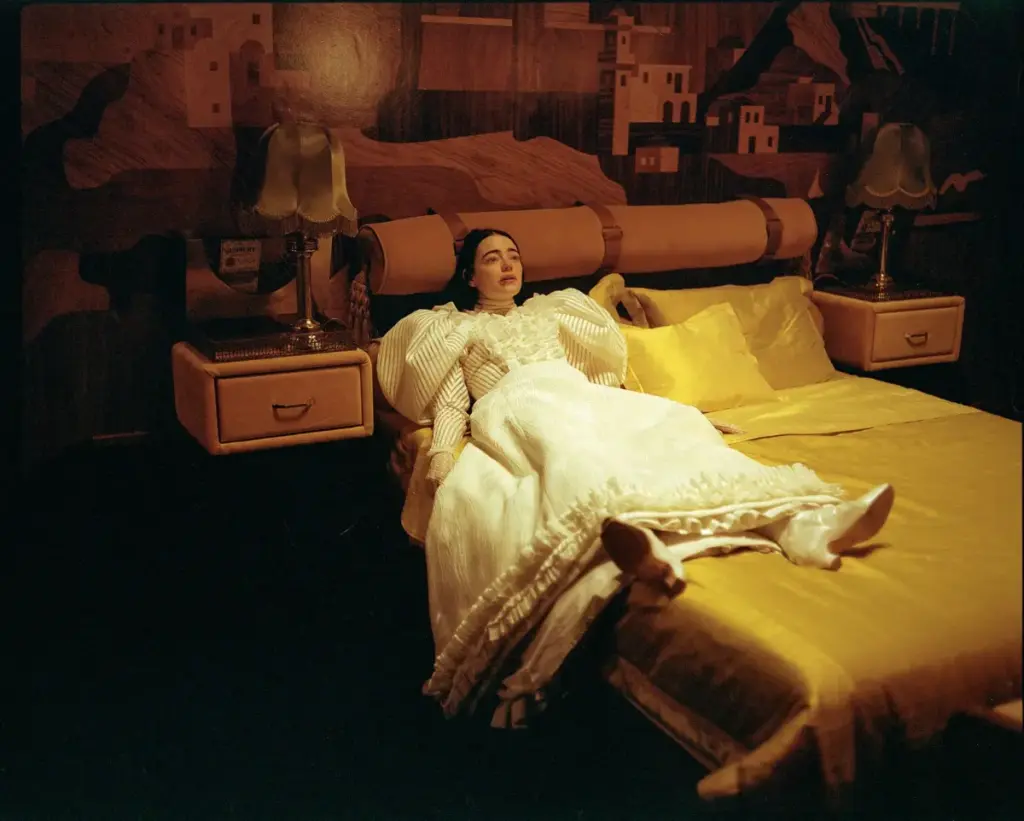
One of the most heavily discussed visual moments in the film is Bella’s unconventional wedding ensemble. The dress itself is a magnificent, billowing white bridal gown rooted in traditional Victorian pageantry. However, it is subverted by a singular, striking styling choice: the bridal veil is wrapped tightly across the lower half of Stone’s face.
Waddington revealed that she debated the inclusion of a traditional veil for days, fearing it was too cliché for a character as subversive as Bella. Ultimately, she decided to weaponize the tradition, binding the fabric over Stone’s visage. This single intervention transforms a symbol of bridal submission into an emblem of muted agency. Notably, this impromptu styling choice became Emma Stone’s favorite look from the entire production, encapsulating the film’s broader thesis of taking traditional cultural artifacts and bending them to radical new purposes.
Official Statements and Design Insights
The creative vision behind Poor Things has been thoroughly contextualized by its primary architects, offering profound insight into the intersection of performance, direction, and costume execution.
Holly Waddington on Escaping Historical Dictates
In discussions surrounding her design methodology, Waddington emphasized the psychological liberation that came with ignoring standard historical timelines:
“[Yorgos Lanthimos] didn’t want me to stay historically true with the costumes. I started my research by looking at the fashion of the 1890s—when huge sleeves were in trend—before adapting those looks to the imaginative plot of the film. I used Victorian silhouettes, but looked for ways to reinterpret the textures of the time. For me, they needed to feel wild, chaotic, and organic.”
This deliberate choice prevented the film from sinking into the dry, academic pastiche that frequently plagues historical fantasy. By injecting modern textural chaos into 19th-century frameworks, Waddington created a timeless, dreamlike alternate universe.
Character Psychology and Wardrobe Impulsivity
Waddington also highlighted how Bella’s background directly informed the physical construction and fit of her garments throughout the global tour:
“She has spent years not participating in the real world and has been brainwashed. That gives her a certain impulsivity—and I therefore liked the idea of putting her in effortless-looking yet striking clothes.”
This "effortless" quality is a masterclass in design trickery; while the garments are structurally complex and avant-garde, they are styled in a way that suggests Bella throws them on with complete indifference to societal propriety. She wears the clothes; the clothes do not wear her.
Future Outlook: The Legacy of Poor Things on Cinematic Costuming
As Poor Things continues to captivate global audiences and dominate critical conversations—backed by widespread recognition during the international awards season—its influence on the future of costume design is already becoming palpable.
For decades, historical fantasy and period pieces have been sharply divided into two camps: rigid, pedantic historical reconstructions or lazy, contemporary-infused modernizations that sacrifice atmosphere for audience accessibility. Poor Things has successfully carved out a brilliant third path: surrealist historical abstraction.
By proving that audiences will enthusiastically embrace a world where 1890s structural tailoring coexists with modern street-style color-blocking and radical feminist subtext, Waddington and Lanthimos have raised the bar for visual storytelling. Future filmmakers tackling period narratives will look to Poor Things as a masterclass in how to use fabric, silhouette, and color not as passive window dressing, but as an active engine for character development and thematic disruption.
Ultimately, Bella Baxter’s wardrobe is more than a collection of beautiful garments; it is a visual manifesto. From the oversized, chaotic infancy of her reanimated life to the streamlined, self-possessed comfort of her final frame, her clothes trace the arduous, beautiful journey of reclaiming one’s own body and mind from the machinery of the world.