Executive Overview
Few franchises carry the pure, unadulterated arcade nostalgia of Sega’s Crazy Taxi. Released at the turn of the millennium for the arcades and subsequently immortalized on the Sega Dreamcast, the series defined an era of vibrant, fast-paced, punk-rock-fueled gaming. Players worldwide fell in love with the simple yet exhilarating premise: pick up passengers, dodge chaotic city traffic, pull off outrageous stunts, and deliver fares to their destinations with seconds to spare—all to the iconic, roaring soundtrack of The Offspring.
More than two decades later, Sega is preparing to breathe new life into the franchise with Crazy Taxi: World Tour, slated for release in 2027 across PlayStation 5, Xbox Series X/S, Nintendo Switch 2, and PC.
Far from a simple graphical remaster, World Tour reimagines the core pillars of the 1999 classic for modern hardware. It introduces expansive open-world cities, deeper vehicle archetypes, strategic perk systems, and—most controversially—robust competitive online multiplayer. During a recent closed network test, players were given their first taste of this multiplayer mayhem, discovering a title that somehow transforms a quintessentially single-player time-attack experience into a high-octane, multiplayer demolition derby. Blending nuanced mechanical depth with the signature chaotic spectacle fans remember, Crazy Taxi: World Tour is shaping up to be one of the most surprising revivals of the modern gaming era.
Detailed Chronology: The Evolution of a Closed Network Test
The journey toward Crazy Taxi: World Tour has been long anticipated by the gaming community, punctuated by teases at major industry showcases and finally culminating in last weekend’s closed online network test. For participants, diving into the test was an exercise in sensory overload.
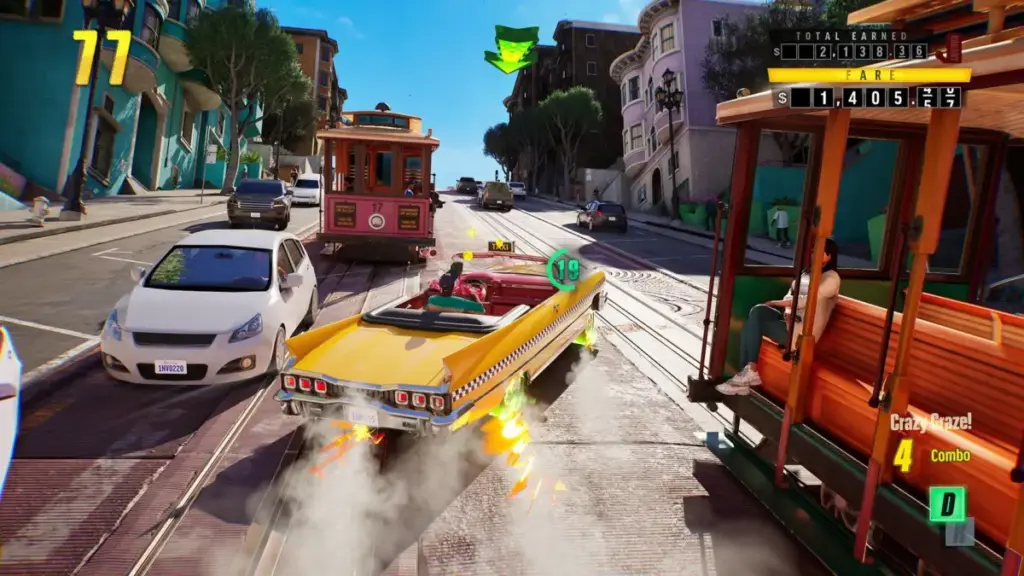
Recreating the frantic energy of the original game’s downtown San Francisco map—and multiplying that chaos by five competing taxis, denser traffic patterns, and a hard-fought finish line—turned each session into a petrol-guzzling tornado tearing through urban environments.
The Core Online Experience: Five-Player Races
The network test primarily showcased two online modes, the first being a five-player linear racing format. In this mode, participants must speed along a designated route, slamming on the brakes within specific drop-off and pick-up zones to gather passengers before rocketing toward their destinations.

On paper, a racing game built around the constant, jarring rhythm of stopping and starting every 20 seconds sounds counterintuitive to traditional racing fun. Yet, due to relentless pacing, completely destructible environments, and a surprisingly nuanced control scheme, the mode excels.
Players quickly learned that mastering the movement mechanics was paramount to survival and victory. Picking up passengers isn’t as simple as holding down the left trigger; doing so bleeds off momentum gradually. Instead, advanced drivers utilized input combinations—such as pressing the circle button followed by the left trigger—to execute a spark-filled, immediate stop known as the "crazy stop."
Conversely, getting moving again required an understanding of the "crazy dash." By timing rhythmic presses of the circle button alongside the right accelerator trigger, drivers could chain explosive bursts of speed across the asphalt. Overshooting a passenger zone similarly required quick-thinking execution, such as performing a reverse dash by hitting circle and left trigger. The resulting gameplay loop frequently resembled a high-speed rhythm game, requiring constant, rhythmic button inputs reminiscent of Guitar Hero, applied directly to vehicular traversal.
Strategic Nitrous Management and Combat Driving
Beyond basic acceleration and braking, World Tour introduces tactical depth through a robust nitrous system. Triggered via the triangle button, a burst of blue-flame acceleration sends path-clogging traffic scattering like fluttering litter.
More aggressive competitors discovered that saving their nitrous for moments when rival players were nearby allowed them to use their vehicles as battering rams. Striking an opponent with a nitrous-fueled charge hurls them out of line and temporarily shuts down their engine.
Furthermore, dangerous driving—including drifts, shunts, and massive airtime—directly builds nitrous reserves. In the San Francisco map, players launched their taxis off steep hill crests to farm juice before unleashing it on competitors around blind corners. Meanwhile, testing in the European-inspired map, which seamlessly blends a Cologne Cathedral lookalike with a distinct homage to Neuschwanstein Castle, offered entirely different tactical opportunities. The map’s endless twists and turns rewarded players who chained precise drifts, saving their reserves for a final, catastrophic rampage down a densely packed autobahn.

Cops and Robbers: The Experimental Palette Cleanser
The network test also offered a glimpse into a secondary online mode: Cops and Robbers. Set within a confined urban hub, one team of players operates taxi cabs attempting to pick up passengers, while a rival team of police cruisers actively hunts and rams them.
Causing sufficient structural damage to a taxi forces it into a fenced-in penalty car park, from which teammate taxis can only free them by smashing through the boundary walls. While playing as the law enforcement side offers a satisfying loop of high-speed pursuit and collision, the taxi experience feels more mixed. Being repeatedly crashed into and subjected to time-outs while other players continue unhindered carries a distinct similarity to Mario Kart‘s polarizing balloon-popping Battle modes. While it serves well as an occasional palette cleanser rather than the main event, the mode successfully shifts the dynamic from avoiding inert pedestrians to outsmarting active, moving targets.
Supporting Context & Metrics: Under the Hood of World Tour
While arcade spectacle remains at the heart of the experience, Sega has quietly introduced deep strategic layers beneath World Tour‘s chaotic surface.
Vehicle Archetypes and Customization
Players can choose from three distinct vehicle classes, each fundamentally altering how tracks must be navigated:
- The Racer: Built explicitly for blistering straight-line speed, this archetype struggles significantly, losing massive amounts of momentum upon impact with obstacles or other vehicles. Racer pilots rely heavily on nimble side-street evasion.
- The Heavy: A tank-like vehicle that carves effortlessly through heavy traffic and rival obstacles, though it falls short on long, open straights. Heavy drivers excel at staying within the pack and forcefully knocking opponents off course.
- The All-Rounder: A reliable, balanced compromise offering a steady mix of handling, acceleration, and durability.
In addition to vehicle selection, the game features a perk-based modification system. Players can theoretically equip perks to generate boost faster, sharpen cornering radii, and reduce off-road performance penalties. However, player feedback from the network test noted that while vehicle archetypes create palpable differences in strategy and routing, the individual perks currently lack noticeable impact in the heat of competition.
Audiovisual Presentation and Campaign Scope
No Crazy Taxi game would be complete without its auditory identity. World Tour delivers on this front with an aggressive rock and punk soundtrack highlighted by the return of classic tracks from The Offspring—including the legendary anthem "All I Want." Combined with fully destructible environments, screaming pedestrians, and flying urban clutter, the presentation is a sensory triumph.

When the full game launches in 2027, it will boast considerably more content than what was shown in the weekend network test. The complete package will feature:
- A mission-based single-player campaign spanning five open-world cities.
- A classic time-based arcade mode for purists.
- A fully fleshed-out suite of online competitive multiplayer modes.
Official Statements and Industry Reception
Sega’s decision to pivot a historically single-player arcade franchise into an online multiplayer arena initially raised eyebrows across the industry. Yet, early critical response from the closed network test has been overwhelmingly positive.
Industry analysts and preview participants have highlighted the sheer improbability of the concept working as well as it does. By marrying the precision-timing mechanics of classic score-attack games with modern, unpredictable multiplayer combat, Sega has managed to capture lightning in a bottle for a second time.
While official press statements regarding monetization, post-launch support, and exact regional server architectures remain tightly under wraps ahead of the 2027 release window, the development team’s willingness to experiment with community-driven network tests signals an open, feedback-oriented approach to the title’s final development phases.
Future Outlook
As the gaming industry looks ahead to Crazy Taxi: World Tour‘s launch in 2027, the title represents a fascinating turning point for Sega’s classic IP vault. The successful translation of a single-player arcade time-waster into a competitive, physics-driven multiplayer riot proves that classic game loops can evolve without losing their underlying soul.
Over the coming months, developers will undoubtedly fine-tune the balance between the frantic passenger-pickup loop and the aggressive combat mechanics, while likely tweaking the perk systems to make vehicle customization more meaningful. If subsequent beta tests and previews can maintain the chaotic momentum, color, and adrenaline of this initial network test, Sega might just have a massive critical and commercial hit on its hands. Crazy Taxi isn’t just back—it’s ready to take the whole grid down with it.