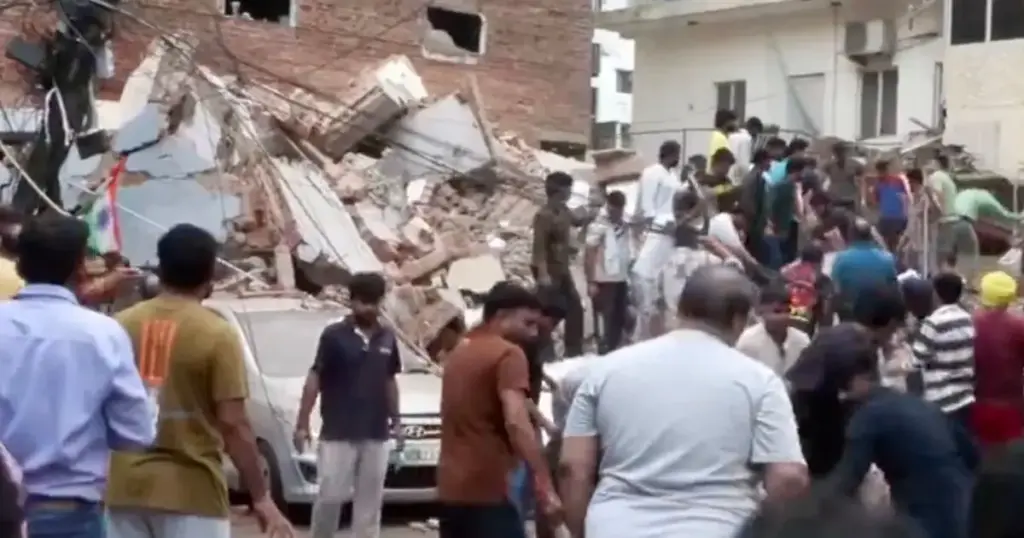
NEW DELHI — Emergency response teams are locked in a desperate, round-the-clock race against time in southwest Delhi following the catastrophic collapse of a multi-storey building on Sunday, September 6, 2026. The incident, which occurred near Satya Niketan in close proximity to Delhi University’s prominent South Campus and the Nanakpura Gurdwara, has triggered a massive, multi-agency rescue operation.
Authorities fear that numerous individuals—including a significant number of university students residing in the densely populated neighborhood—remain trapped beneath the unstable mountain of concrete, twisted rebar, and pulverized masonry. While early reports confirm that at least two individuals have been pulled alive from the wreckage, the precise number of victims still unaccounted for remains terrifyingly unclear as heavy machinery and specialized canine units comb through the debris.
Executive Overview
The structural failure occurred in the early afternoon, abruptly shattering the Sunday routine of one of Delhi’s bustling student-heavy localities. Satya Niketan, known for its high concentration of budget accommodations, student-focused eateries, and multi-storey residential blocks catering to Delhi University scholars, was instantly transformed into an active disaster zone.
Within minutes of the collapse, emergency airwaves were flooded with distress calls. The Delhi Fire Service, local police divisions, the Municipal Corporation of Delhi (MCD), and elite disaster mitigation personnel descended upon the site in a coordinated mobilization effort. Delhi Chief Minister Rekha Gupta personally intervened, overseeing the crisis response and ordering the immediate evacuation of adjacent properties to prevent secondary collapses as destabilized ground threatens neighboring structures.
As rescue crews deploy hydraulic cutters, thermal imaging equipment, and manual excavation techniques, the incident has once again cast a harsh, national spotlight on urban safety, regulatory enforcement, and the endemic vulnerabilities plaguing high-density residential zones across India’s metropolitan centers.
Detailed Chronology of the Disaster
Phase 1: The Collapse and Immediate Alert
The catastrophic event unfolded rapidly shortly after midday on September 6, 2026. According to official logs from the emergency response network, the Delhi Fire Service received its first urgent dispatch concerning a structural cave-in near Satya Niketan at precisely 1:33 PM local time.
Almost simultaneously, at 1:34 PM, a frantic call was logged at the South Campus police station. Callers reported the catastrophic failure of a multi-storey residential building situated perilously close to the well-known Nanakpura Gurdwara—a landmark that instantly helped pinpoint the disaster’s exact geographical coordinates for incoming responders.
Phase 2: Multi-Agency Mobilization
Realizing the gravity of the threat, dispatchers escalated the response level within minutes. Police patrols stationed in southwest Delhi were the first to arrive, sealing off the perimeter to clear vital corridors for incoming emergency vehicles and to hold back panicked crowds of onlookers and fellow students.
Shortly thereafter, multiple fire tenders from the Delhi Fire Service arrived, followed swiftly by advanced life support ambulances operated by the Centralized Accident and Trauma Services (CATS), civil defense volunteers, and municipal engineering teams. Recognizing that local municipal equipment might be insufficient to breach the heavier concrete slabs, authorities deployed a specialized team from the National Disaster Response Force (NDRF) alongside representatives from the Delhi Disaster Management Authority (DDMA).

Phase 3: The Ongoing Rescue Operation
By mid-afternoon, the site had transitioned into an intense, methodical excavation zone. Rescuers faced immediate hazards: shifting rubble piles, leaking utility lines, and the constant threat of a progressive collapse from structurally compromised walls standing adjacent to the crater.
Amidst the chaos, search and rescue teams managed to locate and extract two survivors within the first few hours of the operation. Both individuals were immediately stabilized by paramedics at the scene before being rushed to nearby trauma centers for urgent medical evaluation. However, as daylight began to wane, the primary focus shifted from rapid debris clearance to precise, acoustic and thermal probing to locate bodies or trapped survivors who may be breathing within hidden air pockets beneath the wreckage.
Supporting Context, Scale, and Metrics
The Student Population and Human Toll
The choice of Satya Niketan as a residential hub for Delhi University students stems from its proximity to the South Campus educational institutions. Thousands of young adults live in independent floors and multi-storey tenements constructed over decades to meet the relentless demand for student housing.
Because many of these buildings operate informally as rental properties, official tenant registries and occupancy logs are frequently non-existent or poorly maintained. This administrative vacuum has severely complicated the rescue effort; emergency commanders have no definitive manifest to cross-reference against the missing persons reports streaming in from distraught families and university peers.
While official governmental figures have maintained caution regarding exact headcounts, eyewitness testimonies shared with regional media outlets—such as reports broadcast via NDTV—suggest a far grimmer reality. Several witnesses on the ground claimed that upward of 50 students and residents could have been inside the structure or its immediate vicinity when the building buckled. If verified, the casualty and entrapment metrics could escalate significantly as heavy excavation unearths the deeper layers of the ruin.
Urban Infrastructure and Precautionary Evacuations
The structural failure has immediately triggered widespread anxiety regarding neighboring constructions in the Satya Niketan and RK Puram sectors. Many buildings in these densely packed neighborhoods share common walls or rely on aging, overburdened foundations originally designed for single-family dwellings but later vertically expanded to maximize rental income.
Acting on direct orders from the city administration, municipal engineers initiated the rapid, precautionary evacuation of structures immediately flanking the collapsed site. Families and students were forced to leave their belongings behind as structural engineers conducted rapid non-destructive testing to assess whether ground subsidence or compromised load-bearing walls threatened adjacent blocks with a domino-effect collapse.
Official Statements and Administrative Response
The disaster prompted immediate high-level political engagement and cross-agency coordination statements.
Delhi Chief Minister Rekha Gupta released a comprehensive public statement addressing the tragedy, emphasizing that every state resource had been mobilized to address the crisis:

"Deeply concerned by the building collapse incident at Satya Niketan, RK Puram. Teams from DDMA, NDRF, Delhi Fire Services, Delhi Police, MCD, CATS, and Civil Defence are carrying out rescue operations on a war footing. The adjacent building has been vacated as a precautionary measure.
Every possible effort is being made to safely rescue those trapped and provide immediate assistance to the affected families."
Gupta further assured the public that the administrative machinery was maintaining constant vigilance:
"The situation is being closely monitored, and all concerned agencies are working in coordination. The safety and well-being of every citizen remain our highest priority."
Local law enforcement agencies have announced that a formal inquiry will be launched once search-and-rescue operations conclude. The investigation is expected to scrutinize the building’s structural blueprints, municipal approval histories, historical alterations, and any potential violations of urban zoning and building codes. Property owners and municipal inspectors who oversaw the zone could face severe criminal liabilities if negligence or unauthorized vertical expansion is proven to be the proximate cause of the collapse.
Future Outlook and Systemic Implications
As rescue operations extend into the night, the immediate priority for the Delhi government, the NDRF, and emergency medical personnel remains singular: saving lives and locating every individual reported missing beneath the Satya Niketan debris. Floodlights have been erected around the perimeter to ensure that excavation and probing can continue uninterrupted through the dark hours.
Beyond the immediate human tragedy, this disaster serves as a stark, urgent warning regarding urban infrastructure resilience in India’s fast-growing capitals. With thousands of aging residential buildings housing transient student populations across Delhi, urban planners and civic bodies face renewed demands to enact sweeping structural audits, enforce strict zoning laws against illegal floors, and establish robust emergency response protocols tailored to high-density academic enclaves.
For now, an anxious city watches and waits, hoping against hope that the ongoing race against time yields more survivors from the dust of Satya Niketan.