Executive Overview
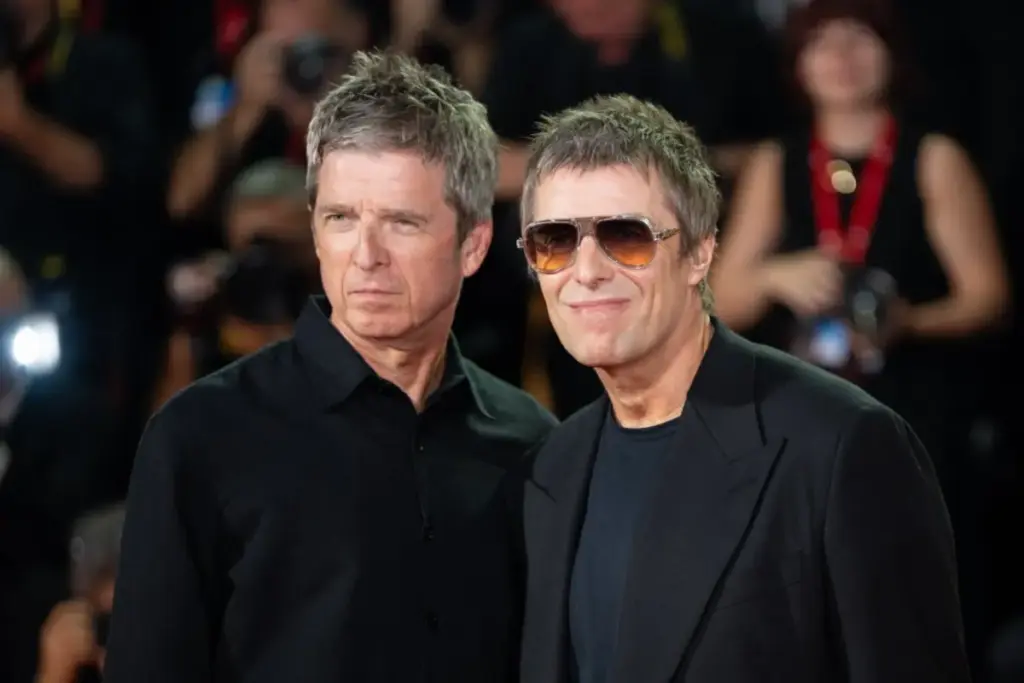
The sun-baked docks of the Lido played host to one of the most volatile and anticipated spectacles in modern music history as Noel and Liam Gallagher arrived at the 83rd Venice International Film Festival. The estranged brothers, whose legendary friction defined the Britpop era and ultimately led to a spectacular 16-year schism, stepped onto the red carpet to promote their new feature-length documentary, Oasis: Don’t Look Back in Anger.
The film, which blends high-octane concert footage with an unvarnished psychological autopsy of the brothers’ famously tempestuous relationship, serves as both a historical record and a living postscript to their blockbuster 2025 reunion tour. In true rock-and-roll fashion, the siblings offered a masterclass in calculated defiance: a swift, photogenic wave to the international press corps on the Venetian waterfront, followed by a total boycott of the traditional press conference circuit.
Directed by Dylan Southern and Will Lovelace and written by Steven Knight, Oasis: Don’t Look Back in Anger explores the enduring cultural gravity of an outfit that rose from the working-class terraces of Manchester in 1991 to conquer global charts. As the documentary gears up for an IMAX release via Disney on September 11, followed by a wider streaming rollout on Disney+, this moment captures Oasis at their most compelling: magnetic, unpredictable, and entirely on their own terms.
Detailed Chronology: From Working-Class Manchester to the Venetian Lido
The Genesis of a Phenomenon (1991–1995)
To understand the weight of the Gallagher brothers’ appearance in Venice, one must retrace the meteoric trajectory that began in Manchester three decades prior. Formed in 1991, Oasis quickly crystallized around the core creative engine of older brother Noel, whose knack for melding Beatles-esque melodic hooks with punk rock bravado yielded an unprecedented string of anthems.
The band’s 1994 debut album, Definitely Maybe, smashed records to become the fastest-selling debut album in British history at the time, debuting at No. 1. Yet, it was their sophomore effort, 1995’s (What’s the Story) Morning Glory?, that cemented their status as global icons. Propelled by generational touchstones like "Wonderwall," "Don’t Look Back in Anger," and "Champagne Supernova," the record became one of the best-selling albums in U.K. history, soundtracking the cultural zenith known as Cool Britannia.
The Paris Meltdown and 16-Year Exile (2009–2024)
Behind the stadium-filling hooks and chart dominance lay a simmering, volatile dynamic. The relationship between Noel and Liam was defined by mutual resentment, physical altercations, and verbal sparring that played out across front pages worldwide. Noel famously encapsulated his brother’s temperament by remarking that Liam was "the angriest man you’ll ever meet. He’s like a man with a fork in a world of soup."
Conversely, Liam maintained that the wounds inflicted by his brother ran deep. In a 2018 interview with The Guardian, Liam expressed bitter betrayal: "He did me out, mate, he threw me under the [expletive] bus, and I won’t forget that. He split the band up and it meant the world to me. Just to further his career."
That underlying toxicity reached its breaking point on August 28, 2009, backstage at the Rock en Seine festival in Paris. Moments before they were due to walk on stage, a violent altercation involving a flying plum, a shattered guitar, and deep-seated animosity brought the band to an abrupt and theatrical halt. Noel issued a statement later that night announcing he could no longer work with Liam for a single day longer, initiating a 16-year hiatus that left millions of fans convinced a reunion was an impossibility.

The 2025 Reunion and the Venice Premiere (2025–2026)
Against all odds, the cultural tectonic plates shifted in 2025. Ending over a decade and a half of icy silence, the Gallaghers announced a blockbuster reunion tour. Skeptics predicted a mid-tour implosion reminiscent of Paris, but the opening night in Cardiff, Wales, proved them wrong. Performing before an ecstatic, multi-generational crowd of over 60,000, a revitalized Oasis lineup—bolstered by legacy members Paul "Bonehead" Arthurs and Gem Archer on guitars, bassist Andy Bell, and drummer Joey Waronker—delivered a masterclass in stadium rock.
Critical reception was rapturous. The Associated Press noted at the time that foundational tracks like "Supersonic" and "Roll With It" sounded "as thunderous as ever and sparked mass sing-alongs."
This monumental reconciliation and subsequent tour form the spine of Oasis: Don’t Look Back in Anger. The documentary traces the fragile process of getting the brothers back into the same rehearsal room—capturing palpable tension every time Liam walked through the door—culminating in their first joint interview in a quarter-century. Their arrival in Venice for the world premiere serves as the latest chapter in a narrative that continues to defy conventional industry logic.
Supporting Context & Metrics: The Anatomy of a Cultural Legacy
The enduring footprint of Oasis is not merely a matter of nostalgic affection; it is quantifiable through commercial metrics, demographic shifts, and critical reassessment.
- Ticket Demand & Demographics: When the 2025 reunion tour tickets went on sale, digital queue lines numbered in the millions, crashing ticketing platforms globally. Crucially, market analysts noted that the audience spanned far beyond Gen X fans who lived through the 1990s; a vast percentage of ticket buyers belonged to Gen Z, discovering the band through streaming platforms and social media algorithms.
- Streaming Longevity: Tracks like "Wonderwall" maintain staggering streaming velocity, regularly pulling in millions of plays daily on platforms like Spotify. This cross-generational appeal forms the central thematic inquiry of screenwriter Steven Knight’s narrative framework for the documentary: why does this music continue to resonate with a demographic born long after the band’s initial disbandment?
- Production Craft: Directors Dylan Southern and Will Lovelace adopted an immersive, fly-on-the-wall methodology. During rehearsals, their explicit mandate was to render cameras invisible to the band, capturing authentic psychological friction without interference. During concert sequences, the objective shifted to a visceral, first-person perspective, augmented by intimate vignettes of superfans from diverse global backgrounds—including, memorably, an enthusiast who named their dog after guitarist Bonehead.
Official Statements and Director’s Vision
The artistic ambitions behind Oasis: Don’t Look Back in Anger extend far beyond a standard promotional vehicle. In their official directors’ statement, Southern and Lovelace articulated the multifaceted scope of the project:
"We set out to make a film about the reconciliation of two brothers, infamous for their volatile relationship, but we also wanted to make a film about the power of music and the way Oasis’ songs have continued to have a life of their own, as the band lay dormant for 15 years. The documentary, like the reunion and the tour, took on a life of its own."
Screenwriter Steven Knight echoed these sentiments, emphasizing that the collaboration with Noel Gallagher was rooted in a mutual desire to deconstruct the mythos of British rock royalty. By interrogating the friction between the brothers’ public personas and their private vulnerabilities, the filmmakers managed to pierce the armor of two of rock’s most guarded figures.
Future Outlook: The Road Ahead for Oasis
As the dust settles on the Lido and the festival crowds disperse, the immediate commercial horizon for the Oasis empire is exceptionally bright.
- The Theatrical Rollout: Disney’s strategic deployment of the film guarantees high visibility. An exclusive IMAX release on September 11 will offer audiences a hyper-scaled, cinematic concert experience, leveraging large-format sound systems to replicate the thunderous acoustic impact of the 2025 stadium tour.
- Streaming Integration: Following its theatrical window, Oasis: Don’t Look Back in Anger will debut on Disney+ later this year, ensuring global accessibility for fans who could not secure festival access or theatrical tickets.
- Long-Term Legacy: The documentary and the ongoing cultural dialogue surrounding their reunion solidify Oasis’ status as a permanent fixture of contemporary music history. Whether the fragile truce between Noel and Liam will endure long-term remains an open question—one that keeps both the press and the public perpetually transfixed. Yet, as the events in Venice demonstrate, whenever the Gallagher brothers share a room, the entire cultural landscape pays attention.