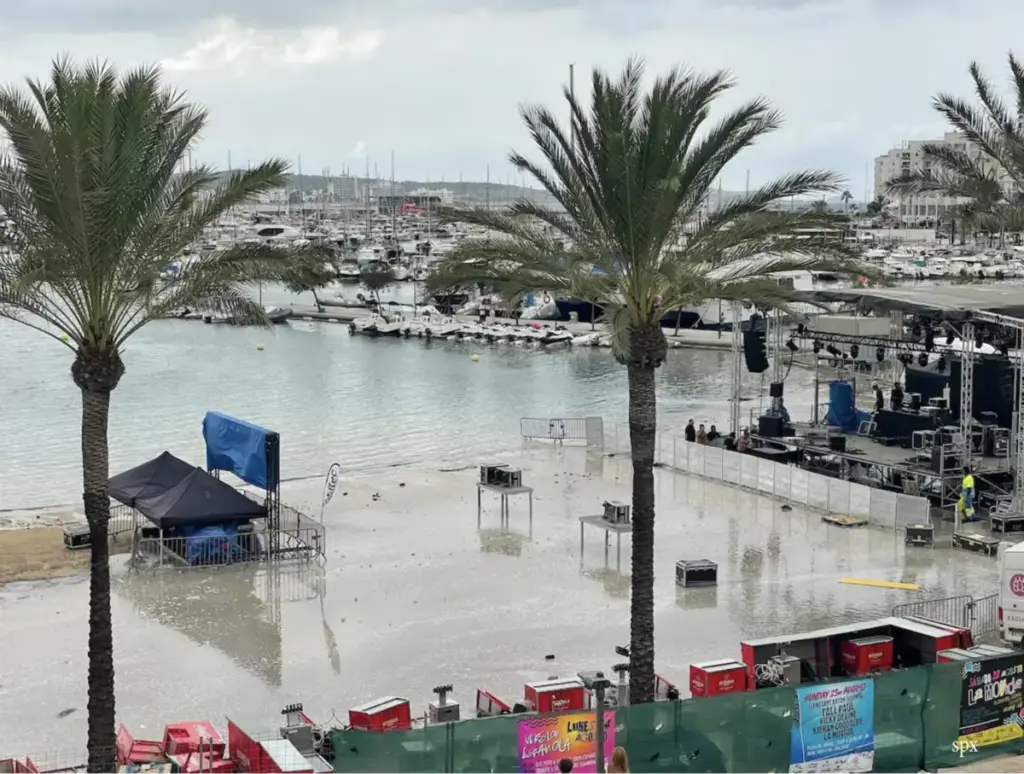
The height of the Mediterranean summer holiday season took a dramatic and frightening turn as a series of rare, fast-moving meteorological phenomena struck the Balearic Islands. Often described locally as "mini-tsunamis" or rissagues, sudden and aggressive surges of seawater breached coastlines across Ibiza and Majorca, overwhelming popular beaches, flooding waterfront hospitality venues, and sending panicked sunbathers scrambling for higher ground.
The unexpected oceanic surges—triggered not by seismic activity, but by volatile atmospheric pressure changes—transformed tranquil tourist hubs into chaotic scenes reminiscent of coastal storms. In San Antonio, Ibiza, the sudden inundation swept away event infrastructure and forced the immediate cancellation of high-profile evening entertainment. Meanwhile, ports across Majorca and standby zones in Menorca experienced rapid, violent fluctuations in sea level, underscoring the unpredictable and increasingly volatile nature of modern Mediterranean weather patterns.
While miraculous early reports indicate zero casualties or severe injuries, the environmental shockwaves have left local authorities, tourism boards, and holidaymakers on high alert. This extensive report examines the chronology of the event, the atmospheric mechanics behind rissagues, historical precedents in the Balearics, and the broader implications for Mediterranean coastal tourism in an era of shifting climatic baselines.
Detailed Chronology: How the Crisis Unfolded
The sequence of events began in the early hours, catching both locals and tourists completely unawares.
Morning Inundation in San Antonio
At approximately 7:55 AM, long before the peak beach crowds had settled onto their towels, the initial surge struck the Platja de s’Arenal beach in the vibrant Ibizan party resort of San Antonio. Unlike wind-driven storm surges or breaking tidal waves, the water arrived with an eerie, deceptive momentum. The sea level rose rapidly by a recorded 86 centimeters (2.8 feet) within minutes, spilling stealthily over the sandy shoreline and pushing deep into the urban fabric of the resort.
Footage captured by early-rising holidaymakers showed seawater silently bubbling up through drainage grates and washing over promenades. Beachgoers rushed to rescue personal belongings as coolers, plastic storage containers, and newly installed beach bars intended for an upcoming open-air event were unceremoniously swept away by the creeping tide. Water poured directly onto the outdoor terraces of beachfront restaurants, forcing staff and early diners to retreat indoors as chairs and tables drifted in the shallow brine.
Expansion Across the Archipelago
By mid-morning, the meteorological anomaly was not confined to Ibiza. Coastal monitoring stations registered parallel disturbances across neighboring islands. Majorca’s picturesque ports—including Alcudia, Andratx, and Sóller, alongside Port Adriano in Calvià—began reporting sudden, dramatic oscillations in sea level.
In Puerto Alcudia, seawater aggressively spilled onto the beachfront promenade. Tourists enjoying morning coffees at terrace cafes found themselves lifting their feet as saltwater lapped around table legs. Further north, the historic port town of Ciutadella in Menorca was placed on high emergency standby. Civil protection agencies warned that sea levels in the narrow harbor could swing by up to 1.2 meters (four feet) in a matter of minutes, prompting harbor authorities to secure moored vessels and restrict public access to vulnerable pier walkways.
Evening Cancellations and Security Standdowns
As the day progressed, weather chiefs issued severe amber alerts warning of potential secondary surges. In San Antonio, municipal authorities convened an emergency meeting regarding a heavily publicized tribute concert celebrating the legacy of a legendary Spanish rock band, scheduled to take place directly on the beachfront.
Citing "strict security reasons" and the unpredictability of further coastal flooding, local officials pulled the plug on the event. The concert area, already waterlogged and stripped of its temporary infrastructure during the morning surge, remained closed off as police and civil protection teams monitored the receding tide lines.
Supporting Context and Metrics: Understanding the Rissague
To the untrained eye, the events unfolding across the Balearics looked precisely like a tsunami—the terrifying wall of water typically associated with undersea earthquakes, volcanic eruptions, or submarine landslides. However, experts stress that the Mediterranean phenomena were fundamentally different in origin, mechanism, and physical behavior.
The Science of Rissagues
Referred to in Catalan as rissagues, these events are classified scientifically as meteorological tsunamis, or meteotsunamis. They are generated by atmospheric gravity waves—rapid, localized fluctuations in barometric pressure caused by severe weather fronts, storm cells, or upper-air atmospheric instability passing over the sea surface.
When a sharp spike or drop in atmospheric pressure occurs over a shallow shelf of water, it acts like an invisible piston, depressing or pulling up the surface of the sea. If the speed of the atmospheric disturbance matches the speed of the long ocean waves moving through the shallow water basin (a phenomenon known as resonance), the energy amplifies exponentially. As this wave train hits narrow coastal inlets, bays, or harbors, it can cause sea levels to rise and fall dramatically over periods ranging from a few minutes to several hours.
Key Metrics of the Event
Initial Surge Height: The primary wave spike measured approximately 86 centimeters (2.8 feet) upon hitting the Ibizan coastline just before 8:00 AM.
Geographical Spread: Impact zones spanned multiple islands, heavily affecting Ibiza (San Antonio) and Majorca (Alcudia, Andratx, Sóller, and Port Adriano), with Menorca (Ciutadella) placed on severe alert for oscillations reaching up to 1.2 meters (4 feet).
Duration: While the most violent pressure anomalies occurred over a matter of hours, atmospheric instability and amber warnings remained active throughout the day, forcing municipal shutdowns well into the evening.
Historical Precedents: The Balearic Islands’ Vulnerability
While meteotsunamis can occur globally—frequently documented in the Great Lakes of North America, the Adriatic Sea, and parts of Japan—the Balearic Islands, particularly Menorca and parts of Majorca, are uniquely susceptible due to their bathymetry and geographical positioning relative to African and European air mass collisions.
The Devastating 2018 Precedent
The recent flooding in Ibiza and Majorca immediately evoked memories of the severe meteotsunami event of July 2018. During that summer, powerful rissagues battered the Balearics, with water levels oscillating by as much as five feet in places like Ciutadella’s harbor.
In 2018, the surges were significantly more violent than the recent 2026 event. Coastal roads in Majorca were submerged under rapid torrents of seawater, beach bars and restaurant terraces were heavily damaged, and multiple boats were violently torn from their moorings, crashing into one another before being dragged out to sea by powerful undertows. Viral videos from that year showed tourists fleeing frantically as churning sea currents surged inland, turning pedestrian walkways into raging marine rivers.
Meteorologists note that while events of the 2018 magnitude are rare, the frequency of anomalous atmospheric disturbances appears to be tracking alongside shifting global climate patterns, which bring warmer Mediterranean sea temperatures and increasingly volatile atmospheric mixing during the peak summer months.
Official Statements and Immediate Responses
The swift and coordinated response of local emergency services prevented what could easily have translated into a major human tragedy.
Civil Protection and Municipal Action
The Balearic Government’s Directorate General for Emergencies maintained an amber weather alert throughout the duration of the storms and subsequent sea-level anomalies. Civil protection teams deployed rapid-response units to San Antonio and Puerto Alcudia, establishing perimeter controls around vulnerable coastal promenades to prevent onlookers from placing themselves in unnecessary danger.
A spokesperson for the San Antonio municipal council issued a brief statement following the cancellation of the evening concert:
"The safety of our residents and visiting tourists remains our absolute priority. While we understand the disappointment regarding the evening’s entertainment events, the sudden and unpredictable nature of the rissagues poses an unacceptable risk to infrastructure and public safety in coastal zones. We urge all beachgoers and hospitality operators to respect ongoing weather warnings and local advisories."
Hospitality and Tourism Impact
Local business owners expressed a mixture of shock and resilience. Waterfront restaurant operators in San Antonio, many of whom spent hours clearing debris, mud, and residual seawater from their dining rooms, noted that the sudden influx of water disrupted the morning service rhythm entirely. However, insurance assessors and municipal cleanup crews were quick to mobilize, ensuring that basic commercial access was restored by late afternoon.
Future Outlook: Climate Change, Tourism, and Coastal Resilience
As the floodwaters recede and the amber weather warnings are gradually downgraded, the events in Ibiza and Majorca have triggered serious conversations among urban planners, climatologists, and tourism authorities regarding the long-term resilience of Mediterranean coastal infrastructure.
The Changing Face of Mediterranean Summers
For decades, millions of international travelers have envisioned August in the Balearics as a period of predictable sunshine, calm azure waters, and uninterrupted relaxation. However, meteorological experts warn that extreme weather events—ranging from sudden torrential downpours and flash floods to atmospheric phenomena like meteotsunamis—are becoming a more prominent feature of the regional climate profile.
Warmer sea surface temperatures store greater amounts of latent heat and moisture, feeding energy into the atmospheric pressure systems that generate rissagues. Consequently, local forecasting agencies are investing heavily in advanced marine-atmospheric sensors designed to provide earlier and more accurate warnings for coastal municipalities.
Adapting Tourism Infrastructure
For tourism-dependent economies like Ibiza and Majorca, the challenge lies in balancing open, accessible coastal spaces with robust disaster preparedness. Urban planners are increasingly examining the need for:
Early-Warning Systems: Integrating real-time barometric and sea-level sensors directly linked to public notification systems and beach lifeguard networks.
Resilient Waterfront Design: Constructing flexible, easily cleared commercial terraces and drainage systems capable of handling sudden marine overflows without suffering catastrophic structural damage.
Public Education: Ensuring that tourists and seasonal workers are educated on the difference between traditional tidal hazards, seismic tsunamis, and meteorological rissagues, ensuring rapid compliance with safety protocols.
For now, the tourists of San Antonio and Puerto Alcudia have returned to the beaches, brushing off the surreal experience of watching the Mediterranean Sea swallow their sun loungers. Yet, the 2026 rissagues serve as a stark, humbling reminder of nature’s unpredictable power—proving that even in the height of mid-summer leisure, the sea ultimately dictates its own terms.