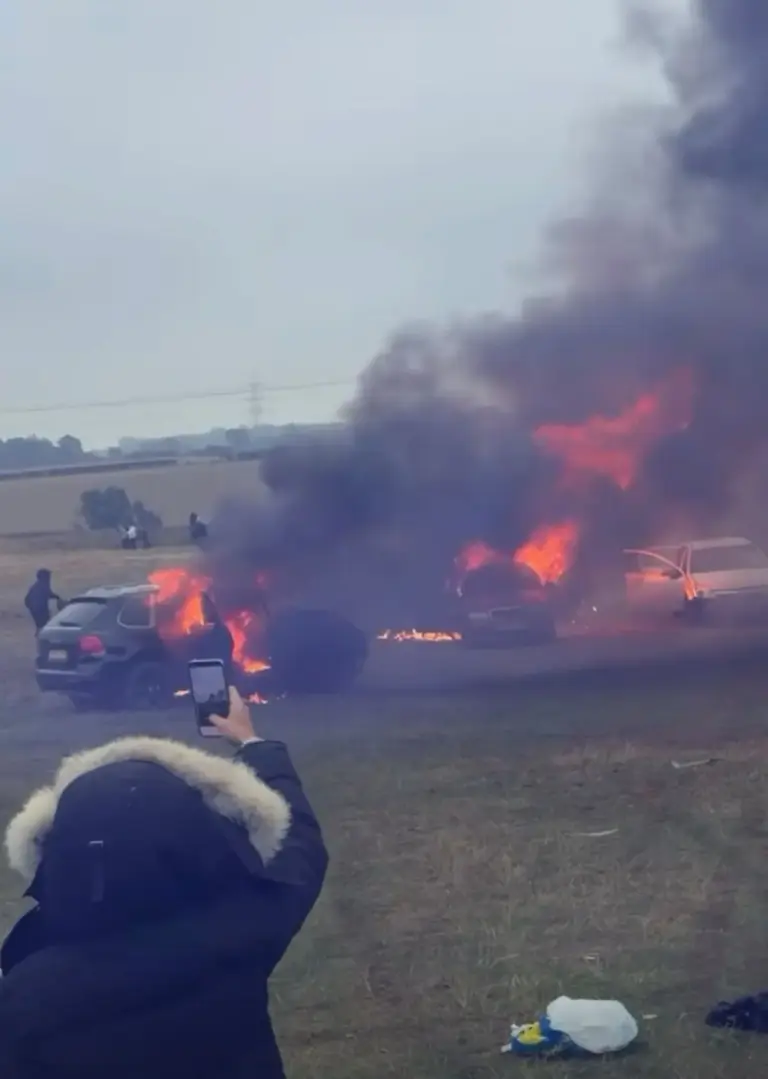
BARNSLEY, UK — Emergency services remain locked in a tense overnight operation in South Yorkshire following a severe industrial fire that broke out at a commercial scrap yard. The high-consequence incident, centered on Boulder Bridge Lane in the Carlton area of Barnsley, has triggered a massive multi-agency response, mobilizing at least eight fire engines alongside a suite of specialized tactical support vehicles.
Thick, billowing plumes of toxic black smoke have dominated the local skyline, visible for miles across the region and prompting urgent public health warnings from local authorities. As firefighters battle intense heat and challenging structural hazards within the facility, residents living in the immediate vicinity have been placed under strict shelter-in-place advisories, with officials urging the public to keep all doors and windows sealed tight against hazardous airborne particulates.
Executive Overview
The unfolding emergency began late on Saturday evening, September 5, 2026. The South Yorkshire Fire and Rescue Service (SYFRS) received the first wave of emergency calls reporting a rapidly escalating fire at a scrap processing and storage facility situated along Boulder Bridge Lane in Carlton, Barnsley.
Due to the combustible nature of the materials typically housed within industrial scrap yards—ranging from crushed automobiles and compressed metals to plastics, residual fluids, and industrial machinery—the fire spread with alarming velocity. Within minutes of the initial alarm, a towering column of dense, carbon-heavy smoke engulfed the area, prompting widespread concern among local residents and generating a flood of dramatic imagery across social media platforms.
Recognizing the severe potential scale of the incident, fire control room commanders rapidly escalated the response tier. A total of eight pumping appliances, backed by specialized operational and technical support units, were dispatched to the scene. Incident commanders are currently coordinating a defensive and offensive attack strategy aimed at containing the blaze, protecting adjacent properties, and mitigating environmental fallout.
While no official casualties have been confirmed at this early stage of the operation, the disruption to the local transport network and the immediate environment has been profound. Emergency services have cordoned off key access routes, and motorists have been explicitly warned to avoid the Boulder Bridge Lane corridor and surrounding industrial sectors until further notice.
Detailed Chronology of Events
The Initial Outbreak and Escalation
The incident commenced shortly before nightfall on Saturday, September 5, 2026. Reports indicate that the fire broke out within the main storage and processing yard of a commercial scrap facility on Boulder Bridge Lane, Carlton.
Early witnesses living near the industrial perimeter reported hearing a series of muffled pops and bangs—sounds typically associated with combusting fuel tanks, pressurized canisters, or rapidly heating metallic components found within scrap processing environments. Within a remarkably short window, what may have started as a localized ignition quickly escalated into a roaring industrial inferno. The combustion of mixed industrial waste, rubber tires, and automotive components fueled a towering firestorm that produced an oppressive, soot-laden smoke cloud.
The Emergency Response Mobilization
At approximately 23:26 BST, South Yorkshire Fire and Rescue Service officially confirmed the deployment of major firefighting assets to the location. The initial dispatch included a heavy concentration of urban search and rescue, water carrier units, and aerial ladder platforms designed to pour high volumes of water onto the seat of the fire from an elevated perspective.
As fire crews arrived on the scene, they were confronted with extreme radiant heat and volatile fire conditions. Tactical commanders immediately established an exclusion zone, deploying firefighters equipped with full respiratory protection apparatus and thermal imaging equipment. The primary objective during these critical opening hours has been to establish water relays—drawing from local hydrants and natural water sources if necessary—to maintain an uninterrupted, high-pressure deluge onto the burning scrap piles.
Overnight Operations and Containment Efforts
As the clock ticked past midnight into Sunday morning, operations transitioned into a protracted, grinding battle of attrition. Scrap yard fires are notoriously difficult to extinguish due to the sheer density of the compacted materials, which can trap pockets of unburned fuel and oxygen beneath layers of debris. Firefighters have had to work methodically, utilizing heavy plant machinery—often operated in tandem with site staff—to break apart compressed metal stacks, allowing water to penetrate deep-seated fire pockets.
Despite the darkness and the heavy atmospheric pall, emergency personnel have maintained a relentless containment perimeter, successfully preventing the flames from jumping to neighboring industrial units or nearby residential zones.
Supporting Context & Metrics
The Industrial Landscape of Carlton and Barnsley
Carlton, situated in the metropolitan borough of Barnsley, South Yorkshire, features a blend of historical industrial heritage and modern commercial logistics. Areas like Boulder Bridge Lane often host heavy industrial enterprises, including metal recycling facilities, automotive dismantling yards, and manufacturing depots. While these businesses play a vital role in the circular economy and local industrial employment, they inherently present elevated fire risks due to the concentration of flammable and combustible materials.
Scrap Yard Fire Dynamics: A Tactical Nightmare
From a fire engineering perspective, scrap metal recycling facilities represent some of the most complex environments for emergency responders. Several key factors compound the danger during an incident of this magnitude:

- High Fire Load: Compressed vehicles often contain residual fuel, oils, plastics, batteries, and synthetic upholstery, creating a volatile chemical cocktail when ignited.
- Deep-Seated Combustion: Because materials are tightly baled or stacked in towering piles, fire can tunnel deep inside the core of a stack, remaining insulated from surface water application.
- Thermal Radiation: The intense heat output of burning scrap can cause structural steel components to buckle, creating collapse hazards for firefighters operating near the perimeter.
- Environmental Runoff: The large volumes of water required to suppress industrial blazes inevitably mix with heavy metals, oils, and industrial chemicals, necessitating careful environmental containment to prevent local watercourse contamination.
Public Safety and Air Quality Metrics
The most immediate public concern during the Barnsley blaze has been air quality. The combustion of mixed industrial waste releases a complex mixture of particulate matter (PM2.5 and PM10), carbon monoxide, volatile organic compounds (VOCs), and potentially toxic combustion byproducts.
Health authorities note that inhaling dense smoke can irritate the respiratory tract, exacerbate underlying conditions such as asthma and chronic obstructive pulmonary disease (COPD), and pose acute risks to vulnerable populations, including the elderly and young children. This explains the absolute urgency behind the shelter-in-place directives issued for Carlton and surrounding neighborhoods.
Official Statements and Public Guidance
South Yorkshire Fire and Rescue Service (SYFRS)
In their primary operational updates released via official channels and media briefings, the South Yorkshire Fire and Rescue Service maintained a clear, cautionary stance:
"We currently have 8 fire engines and a number of specialist vehicles at an incident on Boulder Bridge Lane, Carlton, Barnsley.
Please avoid the area while crews work to bring this incident under control. Anyone living nearby should keep their doors and windows closed due to a large amount of smoke in the area."
Operational commanders have praised the swift response of regional fire crews and control room staff, who managed the sudden influx of emergency calls and rapidly coordinated multi-station asset deployment.
Local Authority and Police Coordination
South Yorkshire Police and local municipal authorities have also been heavily involved in securing the perimeter, implementing emergency road closures along Boulder Bridge Lane and surrounding approach roads, and managing traffic diversions to ensure clear transit corridors for arriving and departing fire appliances.
Police officers have reinforced the fire service’s messaging, patrolling nearby residential streets to advise citizens to remain indoors and urging curious onlookers to stay well clear of the operational zone to prevent hampering emergency vehicle movement.
Future Outlook & Next Steps
Transition to Investigation and Cooling Operations
Once the active flames are fully beaten back and suppressed, the incident will enter its critical cooling and overhaul phase. Fire service personnel, supported by thermal imaging drones and specialized infrared cameras, will spend hours scanning the wreckage for hidden hot spots capable of re-ignition.
Following complete extinguishment, the focus will shift toward a rigorous joint investigation involving SYFRS fire investigation officers, local council environmental health teams, and potentially national regulatory bodies such as the Environment Agency.
Investigating the Origin and Cause
Determining the exact cause of a scrap yard fire is notoriously challenging given the extensive destruction of the physical evidence. Investigators will look at multiple hypotheses:
- Spontaneous Combustion: Chemical reactions or the decomposition of organic/oily waste within compressed piles under high ambient temperatures.
- Mechanical Friction: Sparks generated during the prior processing, shearing, or sorting of metal items.
- External Ignition Sources: Discarded smoking materials, electrical faults in site infrastructure, or malicious intervention.
- Lithium-Ion Battery Ignition: An increasingly prevalent hazard in modern waste and recycling facilities, where discarded consumer electronics or vehicular batteries inadvertently enter the scrap stream and trigger violent thermal runaways.
Long-Term Implications for Site Operators and Local Residents
This incident is expected to prompt renewed scrutiny regarding safety protocols, hazard management, and environmental compliance at industrial recycling facilities across South Yorkshire. Local residents and community representatives will likely demand accountability regarding the proximity of such high-risk industrial operations to populated residential areas.
As recovery operations continue through the weekend, authorities have reiterated that updates will be provided via official municipal and emergency service communication channels. In the interim, public cooperation remains paramount: motorists must continue to steer clear of Boulder Bridge Lane, and residents within the smoke plume’s footprint must maintain their precautionary window and door closures until all residual hazards are fully neutralized.