Executive Overview
The enduring allure of Earth’s highest peak has long been summarized by British mountaineer George Mallory’s apocryphal rationale: "Because it’s there." Yet, modern extreme sports have pushed past the simple geometry of scaling a summit. Today’s elite adventurers seek to conquer the insurmountable by pairing historic climbs with perilous descents—skiing down faces of ice and vertical rock where a single miscalculation means instantaneous death.
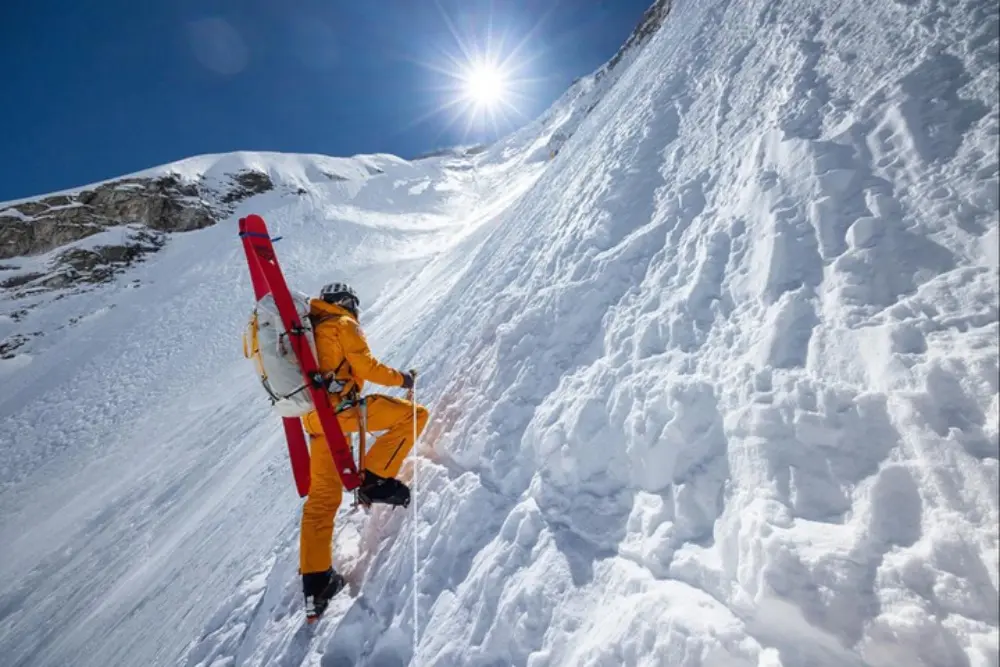
Everest: The Other Side, the latest documentary from Academy Award-winning directing duo Elizabeth Chai Vasarhelyi and Jimmy Chin (Free Solo), captures this precise intersection of high-risk ambition and visceral tragedy. The film chronicles elite ski-mountaineer Jim Morrison, his late partner and legendary mountaineer Hilaree Nelson, and their shared obsession with carving a ski descent down the treacherous north face of Mount Everest.
What begins as an awe-inspiring exploration of human potential, however, shifts into a sobering meditation on the ethics of extreme sports filmmaking when tragedy strikes. Approximately thirty minutes into the runtime, the documentary reveals that Nelson lost her life during the expedition, caught in a small avalanche that swept her nearly 6,000 feet down the mountain on September 26, 2022.
Rather than pivoting into a deeply introspective examination of the hubris, grief, and moral complexities surrounding extreme risk-taking, Everest: The Other Side presses forward with a gung-ho cinematic momentum. The film attempts to frame Morrison’s subsequent completion of the descent as a cathartic tribute to Nelson and others he has lost. Yet, this narrative choice leaves many viewers grappling with a profound ethical dissonance: Can an enterprise defined by fatal self-indulgence truly be framed as a triumph?
This review and investigative breakdown examines the documentary’s structural choices, the haunting interpersonal dynamics of its subjects, the erasure of marginalized labor on the mountain, and the troubling glorification of adrenaline-fueled recklessness under the prestigious banner of documentary adventure.
Detailed Chronology: The Ascent, the Avalanche, and the Aftermath
To understand the emotional and structural turbulence of Everest: The Other Side, one must trace the timeline of events that transformed a celebratory project into a memorial expedition.
The Genesis of a Dream
The project began with an ambitious, celebratory premise: follow one of the world’s most accomplished couples—Jim Morrison and Hilaree Nelson—as they pursued a historic first descent on skis down Mount Everest’s formidable north face. Vasarhelyi and Chin approached the production with the same breathless, celebratory aesthetic that defined their 2018 smash hit Free Solo, which followed daredevil rock climber Alex Honnold. Early footage showcases the couple’s vibrant partnership, shared passion, and the palpable tension between their domestic responsibilities and their relentless drive for high-altitude glory.
Nelson, notably self-aware, wrestled openly with the friction of motherhood. Archive interviews capture her frustration with gendered expectations:
"People ask, ‘How do you find the balance,’ and I want to punch them,"
she remarks, reflecting on the chasm between her maternal obligations to her young sons, Grayden and Quinn, and her compulsion to scale the world’s most dangerous peaks. Yet, she rationalizes her choices with a poignant pragmatism: "What I can do is love my kids today when I see them. What else can I do?"
The Turning Point: September 26, 2022
These words acquire a haunting resonance midway through the documentary. On September 26, 2022, while navigating the slopes of Nepal alongside Morrison, Nelson was struck by a small avalanche. The resulting fall sent her tumbling nearly 6,000 feet to her death.
In a directorial choice that has drawn criticism for its sensationalism, Vasarhelyi and Chin present this devastating event almost as a narrative plot twist. Up to this point in the film, viewers unfamiliar with the real-world tragedy are given no indication that Nelson—the vibrant, driving force of the narrative—has already passed away.
The Push to the Finish
Following Nelson’s death, the documentary faces a crossroads. For filmmakers who counted the couple as close personal friends, the tragedy offered an opportunity to interrogate the fatal calculus of modern mountaineering. Instead, the project leans into a conventional, momentum-driven narrative: the show must go on.
Driven by grief and a complex network of past bereavements, Morrison fixates on completing the world-first ski descent. To him, the act serves as both personal vindication and a transcendent monument to Nelson’s memory. Chin—himself a father of two—joins the perilous mission, casting aside potential misgivings to support his grieving friend. The documentary tracks their progress alongside a massive camera crew, culminating in a successful physical descent that the filmmakers treat as a spiritual victory.
Supporting Context & Metrics: The Human and Environmental Cost
While Everest: The Other Side immerses viewers in sweeping vistas, brilliant white snow, and the neon-yellow punctuation marks of high-altitude gear, it largely sidesteps the sobering statistics and human costs that define contemporary commercialized mountaineering.
The Realities of Everest Ski-Mountaineering
Attempting to ski down Everest is statistically among the most lethal endeavors on Earth. The extreme altitude (above 8,000 meters, known as the "Death Zone") severely impairs cognitive function, decision-making, and physical endurance. Adding skis to the equation introduces exponential risks:
- Equipment Failure: Carrying heavy skis and navigating binding releases on sheer ice faces increases fall potential.
- Unpredictable Weather: Rapid barometric shifts, high-altitude winds, and sudden avalanches render even meticulously planned routes lethal.
- The Burden of Commercialization: Modern Everest expeditions often rely on massive logistical infrastructures, placing immense pressure on local labor forces.
Sidelining the Sherpa and Local Workforce
A notable critique of Everest: The Other Side lies in its treatment of the Nepalese guides and Sherpas who make these elite feats possible. While Morrison and Chin occupy the focal point of the camera lenses, the indigenous workforce is largely sidelined, functioning as a silent support system for foreign glory.
This oversight is compounded by subsequent tragedies off-screen. Nepalese guide Pur Bahadur "Yukta" Gurung sustained a near-fatal injury during the venture documented in the film. In a devastating epilogue that underscores the relentless danger of the trade, Gurung died in an avalanche just a month before the documentary’s premiere at the Venice Film Festival. His inclusion in the closing credits as a posthumous tribute serves as a stark reminder of the human toll borne disproportionately by local mountaineering communities.
Official Statements and Behind-the-Scenes Friction
The production of Everest: The Other Side was not merely a professional assignment for its creators; it was an intimate project entangled with their personal lives. Vasarhelyi and Chin were close friends with Morrison and Nelson, rendering the documentary an exercise in blurred personal and professional boundaries.
Creative Tensions Behind the Camera
Evidence of internal friction leaks through the cracks of the film’s polished surface. Unlike Free Solo, where Vasarhelyi and Chin operated with a unified directorial vision, Everest: The Other Side suggests a divergence in perspective between the co-directors.
Vasarhelyi emerges as a more questioning presence, less willing to blindly romanticize the endeavor. In one revealing scene, she directly challenges her husband, asking him to tally how many of their former dinner-party guests have now died in pursuit of extreme sports.
While the film omits off-screen developments, industry reports add further context to the strained dynamic: the filmmakers filed for divorce the year prior to the documentary’s release. This interpersonal fracture mirrors the thematic split within the documentary itself—a tug-of-war between the exhilarating romance of adventure and the sobering, unforgiving reality of loss.
Future Outlook: The Ethical Crossroads of Adventure Filmmaking
Everest: The Other Side arrives at a critical juncture for the genre of adventure documentary. For decades, audiences have thrilled to tales of human endurance, cheering as protagonists push past physical limits against the majestic backdrop of the world’s most remote environments. However, cultural attitudes toward extreme risk are evolving.
The Question of Complicity
As climate change destabilizes alpine environments and commercial crowding on peaks like Everest increases the frequency of rescue operations and fatalities, viewers are no longer content with uncritical hero worship. Key questions now dominate critical discourse around adventure media:
- Where is the line between inspiration and irresponsibility? When extreme athletes are also parents, does the pursuit of legacy outweigh the societal and familial duty of care?
- What is the filmmaker’s ethical obligation? When documentarians are personal friends with their subjects—and when those subjects face mortal peril—does the camera bear witness, or does it become an active participant in incentivizing reckless behavior?
- Who bears the ultimate cost? As demonstrated by the fatal fate of Pur Bahadur "Yukta" Gurung, the glamour of Western "firsts" often rests on the unacknowledged labor and hazard absorbed by indigenous mountain guides.
Conclusion
Everest: The Other Side offers staggering visual splendor, buoyed by Caroline Shaw’s soaring orchestral score and National Geographic’s signature high-production values. Yet, it falters under the weight of its own narrative dissonance. By glossing over the profound grief of Hilaree Nelson’s death in favor of a triumphalist narrative arc, the film asks its audience to compartmentalize tragedy for the sake of adrenaline.
Ultimately, the documentary leaves viewers stranded in an ethical vacuum. It brilliantly captures the technical mastery required to conquer Everest, but it fails to answer the most pressing question of all: Why do we continue to celebrate a triumph that demands such a catastrophic sacrifice? Until adventure filmmakers are willing to confront the hubris at the heart of their subjects’ quests, their works will remain trapped in the thin, unforgiving air of the death zone—capturing the spectacle of the fall, but missing the deeper humanity of the ground below.