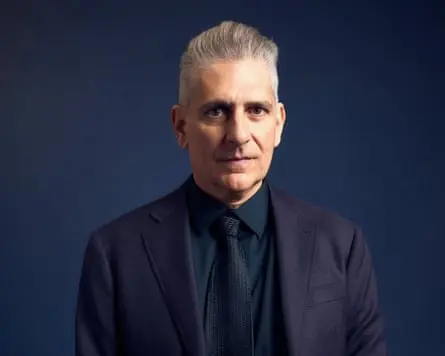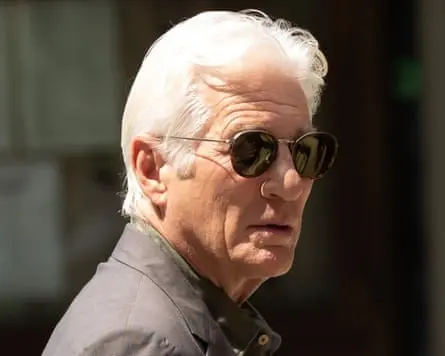
In the contemporary landscape of international cinema and television, few figures command the distinct affection and critical gravitas of Bill Nighy. At 76 years of age, the British actor remains an inimitable presence—instantly recognizable by his trademark sartorial elegance, wry cadence, and a career spanning over five decades. While his filmography encompasses multi-million-dollar studio tentpoles, such as the Pirates of the Caribbean franchise, Nighy is fundamentally celebrated for delineating exquisitely flawed, melancholic, and deeply human characters. From his unforgettable turn as fading rocker Billy Mack in Love Actually to his Oscar-nominated, buttoned-up bureaucrat in Living, Nighy has carved out a singular niche in the cultural consciousness.
This profile explores his latest cinematic venture, the sci-fi-infused domestic drama & Sons, in which Nighy stars as a reclusive, misanthropic patriarch alongside Johnny Flynn, George MacKay, and Imelda Staunton. Beyond the silver screen, this feature investigates Nighy’s idiosyncratic transition into the podcasting sphere with his award-winning, off-the-cuff agony uncle series Ill-Advised, and retraces his fascinating, accidental journey from a young literary aspirant begging on the steps of Paris’s Trocadéro to an international acting icon. Through candid reflections on fame, parenting, modern technology, and the perils of the "working lunch," this piece captures a master craftsman at a reflective crossroads in his storied career.
Detailed Chronology
From Caterham to Shakespeare & Company: The Early Years
Long before he was commanding the attention of global audiences, a young Bill Nighy harbored ambitions far removed from the footlights. Growing up in the quiet suburban town of Caterham, Surrey, a teenage Nighy was captivated not by acting, but by the written word. Inspired by the romanticized ideals of Ernest Hemingway and F. Scott Fitzgerald, his formative years were saturated with literary daydreams.
This trajectory was radically altered at age 14 by an English teacher named Mr. Weir at his Catholic grammar school. Upon being told, "You might want to try your hand at the novel," Nighy experienced what he describes as a metaphorical bomb going off in his head. Though he secured a modest job at the hunting and fishing magazine The Field—where his primary responsibilities included changing the ladies’ room roller towel and inadvertently blushing when typing-pool employees played practical jokes—his literary ambitions soon prompted a more radical relocation.
In a move that mirrors a classic bohemian trope, Nighy decamped to Paris. He spent his days loitering around the legendary bookstore Shakespeare & Company, nursing fantasies of penning definitive literary masterpieces and securing a Parisian romance. Reality proved less romantic; when neither masterpiece nor girlfriend materialized, Nighy found himself begging on the Trocadéro. It was only after a casual suggestion from an acquaintance that he pivoted toward drama school, setting in motion a theatrical and cinematic career that would eventually eclipse his writing ambitions—though he remains a dedicated procrastinator regarding that mythical first novel.
The Rise of a Versatile Character Actor
Nighy’s professional breakthrough was neither meteoric nor instantaneous. He spent decades honing his craft across British theatre, television, and film. Early successes, such as the raunchy 1991 BBC series The Men’s Room, established his reputation for magnetic, complex screen presence—earning him both critical acclaim and the gentle censure of the era’s Broadcasting Standards Council for his explicit performances as a libidinous academic.

As his career progressed into the new millennium, Nighy’s trajectory transformed significantly. His portrayal of the cynical, hedonistic rock star Billy Mack in Richard Curtis’s 2003 romantic comedy Love Actually catapulted him into international household-name status. While blockbuster success followed—including memorable creature-feature work as Davy Jones in the Pirates of the Caribbean films, obscured behind a writhing computer-generated beard—Nighy continuously gravitated toward nuanced, understated character studies. Whether playing the husband who resists infidelity in Lawless Heart, a Scrabble enthusiast searching for his missing son in Sometimes Always Never, or the terminally ill civil servant in Oliver Hermanus’s Living (which secured his first Academy Award nomination), Nighy’s performances are defined by a profound emotional resonance.
Supporting Context & Metrics
The Phenomenon of Ill-Advised
In recent years, Nighy has expanded his cultural footprint into the digital audio space, defying his own self-professed aversion to modern technological trappings. His podcast, Ill-Advised, features the actor serving as a soothing, meandering agony uncle who fields listener queries on everything from fashion to interpersonal etiquette.
Operating entirely off-the-cuff—he steadfastly refuses to preview questions before recording—Nighy relies on a lifetime of internal rumination. As he notes, subjects like trouser cuts, lounge suits, and shirt collars are topics he has already spent considerable time analyzing. This charmingly unfiltered approach has resonated deeply with audiences:
- Monthly Listenership: Exceeds 300,000 active listeners globally.
- Critical Acclaim: Crowned Podcast of the Year at the prestigious Broadcasting Press Guild Awards.
- Series Longevity: Currently preparing to launch its third successive season, despite Nighy’s characteristically self-deprecating insistence that he "tried not to have a podcast."
Sartorial and Technological Boundaries
Nighy’s relationship with technology and contemporary social norms is characterized by a charmingly old-school pragmatism. While he admits to being an enthusiastic texter who mastered the old Nokia keypad with impressive speed, his patience for modern communications has strict limits:
- The Zoom Ban: Nighy has officially retired from video-conferencing platforms, noting that every Zoom call left him fundamentally unhappy.
- Emoji Philosophy: Philosophically opposed to most emojis for being "a bit naff," he makes specific, curated exceptions for the flamingo, the purple dahlia, the leaping shark (occasionally combined with a leaping dolphin), and the golfer in mid-swing.
- Social Engagements: Working lunches are entirely off the table. Believing that combining food with professional discussions merely complicates the issue, he has spent decades discarding prestigious party invitations straight into the bin for the quiet thrill of declining.
Official Statements
On Artistry, Temperament, and & Sons
In & Sons, Nighy stars as AN Dyer, a reclusive, abrasive literary lion who summons his estranged family for a dramatic, science-fiction-adjacent announcement. The character embodies an antiquated archetype: the brilliant artist whose toxic behavior, emotional absence, and misanthropy are purportedly excused by his creative output.
Nighy expresses absolute disdain for this rationalization, drawing a sharp parallel to contemporary culture:
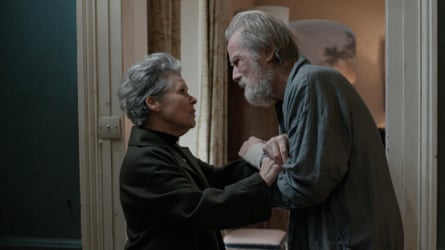
"It’s like when footballers behave badly on the pitch and people say, ‘Temperament is part of his genius.’ Give me a break. That’s anathema to me. I don’t believe it in the least."
Addressing his departure from his usual casting tropes—shifting away from sweet, diffident, or charmingly eccentric figures toward unadulterated rage and misanthropy—Nighy acknowledges the deliberate subversion of audience expectations:
"I’m not thought of in those terms. Though of course, half my work is not in living memory. You get to the stage where everyone who watched it is dead."
On Parenting and the Passage of Time
Reflecting on Dyer’s professed parental philosophy of striving to "do no harm," Nighy offers a grounded, pragmatic view of his own experience raising his daughter, actor-director Mary Nighy (with ex-partner Diana Quick), and embracing his role as a grandfather:
"Blimey. It’s a long time ago. You make it up as you go along. You make mistakes, then correct them, and hopefully you arrive at something that works. My parents were not oppressive or unkind, and I didn’t want to be either."
On Idols and Restraint
Discussing his cinematic and musical heroes, Nighy cites minimalist icon Steve McQueen and boundary-pushing musician Prince as foundational inspirations. Describing McQueen’s acting philosophy, Nighy highlights a creed that could easily be applied to his own body of work:

"You need a lot of confidence to do what he did. No fireworks, no reaching for prizes. It’s a kind of reckless restraint."
Future Outlook
As Bill Nighy enters his late seventies, his career shows no signs of losing its momentum or cultural relevance. The upcoming release of & Sons promises to showcase a darker, more abrasive facet of his dramatic range, proving that his artistic curiosity remains thoroughly unquenched. Concurrently, the resounding success of Ill-Advised demonstrates his enduring viability across emerging media formats, bridging generational divides through humor, empathy, and unmatched vocal delivery.
Whether he is fielding questions about tailoring on a weekly podcast, grumbling over a phone line from north-west London about the perils of video calls, or delivering masterclasses in cinematic minimalism on the big screen, Nighy continues to operate on his own distinct terms. Rejecting flashiness in favor of authenticity, he remains that rare commodity in modern entertainment: an enduring icon who achieves extraordinary emotional resonance through the quiet power of reckless restraint.