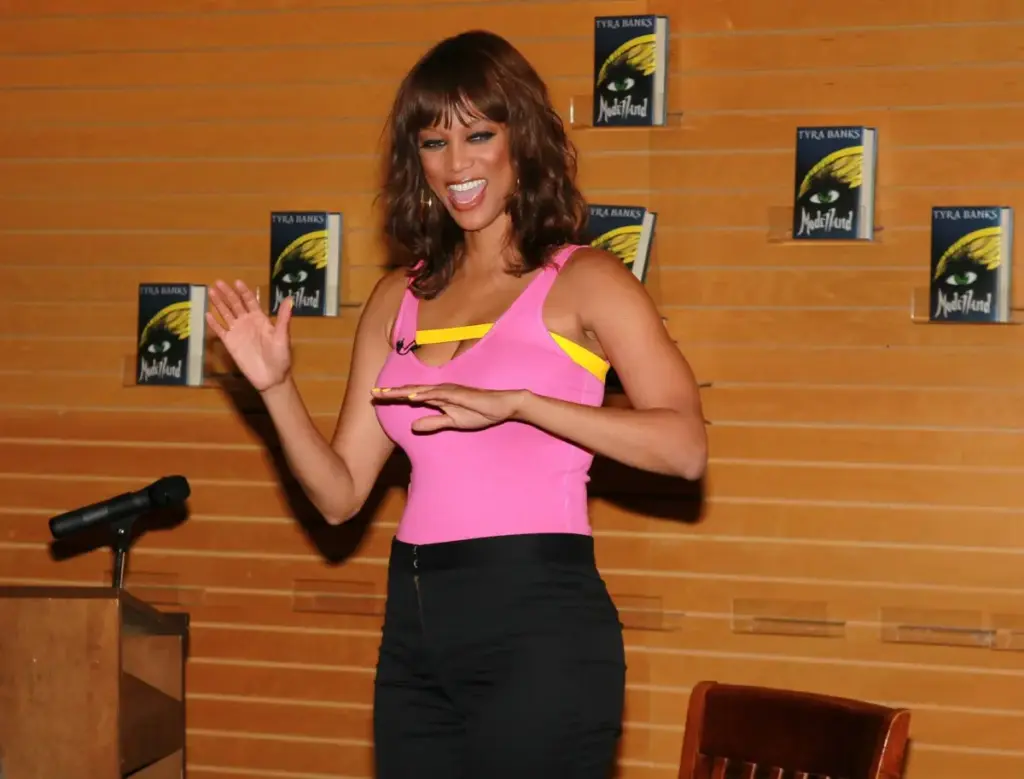
Fifteen years after its initial, heavy-handed rollout, Tyra Banks’ 2011 young-adult dystopian novel, Modelland, has unexpectedly re-emerged from literary obscurity to captivate a bewildered online subculture. Sparked by a viral wave on social media—anchored by the rediscovery of Banks’ eccentric, avant-proto-hyperpop promotional theme song and its central, existential inquiry, "Can you, can you, can you, can you survive Modelland?"—the text has once again entered the public consciousness.
What began as ironic internet commentary has quickly morphed into an investigative descent. Long out of print, copies of the nearly 600-page tome are once again being hunted down in the subterranean archives of metropolitan libraries. Co-authored by Banks and ghostwriter Michael Salort, Modelland was originally pushed through every possible commercial channel: a tie-in narrative arc during Cycle 17 of America’s Next Top Model, an ominous promotional trailer, a dedicated Google+ page, and plans for a physical theme park. Yet, despite this multi-media onslaught, the novel ultimately faded into the cultural ether.
Now, a new generation of readers is confronting the chaotic architecture of Modelland head-on. Equal parts fever dream and literary anomaly, the novel offers an almost clinical study in over-engineered world-building, warping the boundaries of genre fiction. This report investigates the cultural footprint of Modelland, examining its complex lore, its grueling reading experience, and the bizarre mechanics of a universe where the ultimate social currency is high-fashion supremacy enforced by supernatural decree.
Detailed Chronology: From the B3 Institute to the Mountain of Modelland
To understand the cultural phenomenon of Modelland, one must first brave the labyrinthine narrative crafted by Banks and Salort. The novel centers on Tookie De La Crème, an archetype the text establishes as a "Forgetta-Girl"—an outcast who fails to register on the radar of high society. Tookie spends her days at the Bangle, Bauble and Bead Institute (B3), located in the factory district of Peppertown within the broader region of Metopia.
Tookie’s coping mechanism for the drudgery of her existence is the SPLD, or "Silent Protest by Lying Down," an act where she abandons classroom instruction to lie motionless on cold hallway floors, sustained largely by canned whipped cream. Despite speaking 28 languages—which she documents exclusively in her multi-colored-pen "T-Mail Jail" journal—Tookie is terminally overlooked. Her home life is equally surreal: her mother, demanding to be addressed exclusively as "Creamy," presides over a household that includes Tookie’s younger sister, Myrracle. Myrracle suffers from a precise cognitive quirk that forces her to mispronounce fundamental terms, notably rendering DNA as "dee-nay-nay."
The Machinery of Discovery
The sociopolitical structure of Metopia revolves around the Day of Discovery (T-DOD). Overhead looms Modelland, a massive mountain crowned by an all-seeing green eye. Periodically, Scouts descend from this peak to select ordinary girls to become Bellas, whisking them away to Modelland for elite schooling. The ultimate goal is to enter the elite class of the "Seven Intoxibellas"—or face a fate worse than obscurity: domestic servitude or, worst of all, becoming an actress.
The cosmic lottery of T-DOD is heavily influenced by SMIZEs—magical yellow bubbles sent down through the municipal water supply. These bubbles burst into gold talismans that, when worn upon the forehead, grant the wearer fierce yellow eyeshadow and a mathematically precise 91% advantage in being "Discovered."
Despite her outcast status, Tookie’s trajectory shifts when she encounters a stray SMIZE. Her Discovery is secured by a Scout who bafflingly camouflages himself as an automobile, seemingly lifted straight from a Transformers mood board. Plunged into the dark, competitive underbelly of Modelland, Tookie is joined by an obligatory ensemble of YA plot-companions:
- Dylan, a young woman residing inside an institution structurally reminiscent of a big-box retail store;
- Shiraz, a Bollywood nepotism baby;
- Piper, a member of an indigenous ethnic group defined by extreme albinism;
- And various fauna, including the LeGizzards—creatures sustained on a diet of Colorian sweetbreads.
As the narrative progresses, it introduces a web of eccentric subplots. These include the superstar Intoxibella Ci~l (pronounced "see-el"), a rare "Seven-Seven" possessing all seven magical Intoxibella powers, such as Chameeleone, the ability to shapeshift wielded by a student named Evanjalinda. We are also introduced to Tookie’s unrequited obsession with class president Theophilus Love—whose campaign buttons ("VOTE FOR LOVE") conveniently scratch down to read "T O O K E"—and his secret dumpster-diving girlfriend, Zarpessa.
Supporting Context & Metrics: Quantifying the Modelland Experience
| Metric / Parameter | Value / Description | Cultural Comparison |
|---|---|---|
| Total Page Count | Approaching 600 pages | Comparable to John Steinbeck’s East of Eden |
| Linguistic Arsenal | 28 spoken languages (utilized via T-Mail journals) | Far exceeding standard young-adult protagonist profiles |
| Discovered Advantage | 91% boost via forehead-mounted SMIZE talismans | Unregulated cosmological advantage |
| Primary Institutional Setting | Bangle, Bauble and Bead Institute (B3) | Industrial dystopian vocational school |
| Original Publication Date | October 2011 | Concurrent with the peak of the blogosphere and early social media integration |
The physical act of reading Modelland has been likened by contemporary critics to an endurance test. Clocking in at a gargantuan length that defies the standard pacing of contemporary young adult literature, the book demands immense psychological fortitude. Its prose weaves together high-fashion jargon, impenetrable phonetic spellings, and high-concept dystopian world-building that reads less like a cohesive narrative and more like a stream-of-consciousness manifesto on celebrity culture and physical perfection.
Official Statements and Industry Impact
When Modelland was first released in 2011, Tyra Banks positioned it not merely as a novel, but as a lifestyle ecosystem. In promotional interviews, Banks emphasized the book’s empowering undertones, claiming that the concept of the "Forgetta-Girl" was designed to resonate with young women who felt invisible in modern society.
"Modelland is about finding your inner light, stripping away the superficial layers of society, and realizing that what makes you weird is what makes you fierce," Banks stated during the promotional circuit for the novel’s launch.
Industry analysts at the time, however, were perplexed by the cross-media strategy. The integration of the book’s themes into the seventeenth cycle of America’s Next Top Model—where contestants were subjected to editorial photo shoots holding campaign buttons bearing Tookie’s name—blurred the line between traditional publishing and reality television marketing.
While the planned physical theme park ultimately failed to materialize, the recent viral resurgence of the Modelland theme song has prompted a cultural re-evaluation. Rather than treating the novel as a failed commercial enterprise, digital culture has embraced it as a camp masterpiece—an unfiltered glimpse into the maximalist imagination of one of pop culture’s most enduring visionaries.
Future Outlook: Will Modelland Endure?
As digital archives and library basements continue to yield long-forgotten copies of the novel, the future trajectory of Modelland remains uniquely positioned at the intersection of irony and academic curiosity.
- Digital Preservation: With generations of internet users archiving the promotional media, music videos, and deep-lore breakdowns, Modelland has secured a permanent, albeit unconventional, digital legacy.
- Secondary Market Resurgence: Out-of-print physical copies are seeing a surge in demand among collectors of postmodern literary curiosities, suggesting that physical print runs may experience localized valuation spikes.
- Cultural Re-examination: Cultural critics are increasingly viewing Modelland as an early precursor to the hyper-surreal, meme-driven content models of the late 2010s and 2020s.
Whether Modelland will ever be officially brought back into print remains to be seen. However, as long as readers continue to ask the fundamental, haunting question posed by its electronic anthem—"Can you survive Modelland?"—the legacy of Tookie De La Crème, Creamy, and the mountain with the all-seeing green eye will refuse to fade into the wasteland.