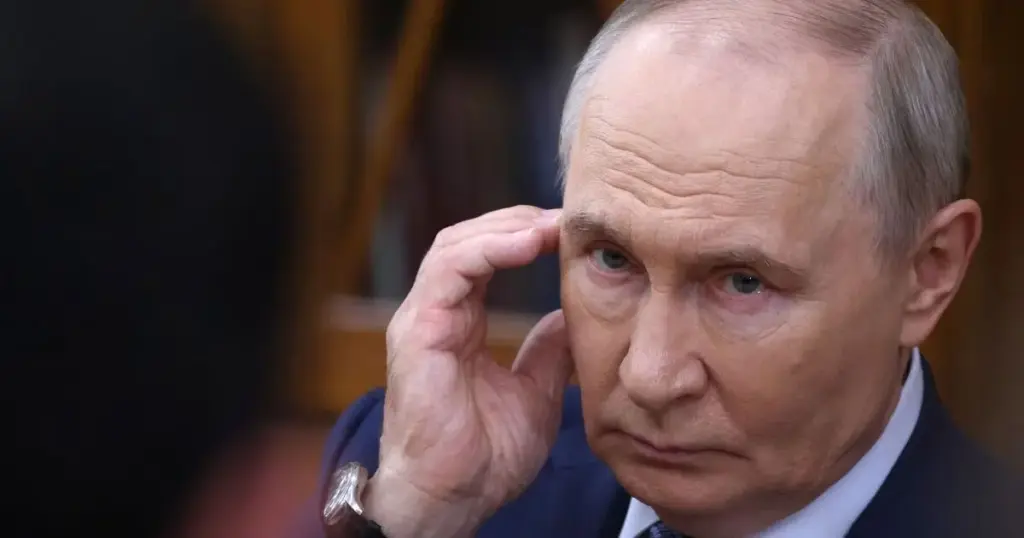
TALLINN, ESTONIA — As the grueling war in Ukraine drags on past its fourth year, the walls are quietly closing in on Russian President Vladimir Putin. According to Kaupo Rosin, Director General of the Estonian Foreign Intelligence Service, the Kremlin is navigating an increasingly perilous domestic landscape. While a traditional, grassroots "street revolution" remains an unlikely catalyst for regime change in Moscow, internal elite frustration is mounting, suggesting that any future reckoning within Russia’s borders could arrive swiftly and without warning.
In a candid assessment highlighting the vulnerabilities of the Russian autocracy, Rosin noted that while hardline voices urging the continuation of the military campaign still echo through the corridors of power, counter-arguments advocating for a strategic reevaluation are gaining serious traction.
"Objectively, Russia is in a very bad place at the moment, and many people understand this in Russia," Rosin stated during a recent briefing.
Executive Overview: The Fragile State of Modern Russia
The assessment from Estonia’s top intelligence official underscores a growing consensus among Western security analysts: Vladimir Putin’s long-term grip on power is facing unprecedented strain. Years of punishing international sanctions, stalled military advancements on the Ukrainian front lines, and an increasingly vulnerable Russian domestic airspace—frequently penetrated by Ukrainian drone strikes—have punctured the aura of invincibility that once defined the Kremlin leader’s rule.
For Estonia, a frontline NATO member situated directly on Russia’s eastern border, monitoring these shifts is not merely an academic exercise. Having spent decades under Soviet occupation before regaining its independence, the small Baltic nation operates with a clear-eyed perspective on Moscow’s internal dynamics. As part of the 32-nation NATO alliance—bound by the collective defense pledge of Article 5—Estonia’s intelligence apparatus closely evaluates whether domestic instability in Russia could ultimately diminish, or dangerously accelerate, aggressive military postures abroad.
According to Rosin, the discontent is no longer confined to isolated anti-war activists or marginalized political dissidents. Instead, unhappiness with the protracted conflict is quietly seeping through every tier of Russian society, stretching from ordinary citizens struggling with a heavily militarized economy to the powerful oligarchs whose fortunes have been battered by Western restrictions.
Detailed Chronology: From Blitzkrieg Ambitions to a War of Attrition
To understand the precarious position in which the Kremlin now finds itself, it is necessary to examine the trajectory of the conflict that began in February 2022.
The Illusion of a Quick Victory (2022)
When Russian forces first crossed the border into Ukraine, the Kremlin anticipated a swift, decisive campaign—a matter of days or weeks—that would topple the government in Kyiv and install a pro-Moscow administration. Instead, fierce Ukrainian resistance, backed by rapid Western intelligence and military aid, shattered these ambitions. The initial push toward Kyiv stalled, forcing a humiliating retreat from northern Ukraine and exposing profound logistical and operational failures within the Russian armed forces.

The Grinding Attrition and Domestic Strain (2023–2024)
As the conflict devolved into a brutal war of attrition across Ukraine’s eastern and southern oblasts, the human and economic costs for Russia skyrocketed. Heavy casualties forced the Kremlin to resort to a chaotic "partial mobilization," sparking protests and a mass exodus of military-aged men from the country. Concurrently, Western nations piled sweeping economic sanctions onto Moscow, targeting energy exports, central bank assets, and critical technological imports.
Despite these pressures, the Russian state pivoted to a war economy, temporarily shielding itself from immediate collapse through heavy state spending and trade rerouting via third-party nations. However, this artificial stabilization masked deepening structural imbalances, runaway inflation, and chronic labor shortages.
The Wagner Mutiny: A Warning Shot (Summer 2023)
Perhaps the most visceral internal challenge to Putin’s authority occurred in June 2023, when Yevgeny Prigozhin, leader of the mercenary Wagner Group, led an armed mutiny. Frustrated by military leadership and logistical neglect on the front lines, Wagner fighters seized control of the southern Russian city of Rostov-on-Don and marched a heavily armed convoy toward Moscow.
Although the mutiny was abruptly halted through a negotiated deal brokered by Belarusian leadership—and Prigozhin subsequently died in a mysterious private plane crash two months later—the event shattered the illusion of absolute regime security. It laid bare the fragility of the Kremlin’s power structures and demonstrated that internal armed challenges to Putin were within the realm of possibility.
The Current Stalemate and Vulnerable Borders (2025–2026)
Entering the latter half of 2026, Russian military momentum has largely stalled. Territorial gains in Ukraine have come at an astronomical cost in men and materiel, yielding marginal tactical advantages rather than strategic breakthroughs. Compounding these battlefield frustrations, the war has increasingly come home to ordinary Russians. Long-range drone strikes launched from Ukraine now regularly target military installations, fuel depots, and industrial facilities deep inside Russian territory, piercing air defenses and exposing the limits of the Kremlin’s protective umbrella.
Supporting Context & Metrics: Economic Strain and Social Discontent
The economic realities facing Russia under Putin are stark. While official state statistics often paint an overly rosy picture of gross domestic product (GDP) growth driven by state-funded defense production, independent economists point to severe underlying distortions.
- Inflation and Interest Rates: Consumer price inflation has remained stubbornly high, driven by labor scarcity as hundreds of thousands of workers are pulled into the military or defense manufacturing sectors. To combat overheating, the Russian Central Bank has been forced to maintain punishingly high interest rates, choking off non-military investment and consumer credit.
- Depleted Sovereign Wealth Funds: Moscow has increasingly drawn down its liquid reserves—particularly the Liquid assets of the National Wealth Fund—to plug federal budget deficits caused by fluctuating energy revenues and soaring military expenditures.
- Brain Drain: The departure of hundreds of thousands of educated, tech-savvy professionals in the wake of the mobilization waves has inflicted long-term damage on Russia’s innovation capacity and labor productivity.
Beyond the balance sheets, social friction is intensifying. While public demonstrations remain tightly suppressed by a pervasive police state and draconian censorship laws, polling and qualitative intelligence indicate a pervasive war-weariness. Families mourning fallen soldiers, coupled with the daily anxieties of a degraded economic standard of living, have eroded the baseline social contract that sustained Putin’s popularity for over two decades.
Official Statements and Intelligence Assessments
Kaupo Rosin’s public remarks provide a rare, unvarnished window into how Western intelligence agencies view the internal stability of Russia. Eschewing sensationalist predictions of an imminent, violent overthrow of the government, Rosin emphasized the nuanced and unpredictable nature of autocratic regime transitions.

"I would say, if something changes in Russia, then it will happen in a very rapid manner and we will all be surprised. It will be an overnight thing, if it ever happens," Rosin stressed to reporters.
When addressing the internal mindset of Russia’s elite, the Estonian intelligence chief noted the widening chasm between the regime’s public bravado and private anxieties:
"We see that overall unhappiness levels with this war are increasing in all echelons of society, starting from normal people and throughout, up to the oligarchs. More and more people do not want this war. The question is: what impact does this have on his [Putin’s] decision-making?"
This sentiment is echoed by broader security analyses across the Baltic and Nordic regions, which suggest that while Putin retains tight control over the apparatus of repression—including the Federal Security Service (FSB) and the National Guard (Rosgvardia)—the elite consensus underpinning his rule is fraying at the edges. Disgruntled billionaires, sidelined technocrats, and military commanders frustrated by strategic miscalculations are increasingly counting the personal costs of Russia’s international isolation.
Future Outlook: What Lies Ahead for the Kremlin?
As the conflict grinds forward, the central question facing international observers is not whether dissatisfaction exists within Russia, but rather how that discontent will ultimately manifest.
Autocratic regimes frequently appear unshakeable right up until the moment of their collapse. Historical precedents—from the sudden dissolution of the Soviet Union to the abrupt falls of various authoritarian figures—demonstrate that systemic decay often occurs behind a monolithic facade before reaching a sudden tipping point.
For Vladimir Putin, the immediate path forward involves balancing the imperatives of a perpetual war economy against the mounting risk of domestic implosion. By continuing to militarize society and suppress dissent, the Kremlin can delay a reckoning, but it cannot indefinitely outrun the fundamental strategic, economic, and demographic traps of its own making.
As Estonian intelligence warns, the warning signs are flashing. Whether the pressure from below and the quiet anxieties from within will coalesce into a sudden, systemic shift remains the defining unknown of modern European geopolitics. One thing, however, is certain: the margin for error for the Kremlin has narrowed drastically, and Russia’s future remains more precarious than at any other point in its modern history.