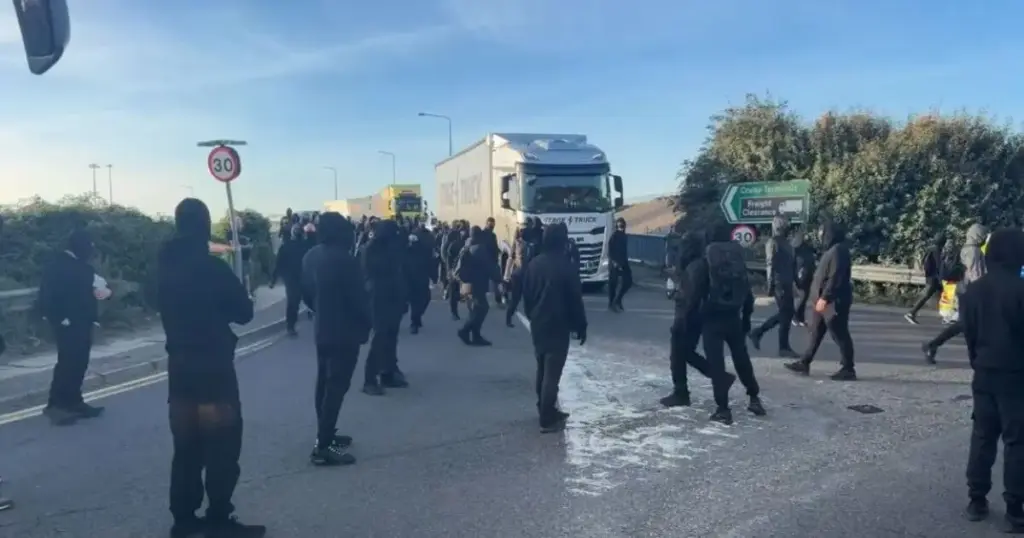
Traffic traveling through one of the United Kingdom’s most vital economic gateways was brought to a dramatic and complete standstill on Saturday morning, September 5, 2026. A coordinated flash demonstration involving hundreds of men clad entirely in black clothing and balaclavas descended upon the town of Dover, effectively blockading major roadways leading in and out of the Port of Dover.
The disruption, locally described as an "anti-migrant" or "Stop the Boats" protest, caused severe gridlock across the A20 and surrounding arterial routes. National Highways confirmed closures in both directions between the A256 (York Street) and the A2 (Jubilee Way), spawning miles of congestion and delays stretching past 45 minutes on approaches. Commuters, freight drivers, and international travellers found themselves trapped inside a rapidly escalating public order crisis.
While Kent Police mobilized officers to the scene to engage with the demonstrators, local officials, transport operators, and regional politicians condemned the chaotic scenes. The sudden blockade has reignited fierce national debates regarding security, civil disruption, and the emotive political fault lines surrounding immigration and small-boat crossings.
DETAILED CHRONOLOGY OF EVENTS
09:00 AM – 10:00 AM: The Early Morning Flash Mob and Gridlock
The disruption began unfolding in the early hours of Saturday morning. According to eyewitness accounts and local leadership, several hundred men traveling in coordinated rental vans arrived abruptly in Dover. Donning black paramilitary-style gear, dark hoodies, and facial coverings (balaclavas), the group systematically occupied three distinct locations on the road network leading to Europe’s busiest international ferry port.
By 09:16 AM, P&O Ferries and DFDS issued early alerts to customers, warning that access to the port was heavily restricted. National Highways quickly confirmed that the A20 was entirely blocked in both directions, trapping motorists and creating an immediate logistical nightmare. Footage shared widely across social media platforms showed lines of masked individuals walking down the center of major carriageways while bewildered drivers sat immobilized behind closed windows.
10:00 AM – 11:00 AM: Escalating Tensions and Local Fallout
As morning operations commenced, the true scale of the blockade became apparent. Dover District Council members and local councillors began fielding panicked calls from residents, stranded workers, and terrified motorists.
Cllr Chris Vinson, leader of the Conservative group on Dover District Council, described the town as being brought to a complete standstill. He noted that while the protesters carried no traditional placards, banners, or visible organizational markers, their coordinated appearance in black paramilitary gear was profoundly intimidating. Local workers completing overnight shifts at the port found themselves too afraid to leave their facilities, while drivers stuck in stationary queues on the approach roads lacked even basic sanitary facilities.
Concurrently, transport operators scrambled to mitigate the fallout. Rail provider Southeastern and cross-channel ferry operators announced emergency accommodations, assuring passengers that missed departures resulting from the road blocks would be honored on the next available sailings without additional charges. Across the Channel, the Port of Calais reported that vessels were continuing to load passengers "for the time being," though departures faced rolling delays pending updates from the UK side.
11:00 AM Onwards: Police Engagement and Alternative Routes
By late morning, Kent Police officers were heavily deployed across the affected zones, maintaining a visible presence and attempting to negotiate with the crowds. Recognizing the severity of the bottleneck, the Port of Dover issued supplementary guidance directing civilian traffic to enter and exit the terminal via the A2 Jubilee Way, providing a vital workaround for trapped motorists.
Despite these relief efforts, primary arteries such as the A20 east remained locked down, with severe residual delays persisting throughout the afternoon as authorities sought to safely clear the unauthorized blockade and restore public order.
SUPPORTING CONTEXT & METRICS: THE GEOPOLITICAL AND ECONOMIC IMPORTANCE OF DOVER
To fully understand the profound impact of Saturday’s demonstration, one must examine the critical national infrastructure under siege. The Port of Dover is far more than a local travel hub; it is the beating heart of the United Kingdom’s trade supply chain.
Trade Volume: Dover manages a staggering £144 billion in goods trade annually, accounting for approximately 33% of the UK’s entire commercial trade exchange with the European Union.
Passenger and Freight Processing: The port processes over 1.7 million tourist vehicles and an eye-watering 2 million freight vehicles every single year, serving as the principal umbilical cord connecting British markets to mainland Europe.
The Migration Flashpoint: Dover has long stood at the frontline of the UK’s ongoing political and humanitarian debates surrounding unauthorized small-boat crossings traversing the English Channel. The emotional resonance of the issue has repeatedly made the town a magnet for polarized demonstrations, public protests, and heightened security operations.
OFFICIAL STATEMENTS AND POLITICAL REACTIONS
The unannounced demonstration has triggered swift and unequivocal condemnation from political figures across the ideological spectrum, alongside cautious updates from emergency services and port authorities.
Kent Police
A spokesperson for Kent Police released an initial statement addressing the rapidly developing situation:
"We are aware of a protest currently taking place at the Port of Dover. Officers are in attendance and engaging with protesters."
Port of Dover Management
In an official operational update, port authorities emphasized the human and economic cost of the public order incident:
"This is an ongoing public order incident happening around the town of Dover, affecting all routes in and out of the port and the town. We are in contact with Kent Police to understand the situation. This situation is impacting our local community and our customers, so of course we are hoping for a swift resolution."
Local and National Political Condemnation
The tactic of utilizing masked groups to enforce a road blockade drew sharp rebukes from local representatives:
Mike Tapp, Labour MP for Dover and Deal: Voiced intense frustration over the disruption, pointing out the factual disconnect of the demonstrators’ apparent agenda:
"I am fed up with idiots coming to Dover to cause disruption. I bet if you asked any one of those ‘protesters’ they wouldn’t know small boat crossings are down by 40% and we are working hard to fix the mess. Go home, enjoy your weekend/get a job."
Cllr Chris Vinson, Dover District Council (Conservative): Highlighted the psychological impact on the local community:
"Having the path of your vehicle blocked by men wearing black paramilitary gear and balaclavas is extremely intimidating… I know people who have worked night shifts in the port who are being prevented from leaving for fears for their safety."
Paul King, Reform UK Councillor for Dover West: Acknowledged the reports linking the action to a "Stop the Boats" protest while drawing a distinct line regarding methodology:
"We don’t condone causing public disturbance by protest. But it’s a very good example of what is happening daily with the boats coming in."
FUTURE OUTLOOK
As law enforcement continues to manage the aftermath of Saturday’s blockade, critical questions loom regarding intelligence failures, the rapid deployment of masked groups, and the enforcement of public order laws around critical national infrastructure.
With the Port of Dover remaining vulnerable to sudden blockades, pressure is mounting on the Home Office and Kent Police to implement robust preventative frameworks. Authorities must balance the fundamental right to peaceful assembly against the catastrophic economic and public safety risks posed by coordinated, anonymous disruptions targeting the UK’s primary European trade artery. For now, local residents, freight drivers, and international travelers are left counting the cost of a Saturday morning that plunged one of Britain’s most vital gateways into temporary lawlessness.