Executive Overview
It has been more than two decades since activist Tarana Burke laid the foundational stones of the Me Too movement, thrusting the daunting, systemic prevalence of sexual assault and harassment into the global spotlight. In the years since, public discourse has shifted irrevocably, altering how society perceives bodily autonomy, interpersonal boundaries, and accountability. Yet, a stark disconnect persists between cultural progress and institutional policy. According to data compiled by the Sex Information and Education Council of the United States (SIECUS), only 27 U.S. states mandate sex education in public schools—and a mere 15 of those jurisdictions require curricula to include comprehensive information regarding consent.
While federal and state governance appears increasingly sluggish in adapting to modern frameworks of interpersonal safety, popular culture has experienced a seismic ideological shift. Taglines such as "Consent is sexy" emerged to modernize and destigmatize conversations surrounding desire, encouraging individuals—particularly women—to speak up about their sexual boundaries and preferences. As AASECT-certified sexologist Natassia Miller notes, "We’re just becoming more vocal about making the choices that feel aligned for us."
In this contemporary landscape, phrases like "enthusiastic consent" have been popularized as the gold standard for safe, pleasurable sexual encounters. However, contemporary sexology asks us to look deeper: What precisely constitutes enthusiastic consent, and is it the only valid pathway to a positive, fulfilling sexual experience for everyone involved?
By examining the broader spectrum of consent—ranging from enthusiastic and willing consent to the problematic territories of unwilling and coerced consent—experts are reframing how we understand desire, communication, and safety in modern relationships.
Detailed Chronology: The Evolution of the Consent Movement
To understand where our cultural conversation surrounding consent stands today, it is essential to trace how the language and legal definitions of sexual autonomy have evolved over time.
The Pre-Me Too Era: From Implied Consent to "No Means No"
For generations, legal and cultural definitions of sexual assault relied heavily on physical resistance. The historical standard required a victim to explicitly fight back or demonstrate extreme physical opposition to prove a lack of consent. During the late 20th century, anti-sexual violence advocates fought to shift this paradigm, introducing the foundational framework of "No means no." While this was a monumental step forward in recognizing verbal rejection, it still placed the burden of communication primarily on the person refusing unwanted advances, leaving the initiative for initiating sex largely unexamined.
The Institutionalization of Affirmative Consent (2010s)
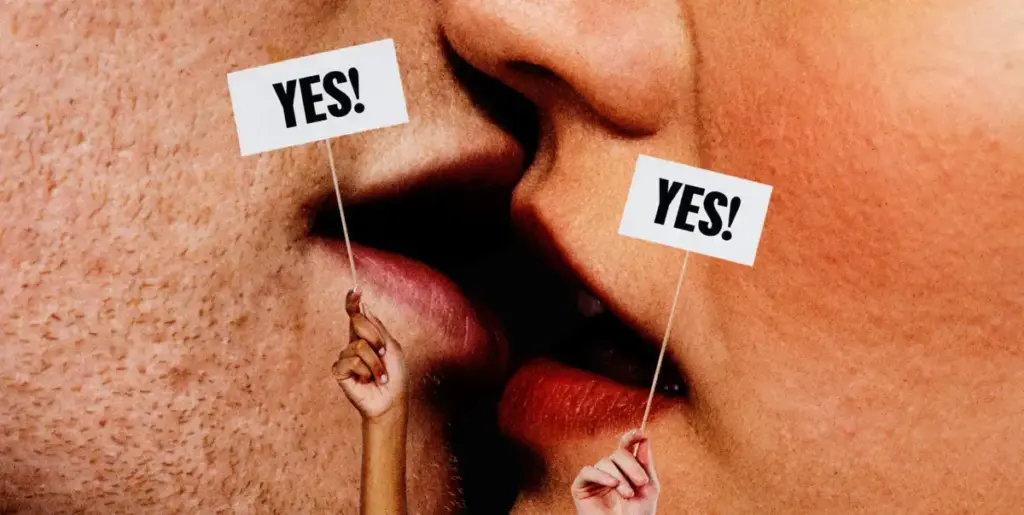
As campus activism surged in the early 2010s, universities and legal systems began adopting the standard of "affirmative consent," colloquially summarized as "Yes means yes." Pioneered by student activists and legal scholars, this framework dictated that consent must be an active, clear, and voluntary agreement—verbal or non-verbal—to engage in specific sexual activity. California became the first state in 2014 to legally mandate affirmative consent standards for all colleges and universities receiving state financial aid, setting a precedent that would ripple across institutional policies nationwide.
The Cultural Explosion of "Enthusiastic Consent" (Late 2010s–Present)
In the wake of the Me Too movement starting in 2017, public consciousness pushed past bare-minimum compliance ("yes") toward emotional alignment and mutual excitement. "Enthusiastic consent" became the new cultural benchmark, championing the idea that sex should be actively desired, mutually anticipated, and emotionally safe by all participants.
The Nuance Era: Re-evaluating Responsive Desire (2020–Present)
Most recently, renowned sex educators and researchers—such as Dr. Emily Nagoski and Dr. Rosemary Basson—have expanded the conversation to account for human psychological and physiological complexities. By introducing frameworks like "willing consent" and acknowledging "responsive desire," modern sexology has opened up a more compassionate, nuanced dialogue that recognizes that human sexual desire is rarely uniform, linear, or always spontaneous.
Supporting Context & Metrics: The State of Sex Education and Legal Frameworks
The modern conversation surrounding consent does not exist in a vacuum; it operates against a backdrop of systemic educational neglect and shifting legal definitions.
The Education Gap
Public schools remain the primary battleground for foundational sex education, yet state-level mandates reveal a deeply fragmented nation. SIECUS state profiles highlight a troubling reality:
- 27 States: The total number of U.S. states that legally require sex education in their public school curricula. This leaves nearly half of all American states with no mandate whatsoever, allowing local districts to bypass comprehensive health education entirely.
- 15 States: Out of those 27 states, only 15 mandate that the curriculum include instruction on consent. Consequently, millions of young people enter adulthood without ever receiving formal, institutional education on how to establish, communicate, or respect interpersonal boundaries.
Deconstructing the Spectrum of Positive Consent
To bridge the gap left by formal education, contemporary sexologists have categorized positive consent into two primary, healthy models: enthusiastic consent and willing consent.
1. Enthusiastic Consent
Enthusiastic consent goes far beyond a neutral compliance or a reluctant nod. As Natassia Miller explains, "It’s when you really want your partner, when you don’t fear the consequences of saying ‘yes’ or saying ‘no,’ and when saying ‘no’ means that you’re missing out on something that you want." It is characterized by mutual excitement, physical arousal, and an eager readiness to engage in intimacy. For many individuals, this is the baseline comfort zone required to feel secure and engaged during sex.
2. Willing Consent
Popularized by sex educator and author Emily Nagoski, PhD, willing consent acknowledges that human desire is diverse. Willing consent occurs when an individual cares deeply about their partner, may not be experiencing spontaneous physical desire at that exact moment, but remains open to the possibility of intimacy.
"You might express willing consent when you believe that your desire is going to show up after you say yes," Miller notes. "It’s not like my body is having this huge ‘no’ that’s coming over it and preventing me from actually moving forward."
This concept is closely tied to responsive desire—a term coined by researcher Dr. Rosemary Basson. While "spontaneous desire" describes the sudden urge for sex that appears out of nowhere, responsive desire means that an individual’s sexual desire is activated in response to a stimulus, such as kissing, touching, or emotional closeness. Pathologizing individuals who do not experience spontaneous desire has historically led many people—particularly women in long-term relationships—to feel "broken." Willing consent validates responsive desire, proving that sex can be deeply positive and pleasurable even if it doesn’t begin with a mutual rush of breathless adrenaline.
As Nagoski wrote in a 2022 essay:
"I live at an intellectual/professional crossroads between promoting active consent (‘Yes means yes!’) and encouraging people to recognize responsive desire and not feel broken if they don’t just want sex out of the blue (‘Willing can mean yes!’)."
Crucially, experts emphasize that willing consent is not about pity, obligation, or mere appeasement. "Not all [sexual experiences] have to start with enthusiasm, but they do all have to start with everyone involved being glad to be there and free to leave with no unwanted consequences," Nagoski explains.
Official Statements and Expert Perspectives
As the dialogue around consent matures, leading voices in sexology and psychology are continuously refining how we talk about interpersonal boundaries. The distinction between healthy models of consent and problematic, potentially abusive dynamics is a central focus of contemporary research.
Navigating the Problematic Side: Unwilling and Coerced Consent
When safety, autonomy, and comfort are compromised, sexual dynamics cross into problematic or legally murky territory. Experts emphasize the critical need to distinguish between healthy participation and harmful compliance.
- Unwilling Consent: This occurs when an individual agrees to sex primarily to appease their partner, stop ongoing nagging, or avoid hurting someone’s feelings. Nagoski describes this as an "absence of desire for desire"—a state where the individual has zero intrinsic interest in the sexual encounter itself, but yields simply to escape social pressure.
- Coerced Consent: Coercion takes place when an individual is subjected to direct or indirect threats, emotional manipulation, or pressure, leading them to believe that refusing sex will result in negative consequences. They may feel that saying "yes" will lead to an experience they actively dread, but that saying "no" carries a heavier emotional or physical penalty. While legal definitions of sexual assault do not always adequately capture the subtle nuances of coercion, experts agree that coerced consent is a violation of true bodily autonomy.
The Tools for Safety: Communication and Attunement
To ensure that all parties remain safe and respected, experts advocate for two foundational practices: continuous verbalization and emotional attunement.
- Explicit Communication: Reminding partners that they retain the right to change their minds at any point during an encounter removes performance pressure and reinforces absolute safety.
- Attunement: Natassia Miller defines attunement as "tuning into how they feel, their body’s reaction, their emotions, what they’re actually verbally communicating, and also tapping into how you’re feeling as well. It’s a simultaneous experience." Attunement allows partners to notice non-verbal cues, hesitation, or discomfort, ensuring that boundaries are respected even before a partner feels compelled to voice an objection.
Future Outlook: Where Do We Go From Here?
The ongoing evolution of the consent conversation signals a cultural maturation regarding human sexuality, autonomy, and emotional intelligence. As society moves past rigid, one-size-fits-all dogmas, the future of sex education and interpersonal relationships lies in nuance, open dialogue, and comprehensive education.
Moving forward, advocates are pushing for several critical changes:
- Legislative Reform in Education: Expanding state-mandated sex education to ensure that all students—regardless of geography—receive comprehensive instruction on bodily autonomy, affirmative consent, and healthy communication.
- De-stigmatizing Responsive Desire: Dismantling cultural myths that frame responsive desire as dysfunctional, thereby empowering individuals to better understand their own unique patterns of arousal and consent.
- Embedding Consent in Everyday Culture: Normalizing ongoing check-ins not just as a legal safeguard, but as a standard component of emotional intimacy in all relationships.
Ultimately, as Natassia Miller observes, consistency is key: "Once you get into the habit of talking about sex consistently, you just feel safer during sex." Whether individuals operate strictly within the bounds of enthusiastic consent or find that willing consent aligns more accurately with the realities of long-term partnership, the core tenets remain unchanged: active communication, mutual respect, and the unyielding freedom to choose.