Executive Overview
For over three decades, Holly Marie Combs was a mainstay of American television. From her early days as a teenage breakout star in the critically acclaimed drama Picket Fences to her career-defining portrayal of Piper Halliwell in the supernatural phenomenon Charmed, and later as the maternal anchor Ella Montgomery in Pretty Little Liars, Combs’s face was synonymous with television longevity. However, after a guest appearance on Grey’s Anatomy in 2019, the actress seemingly vanished from the screen.
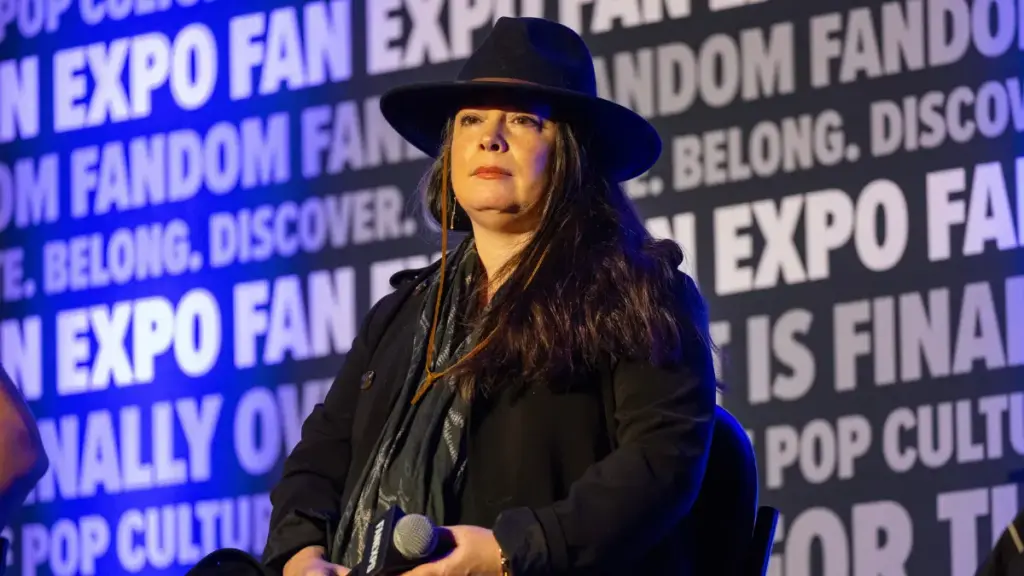
In a recent episode of her rewatch podcast, The House of Halliwell, the 52-year-old actress broke her silence regarding her quiet retirement from the entertainment industry. Speaking with guest Scout Taylor Compton, Combs detailed a multifaceted decision-making process that led her away from the camera.
Her departure was not driven by a single event, but rather by a perfect storm of domestic demands during the COVID-19 pandemic, a systemic lack of compelling roles for women in their 40s and 50s, and a conscious rejection of an increasingly homogenized audition circuit.
Combs’s revelations shed light on the structural challenges veteran actresses face in a youth-obsessed industry, while offering an intimate look at the peace she has found away from the Hollywood machine.
Detailed Chronology: From Teen Star to Quiet Retirement
To understand Holly Marie Combs’s exit from acting, one must examine the trajectory of a career built on continuous, demanding production schedules.
[1992–1996] Picket Fences (Kimberly Brock) — Early Critical Acclaim
       │
[1998–2006] Charmed (Piper Halliwell & Producer) — Global Stardom & Creative Control
       │
[2010–2017] Pretty Little Liars (Ella Montgomery) — Transition to Mature Roles
       │
[2019]       Grey's Anatomy Guest Spot — Final On-Screen Appearance
       │
[2020–Pres.] Domestic Transition & Podcast Launch — Quiet Retirement & Legacy Preservation
The Early Years and Critical Acclaim (1992–1997)
Combs began her career as a teenager, landing minor film roles before capturing national attention at age 18 in David E. Kelley’s quirky, CBS drama Picket Fences. Playing Kimberly Brock for four seasons, Combs developed a reputation for grounded, emotionally complex performances. The grueling pace of network television became her norm early on, earning her a Young Artist Award and establishing her as a reliable talent.
The Charmed Era and Creative Sovereignty (1998–2006)
In 1998, Combs was cast as Piper Halliwell in The WB’s Charmed. The series became a global cult phenomenon, running for eight seasons. By Season 5, both Combs and co-star Alyssa Milano became producers of the series. This transition was pivotal; it gave Combs a taste of creative control, financial agency, and behind-the-scenes influence. She was no longer just an actress reading lines; she was instrumental in shaping the narrative arc of a major television franchise.
The Transition to Mature Archetypes (2010–2017)
Following the conclusion of Charmed, Combs stepped into the role of Ella Montgomery in Freeform’s Pretty Little Liars. While the show was a massive hit, Combs’s role as the mother of a teenager marked a classic Hollywood transition: the shift from romantic lead or central protagonist to the maternal supporting player. Though she executed the role with her signature warmth and nuance, the position on the call sheet was fundamentally different from her years leading Charmed.
The Final Bow (2019)
Combs’s last on-screen appearance occurred in a 2019 episode of ABC’s Grey’s Anatomy. In a highly publicized event, she reunited with her former Charmed sister Alyssa Milano, playing sisters who must decide whether to keep their third sister on life support. The guest spot was a nostalgic nod to her past, but it also marked the end of her active acting career. Shortly thereafter, the global pandemic altered the entertainment landscape—and Combs’s personal life—irreversibly.
Official Statements: Deconstructing the Decision
During a candid conversation on The House of Halliwell podcast, guest Scout Taylor Compton asked Combs a direct question that many fans had been pondering for years: "What made you leave the industry? Is it just family like it was?"
Combs’s response was multi-layered, addressing both her domestic reality and her professional disillusionment.
The Pandemic and Domestic Demands
The onset of the COVID-19 pandemic in early 2020 forced a sudden pause on Hollywood productions, but for Combs, it amplified the demands of her household.
"It was a lot of family," Combs explained. "During COVID, we had three teenagers. Well, there were three teenagers and a preteen in the house, and it was just mayhem and chaos."
Living with her husband, restaurateur Mike Ryan, and her three sons—Finley, Riley, and Kelley (from her previous marriage to David Donoho)—Combs found herself managing a bustling household during a global crisis. The daily realities of parenting multiple adolescents during lockdowns eclipsed the appeal of returning to stressful, long-day production sets that were operating under strict, isolating pandemic protocols.
The Shrinking and Less Interesting Job Pool
Beyond her family life, Combs was experiencing a profound creative disconnect with the material being sent to her. Having spent years as a producer and lead actress, the audition materials landing on her desk felt uninspired.
"The stuff that I was getting and coming across my desk was just nothing that I was like, ‘Oh my gosh, this is really great. I need to do this.’ And being in, you know, that 40 to 50 range, the job pool gets even smaller and smaller. And I feel like the roles get a little less interesting."
This statement highlights a common frustration among mid-career actresses. Once an actress ages out of the 20-to-30 demographic, the industry’s writing rooms historically struggle to conceptualize complex, multi-dimensional roles for them, often relegating them to flat, stereotypical maternal figures or minor supporting parts.
The Double-Edged Sword of Escapism
Despite her retirement, Combs admitted to occasionally missing the therapeutic nature of the craft. She described the unique psychological space that acting provided:
"I miss it occasionally because… there’s those moments when you’re involved, and you’re acting, and you’re working that are just, I think it’s like being present. That’s what escapism is. And we get to escape into this different character with a different set of situations than our own life. And there is something about being in that moment that is quite peaceful, even if you’re doing something highly dramatic."
This duality—missing the pure art of performance while rejecting the business and casting structures surrounding it—characterizes her current relationship with Hollywood.
Supporting Context & Metrics: The "Age Cliff" for Actresses
Combs’s experiences are not isolated; they are backed by extensive industry research detailing the systemic drop-off in representation and role quality for women over 40.
The Underrepresentation of Mid-Career Women
Data from the Center for the Study of Women in Television and Film at San Diego State University consistently reveals a stark gender disparity regarding age in film and television:
- The Age Cliff: While male characters are permitted to age into their 40s, 50s, and 60s while retaining leading-man status, female characters face a steep decline.
- The Numbers: In recent years, studies of top-grossing films showed that only about 20% of all female characters were in their 40s and 50s, compared to over 35% of male characters in the same age bracket.
- The "Mother/Mentor" Pigeonhole: For women over 40, the variety of roles shrinks dramatically. Actresses are frequently limited to supporting archetypes—mothers, grandmothers, judges, or bosses—whose primary function is to support the narrative journey of a younger protagonist.
| Metric / Aspect | Female Characters (Ages 40+) | Male Characters (Ages 40+) |
|---|---|---|
| Representation Share | ~20% of all female roles | ~35% of all male roles |
| Narrative Agency | Often limited to supporting/maternal roles | Frequently maintain leading/action status |
| Industry Perception | Often viewed as "past prime" for romantic leads | Viewed as "distinguished" or "experienced" |
The Post-Pandemic Production Shift
The pandemic also permanently altered the economics of television production. The introduction of expensive safety protocols, coupled with the streaming industry’s pivot toward shorter, limited-run series (8 to 10 episodes) rather than traditional 22-episode network seasons, altered the financial landscape for actors. For a veteran actress like Combs, who was accustomed to the steady, highly lucrative structures of network television, the modern landscape of low-budget, high-turnover streaming projects offered fewer incentives to leave her family.
Future Outlook: Reclaiming the Narrative on Her Own Terms
While Holly Marie Combs has stepped away from traditional on-camera acting, she has not disconnected from her audience or her legacy. Her current endeavors suggest a deliberate pivot toward self-determined, modern media spaces.
                  [Traditional Hollywood Structure]
                                 │
                   (Uninspiring Roles / Ageism)
                                 │
                                 ▼
                    [Holly Marie Combs's Pivot]
                                 │
         ┌───────────────────────┴───────────────────────┐
         ▼                                               ▼
[The House of Halliwell]                       [Domestic Autonomy]
- Direct fan connection                        - Focus on family life
- Audio medium control                         - Rejection of audition grind
- Preservation of Charmed legacy               - Peace away from the camera
The Power of Podcasting
Through The House of Halliwell podcast, Combs has bypassed traditional studio gatekeepers to connect directly with her global fan base. Alongside co-stars, she rewatches and dissects episodes of Charmed, offering behind-the-scenes insights.
This audio-first platform allows her to remain a public figure, monetize her legacy, and engage with her craft without the demanding physical hours, travel requirements, and scrutiny of a traditional television set. It represents a growing trend among Gen-X television stars who are leveraging nostalgia and direct-to-consumer media to maintain professional autonomy.
Will She Ever Return to the Screen?
While Combs has characterized her current status as retired, the door in Hollywood is rarely permanently shut. For an actress of her caliber, a return to the screen would likely require a project that bypasses the standard audition circuit—a role specifically written for her, offering the complexity and depth she found lacking in the scripts of the late 2010s.
Until such an opportunity presents itself, Combs appears content living a quiet life in her blended family home, free from the constraints of an industry that has yet to fully value the depth, experience, and wisdom of its veteran actresses.