By Global Media & Culture Correspondent
Published by Special Arrangement with Fashion & Tech Insights
Photo by Benjamin Esakof / Halo Creative Studios
Executive Overview
The modern digital economy operates on a notoriously fickle currency: the viral moment. For Meredith Duxbury, that moment arrived as a tidal wave of foundation—thick, generous layers applied directly with the palms of her hands to completely blanket her natural freckles. What began as a hyperbolic, hypnotic beauty routine drew millions of spellbound viewers to TikTok, turning Duxbury into an overnight sensation. Yet, as the digital landscape matures, the initial euphoria of going viral is increasingly overshadowed by a much harder, existential question for internet personalities: What happens after the first hit fades?
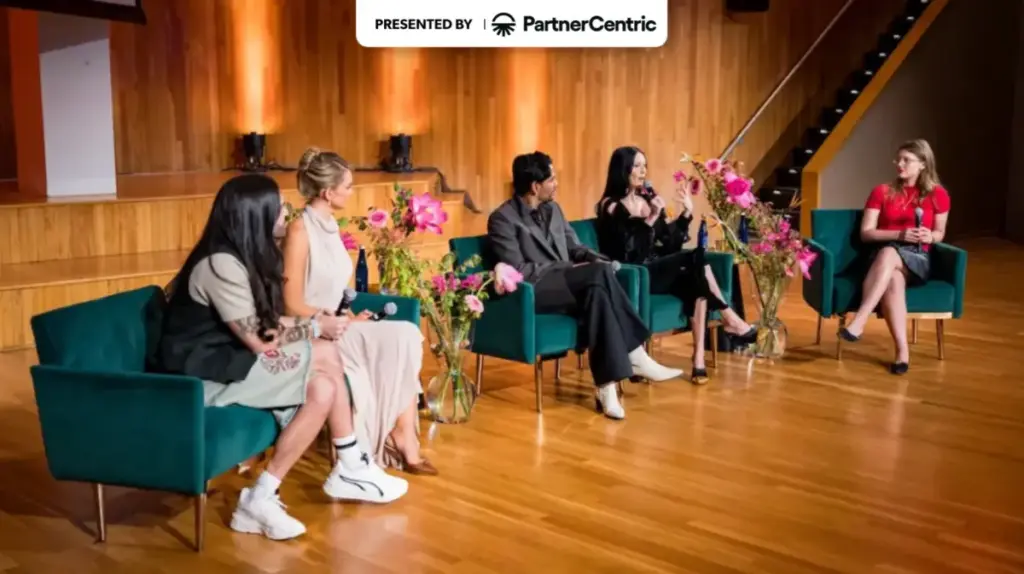
This pivotal shift took center stage during an exclusive panel discussion at New York Fashion Week, hosted by the digital media trade publication Glossy. Moderated by Glossy Senior Beauty Reporter Emily Jensen, the panel assembled four of the industry’s most prominent digital architects—Meredith Duxbury, makeup artist Aditya Madiraju, beauty creator Shay Sullivan, and hairstylist Matt Newman (widely known online as Matt Loves Hair).
While each panelist initially captured lightning in a bottle through distinct beauty niches, their collective consensus in New York was clear: the era of relying purely on shock value, algorithmic hacks, or fleeting internet trends is drawing to a close. Today’s digital creators are navigating a sophisticated evolution, moving away from superficial virality and pivoting toward authentic personality-driven content, practical value, multi-platform diversification, and long-term community building.
This comprehensive report examines the strategic paradigm shift currently reshaping the digital beauty industry. Through insights shared at the Glossy panel, we explore how top-tier creators are redefining audience retention, decoding the psychological contract between influencer and consumer, and transforming transient digital fame into enduring, tangible business enterprises.
Detailed Chronology: From Accidental Stardom to Intentional Longevity
To understand where the creator economy is heading, one must trace the evolutionary arc of those who built it. The journey from a lone smartphone camera in a bedroom to a seat at New York Fashion Week is rarely linear, marked by sudden explosions of growth followed by grueling phases of reinvention.
Phase 1: The Accidental Spark and the Power of the Niche
For Meredith Duxbury, the catalyst was visual disruption. In the early days of her TikTok journey, her heavy-handed foundation application defied conventional makeup wisdom, creating a stark visual contrast that forced users to stop scrolling. Was it practical? No. Was it mesmerizing? Absolutely. The comments section erupted into a polarized debate, and the algorithm did the rest.
Similarly, Matt Newman found his footing by solving hyper-specific aesthetic problems through unconventional means. His early hair tutorials resonated deeply, none more famously than a tutorial utilizing a disposable Dunkin’ coffee cup lid to construct a voluminous, effortless messy bun. These early milestones established a baseline: a strong, easily digestible hook can catapult an unknown creator into global visibility almost overnight.
Phase 2: The Vulnerability Deficit
However, the panelists noted that relying indefinitely on an initial trick quickly hits a psychological ceiling. Audiences saturated with content eventually grow immune to hyperbole. Duxbury realized that her silent, rapid-fire lip-syncing videos—while visually arresting—were failing to build a genuine bond.
Prompted by reading her own comments, Duxbury began talking to her camera, offering glimpses into her workday, her thoughts, and her personal life. The transition was transformative. By pulling back the curtain on her off-camera persona, she converted passive viewers—curious about her foundation routine—into dedicated loyalists invested in her as a person.
This sentiment was echoed by Shay Sullivan. Though her foundation remains rooted in hair and beauty content, Sullivan experienced a major breakthrough when her husband challenged her to expand her narrative. "Show more of your personality. Show more of your life," Sullivan recalled him advising. "That’s what people relate to." By injecting humor, daily struggles, and authentic lifestyle elements into her grid, Sullivan transcended the narrow confines of a traditional "beauty guru" to become a relatable companion to her followers.
Phase 3: The Pivot to Tangible Value and Diversification
As audiences matured, so did their expectations. Matt Newman observed a distinct fatigue among viewers regarding hollow gimmicks. In an era where attention spans are measured in milliseconds, consumers have developed a low tolerance for wasted time.
"People don’t want to feel like their time was wasted," Newman stated during the panel. Whether delivering a tutorial lasting 15 or 60 seconds, creators are now compelled to provide actionable, high-utility advice. If a viewer walks away without a tangible tip they can replicate in their own bathroom mirror, the content has failed its primary objective.
Yet, this demand for substance does not universally translate to compressed, bite-sized clips. Providing value can take multiple forms, as demonstrated by Aditya Madiraju. While short-form video dominates industry conversations, Madiraju routinely publishes in-depth TikTok tutorials running nine to eleven minutes long. Leveraging his analytical background in finance, Madiraju studies audience retention charts and dives deep into comment sections to decode precisely what his followers want next. To Madiraju, video length is secondary; the primary metric of success is whether the content continuously delivers on the foundational promise made to the viewer at the opening frame.
Supporting Context & Metrics: Decoding the Algorithm and Managing Burnout
Behind the glamorous facade of curated feeds and front-row seats at fashion shows lies a grueling operational reality. The metrics governing social media platforms—Instagram, TikTok, and YouTube—are famously volatile, creating an environment of profound unpredictability for even the most established digital stars.
The Illusion of Scale
Consider the numerical disparity highlighted by Aditya Madiraju. Despite commanding an impressive community of approximately 3 million followers on Instagram, Madiraju experiences wild fluctuations in engagement across his posts. This phenomenon underscores a fundamental truth of the modern creator economy: scale does not equal security.
A massive follower count acts as a community anchor, but it offers zero immunity against algorithmic shifts. Shay Sullivan reinforced this reality by sharing her own counter-intuitive experiences with content creation. Projects that demanded extensive preparation, high-end production equipment, and hours of painstaking editing often yielded lackluster engagement. Conversely, a spontaneous, unscripted voiceover recorded on a whim would occasionally skyrocket, achieving viral status overnight.
This inherent volatility introduces severe psychological strain. Newman reflected on his early years in the industry, admitting that the pressure to replicate a successful year two performance based purely on view counts felt suffocating. Tying self-worth and business viability strictly to algorithmic metrics creates a precarious, burnout-inducing cycle.
To achieve longevity, creators are increasingly detaching their mental health from view counts. Newman noted that he now evaluates his work through an internal lens: Am I genuinely proud of this piece of content, regardless of how the numbers perform?
Official Insights & Panel Highlights
The Glossy panel at New York Fashion Week provided rare, candid transparency into the mechanics of the digital beauty industry. Moderated expertly by Emily Jensen, the conversation crystallized into several core takeaways for brands, aspiring creators, and industry observers alike:
- Meredith Duxbury on Evolution: Emphasized that shifting from silent, hyper-visual videos to vocal, transparent communication was essential in turning transient viewers into a lasting community. Her new book, Get Ready with Meredith, represents the ultimate evolution of this philosophy—moving from ephemeral digital spaces into a tangible, offline medium.
- Shay Sullivan on Relatability: Highlighted that physical aesthetics alone cannot sustain a long-term digital career. By leaning into authentic personality traits and real-life experiences, creators unlock deeper layers of human empathy and connection with their audience.
- Matt Newman on Practical Utility: Stressed that modern audiences demand respect for their time. Gimmicks may spark initial curiosity, but sustained viewership requires delivering practical, high-value takeaways in every single piece of content, no matter how brief.
- Aditya Madiraju on Data-Driven Content: Demonstrated that analytical rigor—studying retention curves, analyzing audience questions, and ignoring arbitrary formatting rules in favor of depth—allows creators to thrive across long-form and short-form video ecosystems alike.
Future Outlook: Beyond the Screen and Into the Physical World
As the creator economy enters its next decade, the boundary between the digital screen and the physical world is dissolving. Creators who built their empires entirely in the cloud are increasingly looking for ways to establish permanent, physical footprints in the lives of their consumers.
Meredith Duxbury’s latest entrepreneurial venture serves as a textbook example of this macro-trend. With the launch of her book, Get Ready with Meredith, she bridges beauty, fashion, and deeply personal narratives—including her candid experiences with anxiety. Rather than asking her community to consume yet another piece of illuminated glass content, Duxbury crafted a physical artifact that followers can hold, read, and keep on their nightstands while taking an intentional break from their smartphones.
"I had so much content digitally online, but I didn’t have anything tangible to share with my community," Duxbury explained.
This pivot toward tangible experiences, physical product lines, books, and live events signals a mature phase in the creator economy. Virality is no longer viewed as a permanent destination, but merely as a top-of-funnel acquisition tool. The true test of a modern beauty creator lies in their ability to transition from an algorithm-dependent internet personality into a diversified, multi-platform media entrepreneur.
For the panel of experts gathered at New York Fashion Week, the message to the next generation of digital talent was unequivocal: algorithms will change, trends will fade, and view counts will fluctuate. But authenticity, practical utility, and a genuine, human connection with an audience will remain the ultimate currency of the digital age.