Executive Overview
In the realm of contemporary public life, wardrobe choices rarely occur in a vacuum. For former First Lady Michelle Obama, fashion has long served as a deliberate instrument of communication—a silent yet potent form of diplomacy, cultural advocacy, and artistic patronage. Over a whirlwind sequence of public appearances spanning continents and emotional extremes, Obama’s recent sartorial trajectory has offered a masterclass in how to dress for the moment without ever surrendering a distinct, highly individual point of view.
From the solemnity of New York’s 9/11 memorial ceremonies to the electric, star-studded energy of the U.S. Open, and culminating in a triumphant international flight to Paris for Céline Dion’s emotional return to the concert stage, Obama’s wardrobe has captured the multifaceted nature of modern American style. Rather than relying on tired tropes of traditional patriotism, her recent looks champion the visionary designers who are actively redefining what American fashion looks like today.
At the heart of this narrative is her deliberate, ongoing elevation of Black designers and immigrant creators—most notably Rachel Scott, the creative force behind Diotima and Proenza Schouler. By pairing high-profile global moments with intentional wardrobe selections, Obama continues to solidify her legacy as one of the most influential style figures of the twenty-first century, proving that clothing can simultaneously honor history, support marginalized talent, and project unyielding personal authority.
Detailed Chronology: A Week of High-Stakes Sartorial Moments
Michelle Obama’s recent fashion run reads like a carefully curated study in context-driven dressing. Within a matter of days, she transitioned seamlessly from the high-energy athletic spectacle of Flushing Meadows to the profound gravity of a national day of remembrance, and finally to the glittering, emotionally charged atmosphere of a Parisian music residency.
The U.S. Open: Leaning into Literal Americana
The journey began in New York City at the U.S. Open women’s semifinals. For an event deeply embedded in the American sporting calendar, Obama leaned into a more literal interpretation of Americana. She stepped out in a striking red, white, and navy striped Chanel midi dress, punctuated with gleaming gold buttons.
While Chanel is a storied French house, the garment’s clean lines and patriotic color palette offered a respectful nod to the host nation’s premier tennis tournament. The look struck a balance between casual elegance and high-fashion curation, drawing immediate praise from fashion critics and setting the tone for a week defined by thoughtful, occasion-appropriate ensembles.
The 9/11 Memorial: Gravity, Respect, and Texture
Just twenty-four hours later, the mood shifted dramatically. Alongside former President Barack Obama and other dignitaries, Michelle Obama attended events commemorating the 25th anniversary of the September 11 terrorist attacks in New York.
For an occasion demanding utmost solemnity and respect, theatricality was entirely absent. Instead, Obama chose a restrained brown jersey-and-leather Ferragamo dress. While the silhouette was suitably somber and respectful of the day’s heavy historical weight, the look remained recognizably "Obama" through its strong architectural lines and rich textural contrast. It was a powerful reminder that honoring a solemn moment does not require sacrificing personal style or sartorial sophistication.

Paris and Céline Dion: Championing Diotima
The most visually striking pivot of the week, however, occurred across the Atlantic. Leaving behind the shores of the United States, Obama jetted to Paris to join a star-studded audience for Céline Dion’s emotional return to the live concert stage. Marking Dion’s first full concert in more than six years—and the opening night of her much-anticipated Paris residency following a harrowing battle with stiff-person syndrome—the evening was an emotional triumph.
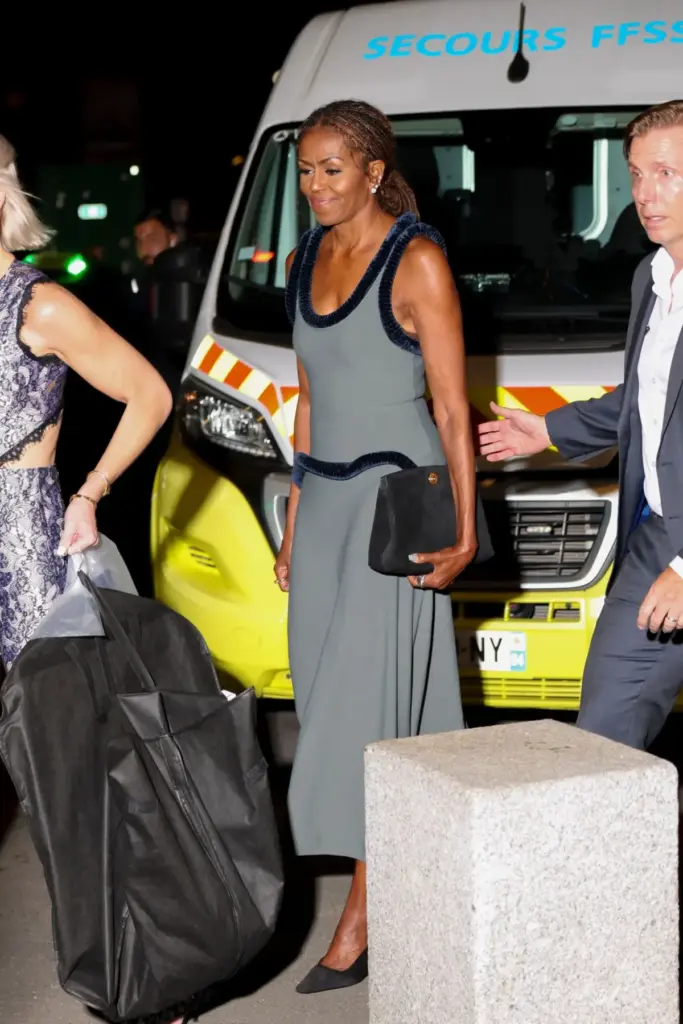
Surrounded by icons such as Oprah Winfrey, Shania Twain, and designer Haider Ackermann, Obama ensured her presence resonated both personally and sartorially. She wore a slate-gray maxi dress by Diotima, the New York-based label founded by Jamaican-born designer Rachel Scott.
The dress featured a low, curved neckline, a sculpted drop-waist bodice, and rich accents of deep navy velvet. Tonal accessories completed the ensemble: a buttery suede Liffner push-lock clutch and matching pumps. Her auburn-brunette braids were swept back into a loose, low ponytail, while subtle touches of color—a baby-pink lip and a pastel-blue manicure—softened the overall aesthetic. It was a sophisticated, deeply considered homage to an evening celebrating resilience, artistry, and survival.
Supporting Context & Metrics: The Power of Intentional Design
To fully appreciate Michelle Obama’s recent fashion choices, one must examine the economic and cultural ecosystem she actively supports. Her post-White House wardrobe has been defined by a consistent, intentional commitment to elevating Black designers and creatives with unique multicultural backgrounds.
Rachel Scott and the Rise of Diotima
Rachel Scott, the founder of Diotima and creative director of Proenza Schouler, represents a vital vanguard in contemporary American fashion. Founded in New York in 2021, Diotima is deeply rooted in Jamaican craft traditions—most notably intricate hand crochet work executed by artisans on the island. Scott seamlessly juxtaposes these traditional Caribbean techniques against precise, modern tailoring and sensual, body-conscious silhouettes.
Obama’s embrace of Scott is more than a fleeting trend; it is a burgeoning design partnership. Earlier in the summer, at the Essence Festival of Culture in July, Obama made headlines by wearing Scott’s other major label, Proenza Schouler, stepping out in a striking black dress punctuated with edgy fringe and gleaming grommets.
By wearing Diotima on the global stage in Paris—viewed by international press, photographers, and style archives worldwide—Obama provided invaluable visibility to a relatively young, minority-led brand bridging the gap between heritage craft and high-fashion luxury.
The Economics of the "FLOTUS Effect"
While political figures often downplay the financial impact of their clothing, the "FLOTUS Effect" remains a measurable economic catalyst. Academic studies and fashion industry metrics tracking Michelle Obama’s tenure in the White House famously demonstrated that her endorsement of a designer could generate millions of dollars in economic value for their brand almost overnight.

In her post-White House chapter, this phenomenon has evolved. Rather than elevating mass-market retailers or traditional corporate luxury houses exclusively, Obama has concentrated her influence on independent labels, immigrant designers, and marginalized talents. When a global icon like Obama wears a brand like Diotima to an internationally covered event like Céline Dion’s Paris comeback, it triggers a cascade of digital engagement, retail interest, and institutional validation that can fundamentally alter the trajectory of an emerging design house.
Official Statements & Cultural Commentary
Fashion historians and cultural critics have been quick to dissect the underlying philosophy of Obama’s recent sartorial run. In interviews and essays analyzing her post-White House style evolution, experts note a deliberate shift away from the rigid protocol of executive office dressing toward a more liberated, artistically driven curation.
"Michelle Obama understands that every single public appearance is a canvas," notes Dr. Elena Vance, a professor of fashion history and cultural studies at Parsons School of Design. "During her time as First Lady, her style was subjected to endless public scrutiny, forcing a delicate negotiation between diplomatic protocol and personal expression. Today, freed from those strict institutional constraints, she is using her wardrobe to curate a living archive of what American fashion should be—diverse, global, texturally rich, and deeply narrative-driven."
Furthermore, representatives for Diotima expressed profound gratitude following the Paris appearance, noting that the brand’s mission has always been to challenge monolithic definitions of luxury and identity. "To see our work embraced by a woman who symbolizes global grace and intellectual rigor is the ultimate validation of our narrative," a spokesperson for the brand shared in an informal statement.
Future Outlook: The Legacy of Post-White House Style
As Michelle Obama continues to navigate her multifaceted public life—balancing literary tours, civic advocacy, philanthropic initiatives, and high-profile cultural outings—her relationship with fashion remains an essential component of her public identity.
The events of this past week—from the red-white-and-blue Chanel at the U.S. Open to the solemn Ferragamo at the 9/11 memorial, and finally the groundbreaking Diotima maxi dress in Paris—signal a mature, unshakeable sense of self. Obama no longer needs to prove her patriotism through predictable sartorial clichés, nor does she need to conform to traditional expectations of post-political decorum.
Instead, she is actively writing a new playbook for former public figures. By championing visionaries like Rachel Scott, she ensures that the future of American style is inclusive, forward-thinking, and deeply connected to global craft traditions. As the fashion industry looks toward upcoming seasons, one truth remains abundantly clear: wherever Michelle Obama goes, her wardrobe will continue to tell a compelling story—one stitch, one designer, and one unforgettable moment at a time.