Achtung: Minor spoilers for Priscilla ahead!
Executive Overview
Elvis Presley remains etched in the cultural consciousness not merely as the King of Rock ’n’ Roll, but as a monumental architect of 20th-century fashion. With his flamboyant stage outfits, capes, high collars, and an innate flair for the avant-garde, he heavily dictated the stylistic currents of the 1960s and 1970s. Yet, in Sofia Coppola’s critically acclaimed biographical drama Priscilla—which stars Jacob Elordi as the cultural icon and Cailee Spaeny as his young wife, and draws directly from Priscilla Presley’s 1985 memoir Elvis and Me—the wardrobe operates on an entirely different frequency.
Rather than leaning into the bombastic, rhinestone-heavy spectacle typically associated with Graceland, the film’s costume design tells a quieter, deeply intimate story. It charts the harrowing psychological trajectory of a young woman gradually stripped of her autonomy, only to painstakingly reconstruct her own independent identity from the ashes of a suffocating marriage.
At the helm of this visual narrative is costume designer Stacey Battat, whose previous collaborations with Coppola on The Bling Ring and The Beguiled established a shorthand for capturing complex feminine interiority through fabric and silhouette. For Priscilla, Battat’s creative journey did not begin with the glitz of Las Vegas or the roaring crowds of screaming fans, but with a single, telling photograph taken in 1970. In this stark image, the widening chasm between Elvis and Priscilla is glaringly evident—not just in their physical posturing, but in the glaring stylistic dichotomy that signaled the dissolution of their relationship.
This article explores the exhaustive research, historical fidelity, high-fashion collaborations, and psychological symbolism that went into crafting the costumes for Priscilla. By breaking down the chronological evolution of Priscilla Beaulieu’s wardrobe, we uncover how clothing served simultaneously as Elvis’s instrument of control and, ultimately, Priscilla’s primary vehicle for emancipation.
Detailed Chronology: The Wardrobe Evolution of Priscilla Presley
To understand the profound transformation Priscilla undergoes throughout the film, one must trace her style chronologically. Battat and her team meticulously mapped out this evolution, mirroring the historical timeline of the couple’s relationship from an innocent military base romance in West Germany to the gilded cage of Graceland, and finally, to the liberating winds of 1970s Los Angeles.
Act I: The Innocence of West Germany (Late 1950s)
The film opens by introducing us to a 14-year-old Priscilla Beaulieu, living a relatively sheltered life with her military family on a U.S. Army base in West Germany. Here, her aesthetic is defined by the wholesome youthfulness of the era: pastel-colored cardigans, sweet A-line skirts, delicate blouses, and a signature heart necklace.
To achieve historical authenticity, Battat and her department dove headfirst into archival research, leafing through vintage editions of Vogue and Harper’s Bazaar from the late 1950s and early 1960s. They analyzed the exact fabrics, hemlines, and silhouettes that defined teenage American expatriate fashion in post-war Europe.
One striking visual reference point for the film is a real-life archival photograph of Priscilla waving goodbye to Elvis as he departs Germany to return to the United States. In the picture—and meticulously recreated in the film—she wears a charming plaid dress accompanied by a transparent headscarf. This early imagery establishes an unpretentious, approachable foundation for Priscilla, highlighting her vulnerability and youth before she is thrust into the dizzying, surreal orbit of global superstardom.
Act II: The Gilded Cage of Memphis and Graceland (The 1960s)
Upon relocating to Memphis, Tennessee, to live under the watchful eye of Elvis at Graceland, Priscilla’s wardrobe undergoes a drastic, enforced metamorphosis. The plaid skirts and innocent hair ribbons of her German adolescence are swiftly discarded, replaced by opera gloves, sophisticated coats, and glamorous minidresses that aligned with mid-60s high fashion.
However, this shift was far from organic. In the film—staying true to historical accounts—Elvis assumes the role of a Pygmalion figure, actively dictating what Priscilla should and should not wear. In an intimate and telling shopping scene, Elvis mandates her fashion choices, explicitly demanding that she dye her natural brown hair jet-black and heavily line her eyes with dramatic liquid eyeliner.
From this juncture onward, Priscilla’s visual palette is strictly curated. She appears in a succession of Elvis-approved pinks and baby blues—shades that suited his personal aesthetic preferences while systematically eliminating hues and patterns he despised, such as brown tones or busy prints.
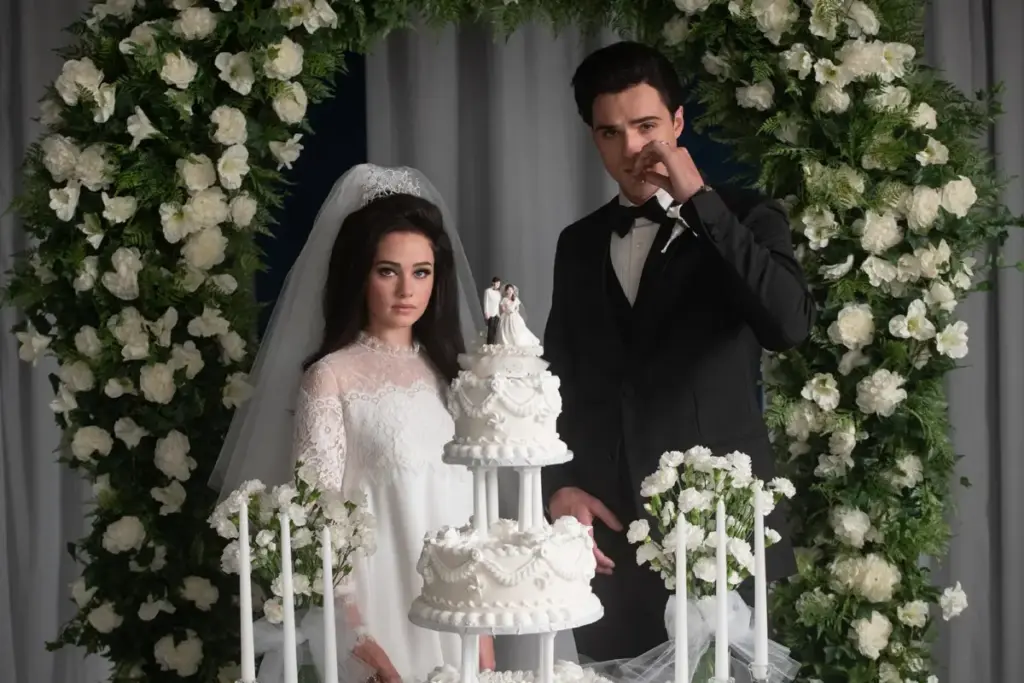
While much of the narrative tension in Priscilla is conveyed through quiet, domestic moments within the sprawling, carpeted halls of Graceland—where Priscilla wanders in pastel lingerie sets and delicate nightgowns—the public milestones demand historical precision. Chief among these is their landmark 1967 wedding in Las Vegas.
For this sequence, Battat partnered with luxury fashion powerhouses Chanel and Valentino, who respectively designed Priscilla’s wedding gown and Elvis’s sharp suit. Mirroring the iconic archival photographs from the wedding day, Spaeny’s Priscilla wears a long-sleeved, lace-trimmed A-line gown, complemented by a sparkling tiara and a dramatic, waist-length veil.
"The look contains clear allusions to the original dress," Battat notes, addressing the logistical challenges of the production. "We had to adapt parts of it to fit Cailee’s specific stature [she stands at 1.56 meters, or roughly 5’1"]," ensuring the proportions remained faithful to the petite frame of the historical figure. Similarly, the outfit Priscilla wears immediately following the birth of their daughter, Lisa Marie—a vibrant, brilliant pink dress—is a direct cinematic translation of her real-life post-maternity style.
Act III: Divergence, Las Vegas, and Liberation (The 1970s)
The second half of Priscilla bifurcates the couple’s geographical and emotional trajectories: Elvis reaches the zenith of his theatrical career headlining residency shows in Las Vegas, while Priscilla carves out a tentative, independent existence in Los Angeles. As the emotional chasm widens, their sartorial paths violently diverge.
Elvis transitions away from his classic leather jackets and tailored suits, diving headfirst into the hyper-theatricality of his iconic sequined jumpsuits. To recreate these legendary stage garments, Battat collaborated closely with BK Enterprises, the original company that tailored costumes for Elvis Presley during his Vegas years. Every rhinestone, belt, and cape was engineered to capture the blinding, peacock-like excess of late-era Elvis.
Conversely, Priscilla sheds the restrictive, pastel-hued constraints imposed upon her during her marriage. Embracing the relaxed, bohemian trends of the 1970s, she adopts wide-leg trousers, earthy patterns, and—symbolically—allows her natural brown hair to return in soft, liberating curls.
"When we looked at historical photos of Elvis and Priscilla, we thought about the image they presented to the world," reflects Battat. "I feel like he became increasingly theatrical and costume-like—heavy makeup, excessive jewelry, and massive sideburns. She, on the other hand, gradually sheds her mask."
Supporting Context & Metrics: The Art of Subtextual Costuming
To fully appreciate the labor behind Priscilla, one must evaluate the logistical and artistic metrics that guided Stacey Battat’s design process. Historical biopics often fall into the trap of historical cosplay—reproducing clothes simply because they existed in an archive. Battat, however, utilized costume as a metric for psychological enclosure.
- Color Theory as Emotional Control: In the Graceland years, the near-total absence of earthy tones, warm browns, and complex patterns in Priscilla’s wardrobe is not an aesthetic accident. It represents a psychological sanitization. Elvis’s aversion to certain colors functioned as a subtle boundary marker, boxing Priscilla into a visual category of perpetual doll-like innocence.
- Scale and Proportion: With lead actress Cailee Spaeny standing at 5’6" (1.56m) portraying a young woman entering a world dominated by towering male egos and gargantuan architecture, costume silhouettes were intentionally engineered to emphasize her initial fragility. High necklines, stiff A-line skirts, and voluminous veils frequently dwarf her early on, making her visual emancipation in flowing 1970s silhouettes all the more striking.
- Archival Collaborations: The inclusion of houses like Chanel and Valentino highlights the production’s commitment to high-end authenticity. Rather than relying solely on vintage stock, the wardrobe bridges the gap between cinematic storytelling and haute couture heritage.
Official Statements and Creative Insights
The philosophy underpinning Priscilla rests on a collaborative vision between director Sofia Coppola and costume designer Stacey Battat. In various press statements surrounding the film’s release, Battat has emphasized that the clothes were never meant to distract from the emotional core of the performances, but rather to amplify the underlying power dynamics of the script.
"Sofia and I looked at this picture together [from 1970] and both agreed that Priscilla looks like she feels deeply uncomfortable," Battat explains, referencing the foundational photo that inspired the film’s visual arc. "I think that photo strongly reflects how we see the two of them later in the film."
Unlike Baz Luhrmann’s maximalist 2022 biopic Elvis, which treated the King’s wardrobe as a spectacle of rock-and-roll mythology, Coppola’s lens treats fashion as a cage. Every garment worn by Spaeny serves as a physical manifestation of the expectations placed upon a teenage bride thrust into an impossible spotlight. The transition from stiff, artificial perfection to soft, organic self-expression is executed with surgical precision, ensuring that the audience feels every ounce of the emotional weight Priscilla carries.
Future Outlook: The Enduring Legacy of Priscilla’s Aesthetic
As Priscilla continues to captivate audiences worldwide in cinemas, its impact on contemporary fashion and cinematic design is already palpable. The film has reignited a cultural fascination with 1960s mod aesthetics, soft pastel subversion, and the bittersweet glamour of mid-century Americana.
More importantly, the film redefines how biopics handle female subjects trapped in the gravitational pull of monumental male figures. By shifting the focus from the pyrotechnics of fame to the quiet, devastating architecture of a wardrobe dictated by another, Priscilla offers a masterclass in subtextual costume design. It proves that what a character is forced to wear can speak infinitely louder than the dialogue they are given—and that true freedom often begins with shedding the clothes that were never truly yours to begin with.
Priscilla is now playing in theaters nationwide.