Executive Overview
Air travel across the United Kingdom plunged into profound chaos on Tuesday, September 8, 2026, following a critical technical failure within the National Air Traffic Services (NATS) flight processing system. The software malfunction, which first manifested around lunchtime, severely restricted the London Flight Information Region (FIR) and triggered a cascade of sweeping Air Traffic Flow Management (ATFM) regulations across the continent.
By late afternoon, European air traffic manager Eurocontrol and independent tracking platforms reported hundreds of flight cancellations and thousands of extensive delays. Major aviation hubs—including London Heathrow, Gatwick, Luton, Manchester, and Edinburgh—became epicentres of severe congestion. Passengers endured hours of confinement inside grounded aircraft under stifling conditions, while others faced sudden cancellations and an acute lack of communication from major carriers like easyJet, British Airways, and Ryanair.
Although NATS engineers successfully implemented an emergency software fix by mid-afternoon, industry experts warn that the structural fallout from the digital outage will take days to fully unwind. With airlines forced to scramble for network recovery plans, the incident has reignited fierce political and commercial scrutiny over the resilience of Britain’s critical aviation infrastructure.

Detailed Chronology of the Crisis
1. The Onset and Initial Warnings (13:17 – 15:00 BST)
The disruption began shortly after 1:00 PM BST when Eurocontrol registered a sudden technical anomaly impacting the London Flight Information Region. The problem rapidly escalated, forcing air traffic managers to implement strict capacity restrictions to maintain absolute safety in British airspace.
By 2:00 PM, major aviation hubs began reporting operational bottlenecks. Flight tracking data from Flightradar24 revealed that inbound flights to Heathrow were heavily disrupted, with Eurocontrol officially marking the airport as unavailable for arrivals between 2:00 PM and 4:00 PM UTC. Incoming aircraft were forced into holding patterns or diverted to alternative northern locations, such as Manchester Airport, while departures ground to a virtual standstill.
2. Escalating Delays and Grounded Aircraft (15:00 – 16:30 BST)
As the afternoon progressed, the logistical gridlock deepened. Passengers already onboard stationary aircraft found themselves trapped for hours without adequate air conditioning or reliable updates.

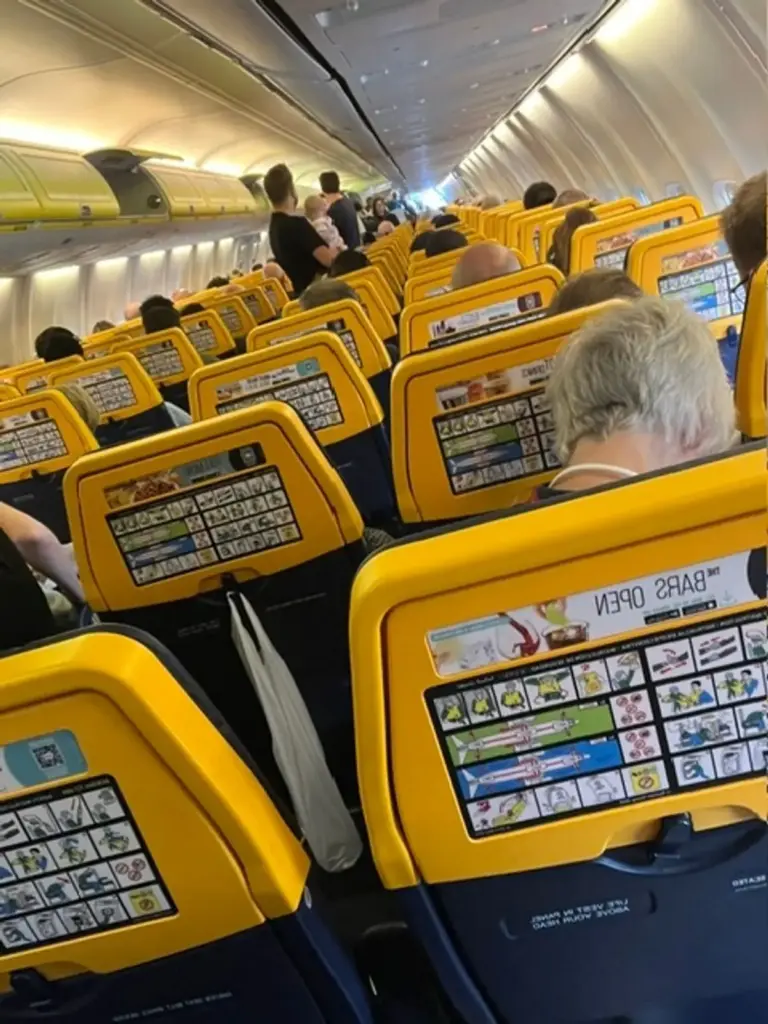
- The Toulouse-Stansted Service: Passengers aboard Ryanair flight FR282 from Toulouse to Stansted—originally scheduled to depart at 12:10 PM—reported being stuck inside the cabin for over five hours as updates trickled in at half-hour intervals.
- Extreme Heat Incidents: On another grounded Ryanair flight, travellers complained of stifling interior temperatures exceeding 30°C. One disabled passenger, expressing severe health concerns regarding the heat, was reportedly given the choice to disembark entirely.
- Stranded Families: Similar scenes played out across multiple airports. A family travelling on an Air France flight from Paris Charles de Gaulle to Newcastle reported being trapped on the tarmac with an infant after learning of a projected five-hour delay. Meanwhile, passengers heading to Cyprus on easyJet flight EZY3169 from Glasgow endured hours of confinement on the tarmac.
3. The Technical Fix and Recovery Phase (16:30 – 18:00 BST)
At approximately 3:45 PM, NATS confirmed that technicians had isolated the root cause of the disruption—a critical fault within its core flight processing system. Engineers mobilized urgently to deploy a patch, and by 4:50 PM, NATS announced that the system was beginning to recover following the implementation of the fix.
Despite the technical resolution, aviation authorities emphasized that safety protocols dictate a measured, step-by-step restoration of airspace capacity. Consequently, the volume of cancellations continued to rise long after the software patch went live, turning a localized technical glitch into a nationwide operational crisis.
Supporting Context and Metrics: The Scale of the Disruption
The digital failure paralyzed roughly 4% of all UK flights—a proportion described by industry analysts as "exponentially higher than normal."

Flight Cancellation Metrics
By 5:00 PM BST, flight intelligence platform Flightradar24 confirmed that 425 flights to and from UK airports had been cancelled. The brunt of these cancellations fell on low-cost and flag carriers managing tight European turnaround schedules:
- EasyJet: 137 flights cancelled
- British Airways: 111 flights cancelled
- KLM: 26 flights cancelled
- Eurowings: 22 flights cancelled
- Ryanair: 21 flights cancelled (with total disruption numbers affecting over 65,000 of their passengers)
Airport Impact Breakdown
The disruption spared few corners of the UK aviation network, though southern airports bore the heaviest burden:
- London Heathrow: Out of roughly 1,300 daily operations, 352 flights suffered severe delays, alongside widespread inbound diversion measures.
- London Gatwick: Recorded 281 delayed flights out of roughly 850 normal daily operations, leaving departure lounges packed to capacity.
- Manchester Airport: Logged 249 delayed services out of 650 normal daily operations.
- Birmingham Airport: Suffered 101 delayed departures out of 300 scheduled operations, directly impacting regional connectivity.
- Edinburgh Airport: Over 58% of all flights were delayed, averaging 26 minutes per flight, pushing the Scottish hub high on global disruption monitoring charts.
- Regional Hubs: Newcastle, Luton, London City, Southend, Glasgow, Belfast, Jersey, Aberdeen, and Southampton all reported cascading knock-on delays.
A satellite-view snapshot from Flightradar24 captured the surreal reality of the crisis: a near-empty airspace over London, a city normally blanketed by hundreds of overlapping commercial flight paths, starkly demonstrating the sudden vacuum left by the NATS regulations.

Passenger Experiences and Industry Backlash
As terminal buildings filled with restless travellers, frustration quickly turned to anger over perceived communication failures from airlines. Social media platforms like X (formerly Twitter) became inundated with complaints.
At Alicante and Porto, passengers reported a complete absence of ground staff after security clearances, leaving travellers stranded without guidance. At Gatwick, a passenger waiting hours past their 2:20 PM departure slot took to social media to mock easyJet’s compensation strategy: "At least EasyJet have offered us a snack of up to value £2.80! Can’t even buy any food or beverages and I’m starving."
Commercial airlines did not hold back their fury either. In a scathing public statement, Ryanair pointedly called for the immediate resignation of NATS Chief Executive Martin Rolfe, labelling the incident "yet another UK ATC system failure" and condemning the management for inflicting misery on tens of thousands of holidaymakers and business travellers alike.

Official Statements and Institutional Response
The cascading crisis drew swift responses from government officials, air traffic authorities, and airport operators:
-
NATS Official Statement:
"We are investigating a technical issue affecting our flight processing system. Engineers are on site and working urgently to resolve the situation. While a fix has been implemented and systems are starting to recover, recovery will take some time. We sincerely apologise for the disruption caused to passengers."

-
Eurocontrol:
"The situation remains very dynamic. A technical issue affecting the London Flight Information Region (FIR) has led to multiple ATFM regulations. We are in close coordination with UK navigation provider Nats and operational stakeholders to mitigate network traffic disruption."
-
Department for Transport:
Transport Secretary Heidi Alexander addressed the public via social media, confirming that she was monitoring the situation closely and noting that technicians were actively working to resolve the issue at Heathrow, Gatwick, and surrounding facilities.
-
Airlines and Operators:
EasyJet confirmed that while some services were completely grounded, affected passengers were being provided with hotel accommodation, meals, and options for refunds or free transfers. Major groups like Manchester Airports Group and Heathrow urged travelers to verify their flight statuses directly with airlines before making the journey to terminals.
Future Outlook and Systemic Vulnerabilities
While NATS has successfully patched the immediate software flaw, the institutional and systemic fallout from the September 8 failure will reverberate for days.
Airlines now face an uphill battle to reposition aircraft and crew members scattered out of position across European networks. Ian Petchenik, Director of Communications at Flightradar24, noted that the true challenge lies in "unwinding the damage," predicting that visible cancellations will fluctuate before gradually tapering off as schedules normalize.

More broadly, the incident has exposed deep-seated vulnerabilities in the technological backbone of European and British airspace management. Coming after previous high-profile IT failures in recent years, this latest outage will undoubtedly trigger rigorous parliamentary inquiries into NATS’ infrastructure modernization programs, spending priorities, and emergency contingency protocols. Until robust redundancies are proven, millions of passengers will continue to fly under the shadow of potential digital gridlock.