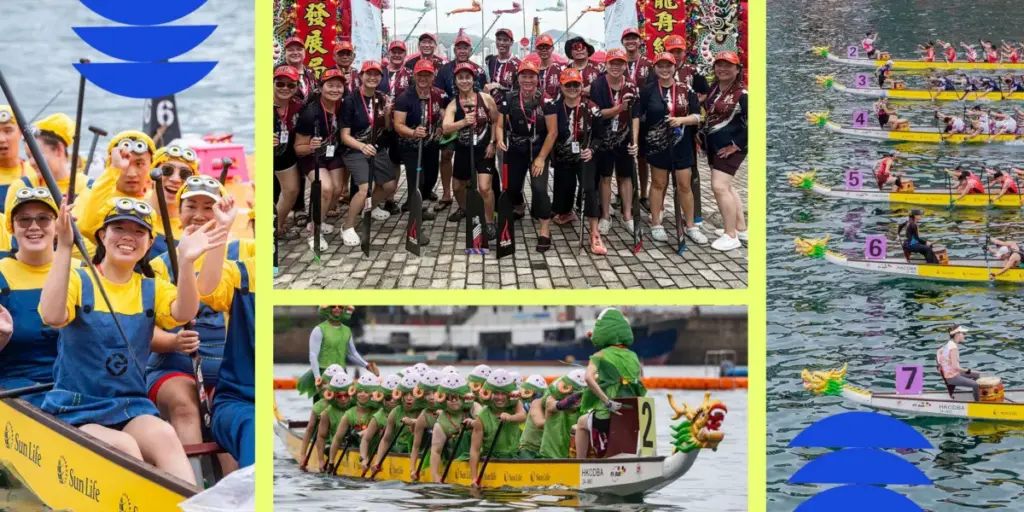
Under a brooding June sky in Hong Kong, the Victoria Harbour waterfront thrums with an electric energy that defies the oppressive climate. At 9 a.m., the thermometer reads 82 degrees Fahrenheit, suffocatingly wrapped in an 88-percent humidity layer threatening afternoon thunderstorms. Yet, the gray, murky waters pulse with life. Brilliant, artistic canoes—accented with striking red-and-gold flourishes and terminating in fierce, ornate dragon heads—slice cleanly through the chop.
This is the Hong Kong International Dragon Boat Festival, a sensory overload of sound and motion. ABBA’s "Dancing Queen" reverberates from powerful public-address speakers, competing with enthusiastic Cantonese race announcements and the rhythmic, thunderous beating of wooden drums. Along the Tsim Sha Tsui Promenade, families, locals, and international travelers intermingle in a colorful sea of board shorts, team jerseys, and raised paddles.
For the uninitiated, dragon boat racing can initially look like a chaotic celebration. But beneath the festive costumes and communal revelry lies a brutal, highly technical elite athletic discipline. It is a sport anchored in over two millennia of folklore, yet fiercely modern in its execution. More than 220 teams representing every corner of the globe converge on this harbor, uniting individuals from vastly different generations, backgrounds, and athletic pedigrees.
As a unique intersection of ancient cultural heritage, intense physiological conditioning, and radical inclusivity, dragon boat racing has quietly evolved into one of the world’s most dynamic team sports. It is a discipline where a ten-year-old child and an eighty-one-year-old senior citizen sit on the exact same wooden bench, striving toward a singular, synchronized goal: propelling a 22-person canoe across a finish line faster than anyone else.
Detailed Chronology: From Ancient Tragedy to Modern International Sport
The Folklore of Qu Yuan
To truly understand the spirit of dragon boating, one must look back over 2,000 years to ancient China and the Kingdom of Chu. During this tumultuous era, the regional government was marred by corruption and political decay. Among the intellectual elite was Qu Yuan, a renowned poet, aristocrat, and statesman whose progressive ideas sharply conflicted with the reigning emperor’s agenda.
Disturbed by the corruption tearing his homeland apart, Qu Yuan penned powerful verses criticizing the administration. His unwavering integrity and vocal dissent ultimately led to his banishment from the country. Heartbroken and disillusioned by the state of his nation, Qu Yuan waded into the Miluo River and ended his life by ritual drowning.
The local villagers, who deeply loved and revered the poet, were devastated. Desperate to save his body from being devoured by fish and river monsters, they rapidly piled into long wooden boats. They raced out onto the water, furiously beating drums and splashing their oars to scare away aquatic life, while scattering balls of sticky rice (zongzi) into the water to feed the fish instead.
This poignant rescue attempt laid the psychological and cultural foundation for the Tuen Ng Festival—commonly known today as the Dragon Boat Festival. Over the centuries, the solemn memorial evolved into a ritualistic folk tradition of racing long, dragon-adorned boats to court good fortune and ward off evil.
The Birth of Modern Competition
While the cultural traditions endured for millennia, the modern, standardized sport of international dragon boat racing was officially born in July 1976. The Hong Kong Tourism Board organized the inaugural Hong Kong International Races, transforming an ancient folk custom into a regulated, international sporting competition.
This year marks the milestone 50th anniversary of modern dragon boat racing. What began as a regional exhibition featuring a handful of local teams has snowballed into a worldwide movement. Today, the International Dragon Boat Federation (IDBF) governs thousands of clubs across more than 60 countries, staging continental and world championships that draw hundreds of thousands of competitive athletes.
Supporting Context & Metrics: Anatomy of a Dragon Boat and Its Fleet
Vessel Specifications and Crew Roles
A standard international dragon boat is a marvel of traditional craftsmanship meeting modern engineering. Typically measuring roughly 40 feet in length, the boat requires a precise complement of 22 people working in absolute synchronicity.
The seating configuration and division of labor inside the boat are meticulously orchestrated:
The Drummer: Positioned at the very front of the boat facing the crew, the drummer acts as the heartbeat and tactical commander of the vessel. Striking a traditional drum, they keep the pace, signal changes in stroke rate, and marshal the crew’s psychological fortitude.
The Paddlers: Ten rows of two paddlers sit side-by-side on wooden benches, totaling 20 athletes. These paddlers are strategically sorted by physical attributes and biomechanical efficiency:
The Front Set (Timers): Typically lighter, highly technical paddlers who set the precise timing and stroke rate for the rest of the boat to follow.
The Middle Set (Power Paddlers): The physically imposing powerhouses of the vessel. These athletes generate the massive torque required to maintain boat speed through the mid-section of a race.
The Back Set (The Rockets): Positioned in the final three benches, these endurance specialists dig deep into their remaining stamina to execute explosive drives, propelling the boat aggressively across the finish line.
The Steersperson: Standing at the stern, the steersperson commands a long sweep oar. They are responsible for navigating the vessel, countering crosswinds and currents, and ensuring the boat maintains the absolute straightest, fastest line down the course.
Race Distances and Physiological Demands
Unlike endurance-heavy disciplines like crew or marathon running, dragon boat racing is fundamentally a high-intensity sprint. The standard international race distance is 500 meters—roughly a third of a mile. Major international regattas also feature longer-distance tests ranging from 1 to 2 kilometers (approximately 0.62 to 1.2 miles).
For a 500-meter sprint, elite crews aim for a finishing time under two minutes. This makes the race a punishing anaerobic test. Lactic acid pools rapidly in the muscles around the 350-to-400-meter mark, pushing athletes to their absolute physiological limits.
The true magic of dragon boating lies in its radical accessibility. It is a sport that welcomes individuals who have never picked up an oar, yet offers a competitive ladder high enough to satisfy elite Olympians.
Lisa Minerd: The Ultimate Team Sport
Lisa Minerd, 67, president of the San Diego Dragon Boat Team and a veteran competitor who represented Team USA at the 2023 World Championships in Thailand, views the sport through an uncompromising lens of collective accountability.
"You can be an Olympian, or you can be a 60-year-old who paddled for two or three years and that’s it," Minerd explains. "And you get into that boat together; you are working together as a team. You have to, or that boat isn’t going to move very well, and you can forget about winning anything."
Reflecting on her journey from watching the festival as a child in Hong Kong to competing internationally in her late fifties, Minerd emphasizes the psychological grit required to excel.
"When you think you are completely spent, you have 40 percent more," Minerd says, quoting the mental mantra she loops in her head during the agonizing final 50 meters of a 1,000-meter race. "That’s the mental game. It’s about whether you have that mental toughness to overcome the fatigue and push that boat through."
Shirley Lau: Fulfilling Childhood Destiny
For Shirley Lau, co-captain of the San Francisco-based Oyster Point Dragons, finding the sport felt like closing a generational circle. At six years old, she sat on her father’s shoulders along the Victoria Harbour promenade, mesmerized by the magnificent dragon boats slicing through the water. Decades later, after moving to the United States and raising a family, Lau crossed the finish line of a half-marathon, spotted a dragon boat recruitment booth, and felt an instant pull to the water.
"Now, I’m paying it forward and trying to train people the same way—be patient, a lot of love, a lot of encouragement," Lau says. At 56 years old, she coordinates a roster that features athletes spanning a remarkable age gap. "Our youngest member is 10 years old and our oldest is 81. But this group that I have right here is really like a family."
Jane Chao Pun & Andrea Yu: Multi-Generational Wellness
Jane Chao Pun, a 54-year-old nurse practitioner with the Oyster Point Dragons, joined the team alongside her teenage son to share an active extracurricular pursuit. Today, she credits the sport with transforming her physical and mental health.
"At 54, this is the best shape I’ve ever been in my whole life," Chao Pun notes. "Doing this activity will even maybe add years to my life that I didn’t think I would gain before."
This sentiment is echoed by younger practitioners like 20-year-old Andrea Yu, who started paddling in middle school.
"The competitive culture is a lot more friendly," Yu observes. "On the water, all the teams, we congratulate each other, we hang out, we have a lot of fun. There’s space for everyone here."
Future Outlook: Growth, Inclusivity, and the Next Generation
As dragon boat racing looks toward the next half-century, its trajectory points sharply upward. Sport administrators and veteran coaches point to a surging influx of youth paddlers as the primary engine driving the sport’s global longevity. High school clubs, collegiate programs, and community-based organizations are successfully introducing younger demographics to water sports, dismantling the outdated perception that dragon boating is strictly an adult recreational hobby.
Furthermore, the sport serves as a shining model of gender equity. Unlike many traditional sports where structural divisions isolate male and female athletes, dragon boating is natively integrated. Crews frequently feature mixed-gender rosters where athletes are evaluated purely on their biomechanical output, resilience, and synchronicity.
"I look at myself as an athlete first, not a female athlete," Lisa Minerd asserts. "I want to beat my male friends as well."
With specialized training paradigms evolving—incorporating Zone 2 cardiovascular endurance, deadlifts, TRX rows, core rotational stability, and ergometer simulations—the athletic caliber of the sport continues to rise. Yet, despite the professionalization of top-tier international competitions, the grassroots soul of dragon boating remains completely un-gatekept.
Whether an athlete is seeking a supportive community to protect their mental health, a rigorous full-body workout that engages the lats, core, and hips, or simply a deeply immersive cultural tradition, the door is wide open. As the global community of paddlers expands across oceans and continents, the core ethos of the sport remains unwavering: once you step onto that wooden bench, pick up your paddle, and push off from the shore, individual titles dissolve. In a dragon boat, you either succeed as one, or you fail as one.