Executive Overview
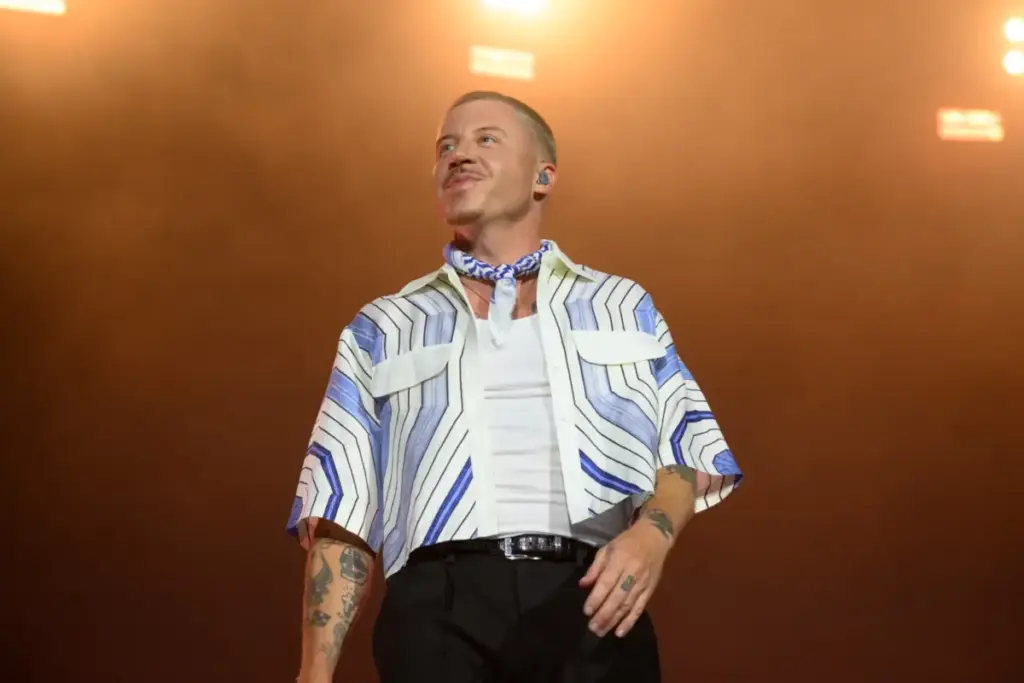
The intersection of popular culture, live entertainment, and international geopolitics has long been a volatile space, but few moments in recent memory have bridged these worlds as sharply as Macklemore’s performance at New Jersey’s MetLife Stadium on Friday, September 4. Serving as the direct support act for British pop megastar Ed Sheeran during a high-profile stop on his sprawling Loop Tour, the 43-year-old rapper seized the massive stadium platform to deliver an impassioned, politically charged speech. His vocal condemnation of ongoing global conflicts, punctuated by a demand to "Free Palestine" and the performance of his provocative protest anthem "Hind’s Hall," instantly ignited a fierce public debate.
While fans in the stadium responded with a mix of cheers and stunned silence, the broader cultural fallout was immediate. Within days, the Israeli-American Council (IAC)—a prominent organization representing more than 150,000 Israeli Americans—mobilized an aggressive counter-offensive. Launching a targeted online petition, the organization called for the rapper’s immediate removal from all remaining dates of Sheeran’s tour.
This incident transcends a simple clash of personal opinions; it serves as a litmus test for the modern live music industry. As artists increasingly use multi-million-dollar global tours as megaphones for sociopolitical causes, venue owners, tour promoters, and major headliners find themselves navigating a precarious tightrope. At stake is the delicate balance between freedom of artistic expression, the expectations of ticket-buying audiences, and the corporate liabilities of massive stadium productions. This report examines the chronology of the MetLife Stadium controversy, the broader contextual framework of Macklemore’s political activism, the swift response from advocacy groups, and the potential long-term implications for touring artists navigating the turbulent waters of modern geopolitics.
Detailed Chronology: The MetLife Stadium Incident
The events leading up to the controversy at MetLife Stadium unfolded under the heavy scrutiny that accompanies any major tour stop. Ed Sheeran’s Loop Tour is a massive global undertaking, regularly drawing tens of thousands of attendees to iconic venues across North America. For Macklemore, performing as direct support offered an expansive platform to reach diverse audiences far beyond his traditional base.
However, the rapper’s intentions for the tour were clear from the outset: the stage was not merely a place to perform commercial hits like "Thrift Shop" or "Can’t Hold Us," but an instrument for advocacy.
The Onstage Address
Midway through his high-energy set on September 4, Macklemore paused the music to address the stadium crowd directly. Speaking with deliberate intensity, the Grammy-winning artist explained his motivation for joining the tour lineup.
"A big part of the reason why I wanted to do this tour in the first place is so I could stand up in stadiums like this and say two words that are very near and dear to my heart: Free Palestine," Macklemore told the audience, his voice echoing across the packed arena. "I said, ‘Free Palestine!’ I want those words to be loud and clear, so that people all the way in Gaza to the occupied West Bank know that we have not forgotten about them."
The speech quickly expanded beyond the Israeli-Palestinian conflict into a broad-ranging critique of global violence and domestic policy. Macklemore articulated a vision of universal human safety, contrasting the realities of war with the fundamental innocence of childhood. He argued that every human being deserves to "know safety and peace before they know the sound of violence," and to hear "the sound of laughter on a playground before planes and bombs." He further emphasized the anguish of parents wondering if they will ever see their children again.
The Performance of "Hind’s Hall"
Central to the rapper’s set was the live rendition of his contentious protest song, "Hind’s Hall." Released earlier in May 2024, the track was written in direct response to the escalating humanitarian crisis in Gaza and the sweeping wave of pro-Palestinian student protests across American college campuses. The song, which heavily criticizes U.S. foreign policy and military support for Israel, became an anthem for anti-war activists. Performing the track live inside a major NFL stadium amplified its message to a scale rarely seen for political protest music in contemporary pop culture.
The Amplification of Radical Critique
As his remarks continued, Macklemore addressed his own internal hesitations about speaking out on such a massive, commercially sensitive stage. He confessed to experiencing fear prior to taking the stage—concerns about alienating audiences or disrupting the comfortable, entertainment-driven atmosphere expected at a major pop concert.
"And if I let that fear I felt on the plane yesterday stop me from speaking my heart in order to keep my own comfort and the audience’s comfort, that is the day I no longer continue to be on stage," he declared to the crowd.
He then broadened his political scope, invoking international and domestic flashpoints:
"So, I say ‘Free Palestine!’ I say, free America, free Cuba to the Congo to Sudan to Iran, and all the people in America who have to live in fear because of this terrorist organization ICE."
With these closing words, the performance concluded, leaving an indelible mark on the evening and setting off a chain reaction that would reverberate far beyond the stadium parking lots.
Supporting Context & Metrics: Macklemore’s Activism and the Tour Landscape
To fully understand the weight of the MetLife Stadium incident, one must examine the trajectory of Macklemore’s recent career and the logistical footprint of the tour itself. Over the past several years, the Seattle-born rapper has increasingly pivoted away from pure pop-rap formulas to embrace explicit sociopolitical activism, a transformation that has cemented his status as a polarizing figure in modern music.
The Genesis of "Hind’s Hall"
Macklemore’s alignment with the pro-Palestinian movement crystallized in early 2024. Following the outbreak of the Israel-Hamas war and the subsequent devastation in the Gaza Strip, the rapper utilized his digital platforms and musical output to voice fierce opposition. The release of "Hind’s Hall"—named after Hind Rajab, a six-year-old Palestinian girl killed in Gaza, and the renaming of Hamilton Hall at Columbia University during student demonstrations—marked a turning point.

Crucially, Macklemore pledged that all streaming proceeds generated by the protest song would be directed to the United Nations Relief and Works Agency (UNRWA), the primary humanitarian organization aiding Palestinian refugees. This financial commitment transformed his musical output from symbolic gesture to material support, drawing both intense praise from human rights advocates and sharp condemnation from pro-Israel organizations.
The High-Stakes Touring Environment
Ed Sheeran’s Loop Tour represents a massive commercial enterprise. According to official tour schedules and ticketing platforms, Macklemore was slated to open eight major U.S. stadium shows spanning from mid-September through early November. These venues—massive, open-air or domed sports cathedrals—routinely host crowds exceeding 50,000 to 80,000 patrons per night.
Performing as an opening act on such a tour grants an artist access to an audience vastly larger than their own headlining demographic. However, it also creates a complex contractual and ethical dynamic. Opening acts are typically hired by booking agencies, tour management, or the headliner to warm up the crowd and complement the overarching entertainment brand. When an opening act uses that shared platform to launch partisan political attacks or controversial advocacy campaigns, it introduces friction between the performer, the headliner, financial stakeholders, and ticket holders who paid to experience a music concert rather than a political rally.
Official Statements and Institutional Backlash
The ripple effects of Macklemore’s MetLife speech were felt immediately within political advocacy circles. Chief among the critics was the Israeli-American Council (IAC), an influential civil rights and community organization representing over 150,000 Israeli Americans across the United States.
The IAC Campaign and Petition
Recognizing the cultural weight of a stadium-scale platform being used for political proselytizing, the IAC swiftly mobilized. The organization launched a formal online petition directed at tour leadership, demanding Macklemore’s immediate removal from all remaining dates on Ed Sheeran’s itinerary.
The petition statement issued by the IAC sharply challenged the appropriateness of the rapper’s actions, framing them as a breach of consumer trust and a misuse of artistic privilege:
"This was an Ed Sheeran concert—not a political rally, not a protest, and not an activist event," the IAC petition stated. "The issue is not whether Macklemore has the right to hold political views. The question is where the line should be drawn when an opening act uses a global concert platform to advance a one-sided political agenda. This becomes even more troubling when the message relies on selective imagery, biased messaging, and disputed claims presented to a massive audience as fact, without context or complexity."
Furthermore, the organization pressed tour leadership for transparency regarding accountability and operational oversight. The petition explicitly called on producers and management teams to clarify whether Macklemore’s political rhetoric, accompanying visual imagery, and the performance of "Hind’s Hall" had been vetted and approved in advance. The IAC urged tour organizers to establish definitive boundaries governing how shared concert stages can be utilized for political messaging in the future.
Silence from Tour Leadership
As the petition gathered digital signatures and generated widespread media coverage across trade publications and mainstream news outlets, neither Ed Sheeran nor his primary booking and management teams issued an immediate public statement regarding the controversy. This strategic silence highlights the precarious position occupied by headliners when their support acts court political controversy. Disavowing an opening act risks alienating progressive fans and free-speech advocates, while failing to address the issue risks drawing the ire of organized community groups and alienating ticket holders seeking apolitical entertainment.
Future Outlook: The Intersection of Music and Politics
The fallout from Macklemore’s MetLife Stadium performance highlights a broader, ongoing transformation within the live entertainment industry. As global conflicts continue to polarize public opinion, artists are increasingly pressured by their own moral compasses—and demanding fan bases—to take public stands. However, the stadium stage remains a corporate-backed, highly commercialized space where millions of dollars in production costs, sponsorships, and ticket sales depend on broad consumer goodwill.
Several critical questions emerge from this controversy for the future of live touring:
-
The Redefining of Artist-Promoter Agreements:
Tour organizers and booking agencies may begin implementing stricter clauses in standard support-act contracts regarding political speech, content vetting, and unexpected stage banter, attempting to shield massive commercial tours from unexpected public relations crises. -
Audience Polarization and Consumer Expectations:
As concertgoers face rising ticket prices in an inflationary economy, expectations regarding the primary purpose of live events are shifting. While some fans applaud artists who use their platforms to champion human rights and social justice, others argue that purchasing a ticket to a pop concert should guarantee an escape from partisan politics and global conflict. -
The Precedent for Future Protests:
Macklemore’s willingness to risk his position on a major tour to amplify causes ranging from Gaza and Sudan to domestic issues involving immigration enforcement signals that socially conscious artists are unlikely to self-censor. For these performers, the stage is an extension of their civic duty, regardless of commercial consequences.
Ultimately, the clash at MetLife Stadium serves as a bellwether for the modern entertainment landscape. It demonstrates that the boundaries separating art, commerce, and geopolitics have dissolved. Whether tour organizers choose to clamp down on political expression or accommodate the growing appetite for artist-led activism, the events of September 4 ensure that the stadium stage will remain a hotly contested battleground for the cultural and political debates of our time.