Executive Overview
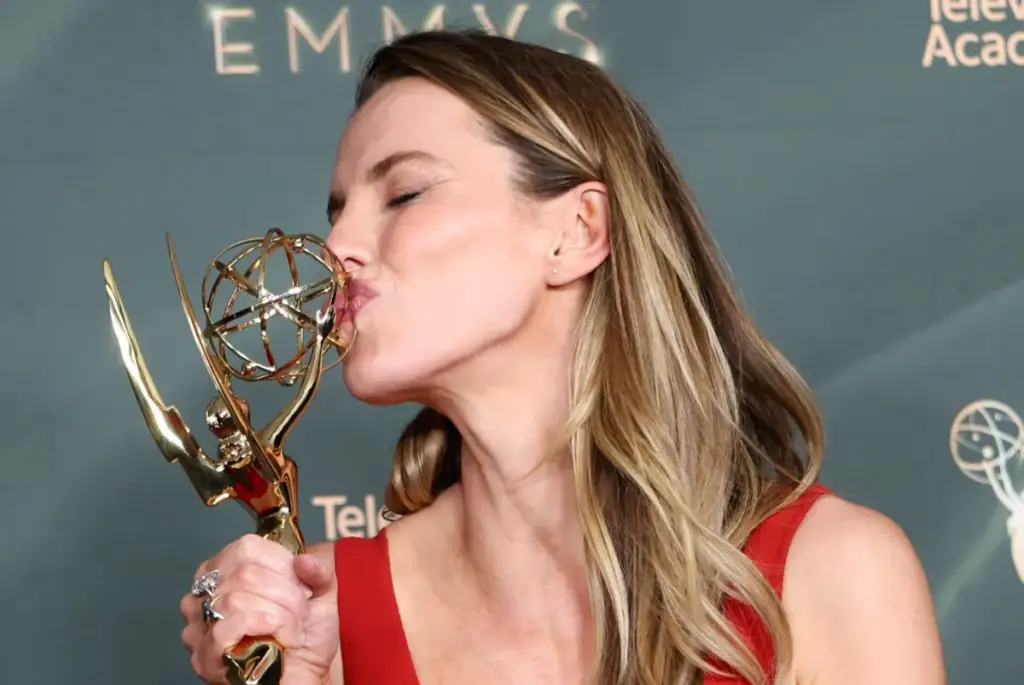
At the 78th Primetime Emmy Awards, amidst the customary sea of polished, tearful, and occasionally over-rehearsed gratitude, actress Betty Gilpin delivered a masterclass in subversive performance art. Accepting the award for Outstanding Guest Actress in a Comedy Series for her critically acclaimed work in Apple TV+’s breakout hit Widow’s Bay, Gilpin bypassed the conventional playbook of industry acknowledgments. Instead, she stepped up to the podium at the Peacock Theatre and recited a self-penned, rapid-fire, sharply self-deprecating poem.
The speech—equal parts poetic confession, industry satire, and existential plea—was designed to mirror the eccentric, darkly comic DNA of the series that spawned it. Yet, it was a single, brilliantly deployed couplet near the end of her address that galvanized the television academy audience and instantly dominated social media discourse: "To be cringe and elitist, which you’re free to find fault in / Let’s all lean toward Sam Shepard and less toward Sam Altman."
This sharply drawn cultural dichotomy—juxtaposing the rugged, poetic romanticism of legendary American playwright Sam Shepard against the techno-optimistic, AI-obsessed corporate ethos of OpenAI CEO Sam Altman—encapsulated the anxieties of a creative community grappling with rapid technological disruption, shifting industry economics, and the erosion of human-centric storytelling.
Gilpin’s victory was part of a historic night for Widow’s Bay, which dominated Night 2 of the Emmy ceremonies by hauling in a staggering eight trophies, cementing its status as one of the most daring and successful genre experiments in recent television history. Behind the viral soundbites and comedic rhymes, however, Gilpin’s speech offered a profound meditation on the absurdities of the acting profession, the value of idiosyncratic creative risks, and the urgent necessity of preserving artistic authenticity in an increasingly mechanized world.
Detailed Chronology: From Airplane Warning to Peacock Theatre Stage
The genesis of one of the most memorable acceptance speeches in modern Emmy history was entirely accidental, born out of mid-air panic and peer pressure. Speaking to press corps backstage immediately following her win, Gilpin revealed that she had arrived at the ceremony entirely unprepared to take home the gold.
The turning point occurred thousands of feet above the ground during her flight to Los Angeles. Seated near her was co-star and fellow nominee Hamish Linklater, who earned a well-deserved Guest Actor in a Comedy nomination for his portrayal of town founder Richard Warren.
"I was on the same flight over as my co-nominee Hamish Linklater, and he came over to my row and was like, ‘Have you written a speech?’" Gilpin recalled with her signature kinetic energy. "And I was like, ‘Oh no, no, no! I’m not going to win.’ He’s like, ‘Well, you need to do that because it’s a scientific possibility, and don’t be stupid. Just prepare something.’"
Startled into reality by Linklater’s pragmatism, Gilpin did what creative minds have done under pressure for centuries: she channeled her nervous energy into verse. Sitting in her airline seat, she hastily composed a manic, rhythmically driven poem that captured the bittersweet absurdity of her career, her profound affection for her peers, and the idiosyncratic nature of the production that brought them together.
When her name was announced as the winner for her performance as Sarah Westcott Warren in the flashback-heavy, period-piece episode titled "Our History," Gilpin took the stage with the poem in hand. Delivered with theatrical timing and a sharp, self-aware wink, the speech unfolded through a series of striking stanzas:
"If by some fluke you win, a poem might give it a less boring spin. If you lose, whisper it drunk to your date, Allie Brie, whose toned shoulders we stand on for her work in TV.
Thank you, ‘Widows Bay’ residents, [Katie] Dippold, [Hiro] Murai, to Hamish and Apple, our director Ti [West]
To my reps Sean, Jenny, Andrea, Dara and Tony. Is it weird I say love you when we hang up the phony? (Sorry)
Rhymings of vulnerability cloak. What we do means so much to me. That part’s not a joke
Look, my family has nurses, a priest and a teacher. I’m a spray-tanned, narcissistic society leecher.
But I want to thank all of the actors I’ve met — old ladies in dressing rooms, hot guys on sets. What a privilege to spend this life laughing at crafty, watching Shakespeare in theaters, half full and drafty.
Our business is stupid, but actors are the bomb. From Martindale to Milioti, my dad and my mom,
To be cringe and elitist, which you’re free to find fault in. Let’s all lean toward Sam Shepard and less toward Sam Altman.
Thank you, Cosmo. My family, my daughters, friends — too many to name — my brothers Sam, Harry and my long dead dog Babe. Thank you."
The room erupted. While the playful digs at her own profession ("spray-tanned, narcissistic society leecher") charmed the audience, it was the pivot toward the cultural debate over artificial intelligence and human artistic labor that transformed a charming awards show moment into a defining cultural statement.
Supporting Context & Metrics: The Rise of Widow’s Bay
To understand the weight of Gilpin’s words, one must examine the extraordinary cultural and industrial footprint of Widow’s Bay. The Apple TV+ original series, created by Katie Dippold and executive produced by visionary filmmaker Hiro Murai, has spent its first season defying conventional television metrics. Rather than adhering to predictable algorithmic formulas or safe, mainstream procedural structures, Widow’s Bay established itself as an unapologetically strange, niche, and haunting exploration of grief, history, and human eccentricity.
The series culminated its run on Night 2 of the 78th Primetime Emmy Awards by capturing an astonishing eight trophies—the highest tally of any single program during the initial awards ceremonies. The crowning achievements reflected a sweeping endorsement from the Television Academy for high-risk storytelling.
At the heart of this success was the ninth episode of the season, "Our History," a standalone period-piece flashback that functioned almost as an entirely separate creative entity. Gilpin stars as Sarah Westcott Warren alongside Hamish Linklater’s Richard Warren, chronicling the dark, psychological underpinnings of the fictional town’s founding.
Reflecting on the unique production environment of the episode, Gilpin noted the surreal nature of stepping onto a set where the main series had already wrapped.
"The episode that Hamish and I did, it’s like we did this strange little period indie movie at the end of the actual filming of contemporary Widow’s Bay," Gilpin explained. "So it felt like, honestly, an island within an island. The crew and writers had filmed all nine episodes before us, and so to encounter all these people who were clearly brilliant and tired and had just taken a big risk, and then to watch that risk pay off immensely—it’s just so satisfying. A point for brilliant, weird, creative people, I’d say."
The triumph of Widow’s Bay serves as a vital counter-narrative in an industry increasingly obsessed with intellectual property exploitation, safe sequels, and algorithmic content generation. The fact that a project so inherently eccentric found both massive critical acclaim and mainstream commercial success offered a much-needed morale boost to creators operating within the modern media landscape.
Official Statements & Industry Reflections
Gilpin’s reference to Sam Shepard versus Sam Altman struck a deep nerve because it crystallized a growing anxiety within Hollywood. As major entertainment conglomerates experiment with generative artificial intelligence, voice cloning, script-writing algorithms, and the digital replication of background actors, the foundational sanctity of human artistic expression faces unprecedented threats.
Sam Shepard, who passed away in 2017, represents the gold standard of American storytelling—gritty, deeply human, flawed, organic, and forged through lived emotional experience. His plays and performances dealt with the messy, unquantifiable realities of the human condition. Conversely, Sam Altman symbolizes the vanguard of Silicon Valley’s march toward automated ubiquity, where art, writing, and performance are increasingly viewed by tech evangelists as mere data points to be optimized and replicated by large language models.
By explicitly urging her peers to lean toward the former and resist the cultural hegemony of the latter, Gilpin issued a rallying cry for the protection of authentic human labor and creative vulnerability.
Her speech also functioned as a profound acknowledgment of the collaborative, often unglamorous reality of being a working actor. Moving seamlessly from humorous self-deprecation to heartfelt tribute, she honored her fellow performers—invoking industry legends and contemporaries like Margo Martindale and Cristin Milioti—while grounding her gratitude in personal history, dedicating the win to her family, her children, and even her long-deceased dog, Babe.
When asked by reporters whether her character, Sarah Westcott Warren—who seemingly perishes while attempting a desperate escape from the titular island—might somehow return via future flashbacks, Gilpin maintained a humorous, hopeful perspective.
"I feel like by her genius demented Widow’s Bay lore math, it doesn’t make sense for her to come back," Gilpin admitted with a laugh. "Pero like, come on, just find it so I can come back. I would love to do that. I loved working on the show so much. Katie Dippold’s brain and work and the fact that Apple made her show a reality gives me renewed faith in our industry. Honestly, something so original and niche and strange and human having success in the mainstream—it gives me hope, honestly, that we’re not totally lost in our industry."
Future Outlook: Navigating the Intersection of Art and Technology
As the dust settles on the 78th Primetime Emmy Awards, Betty Gilpin’s poetic intervention will likely be remembered as one of the defining cultural touchstones of the 2024 awards season. It proved that live television still possesses the capacity for genuine surprise, intellectual provocation, and spontaneous artistic expression.
More importantly, the overwhelming positive response to her "Sam Shepard vs. Sam Altman" line underscores a broader ideological battle line within the entertainment industry. As studios continue to negotiate complex labor agreements regarding the integration of artificial intelligence, and as writers and actors fight to retain ownership over their likenesses, voices, and creative outputs, the cultural mandate articulated by Gilpin takes on heightened urgency.
The success of Widow’s Bay—alongside Gilpin’s celebrated, unhinged, and deeply moving poetic victory—demonstrates that audiences do not crave sanitized, algorithmically generated content. They crave the messy, unquantifiable, and brilliantly idiosyncratic output of human minds working at the peak of their creative powers.
In a world increasingly tempted to hand the reins over to automated systems, Betty Gilpin’s Emmy night reminder was clear: hold fast to the poetry, protect the human storytellers, and always choose the gritty reality of Sam Shepard over the cold calculations of Silicon Valley.