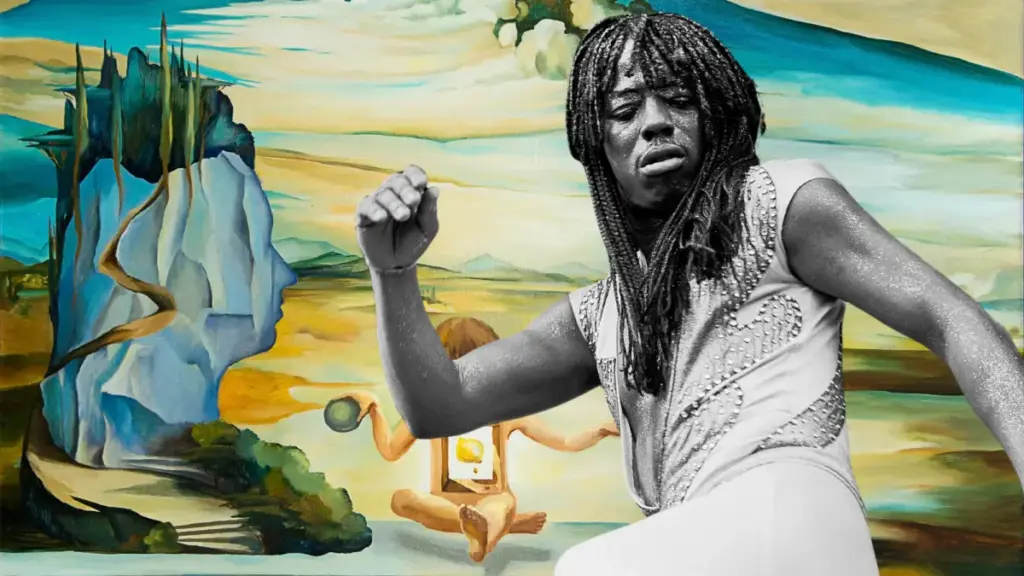
Executive Overview
In the annals of rock-and-roll lore, tales of excess, absent-mindedness, and fleeting fortune are practically par for the course. Yet, few anecdotes match the tragicomic brilliance—and sheer, staggering waste—of the afternoon Rick James inadvertently dissolved a priceless original work of art by the world’s most famous surrealist.
The year was 1981. The King of Punk-Funk, riding the turbulent waves of fame, artistic self-doubt, and the shifting tides of the music industry, found himself retreating to the sun-drenched shores of Maui. Seeking solace after an underwhelming commercial performance from his fourth studio album, Garden of Love, James crossed paths with the eccentric surrealist master Salvador Dalí at a poolside gathering hosted by legendary talent manager Shep Gordon.
What transpired over the course of a twenty-minute interaction should have been a crowning cultural intersection: the surrealist titan capturing the soul of the funk innovator on a simple cocktail napkin. Instead, fueled by a potent morning wake-and-bake session and a refreshing dip in the Pacific Ocean, James committed one of the most careless archival blunders in modern entertainment history.
This deep-dive investigative feature reconstructs the fateful Hawaiian evening, contextualizes the pressures weighing on James at the height of his career, analyzes the market value of what was lost, and explores the profound legacy of two monumental figures whose eccentricities momentarily collided in paradise.
Detailed Chronology: From Chart Anxiety to Surrealist Encounters
The Commercial Slump of 1981
To understand how Rick James ended up sitting across from Salvador Dalí in Maui, one must first understand the intense psychological pressures facing the "Super Freak" singer in the early 1980s. Following the massive success of earlier works, James had poured his heart and soul into his fourth studio effort, Garden of Love.
However, the musical landscape was shifting rapidly. Disco was facing a coordinated backlash, MTV was on the horizon, and musical tastes were becoming increasingly eclectic. When Garden of Love managed only a lukewarm reception—barely scraping past the threshold to achieve gold certification—James experienced a crisis of confidence.
Concert promoters, historically eager to throw massive guarantees at the flamboyant showman, began exhibiting signs of hesitation. Ticket sales for certain dates softened, and the infallible armor of James’s ego began to crack. In his 2014 posthumous memoir, Glow: The Autobiography of Rick James, the singer laid bare his internal monologue during this turbulent epoch:
"Had my arrogance finally caught up with me? Was I too cocky for my own good? Had I lost my glow?"
Seeking an escape from the relentless scrutiny of the music industry and the suffocating anxiety of failing expectations, James packed his bags and fled to the Hawaiian island of Maui. There, he took up residence at the luxurious beach house of his fiercely loyal manager, Shep Gordon—a man renowned for managing shock-rockers, chefs, and legends alike, and for throwing parties that routinely attracted the world’s most eccentric icons.
The Poolside Convergence
It was during this therapeutic retreat that Shep Gordon hosted a casual evening get-together by the pool. Among the eclectic guest list was none other than Salvador Dalí, the Spanish surrealist master whose melting clocks, exaggerated mustaches, and avant-garde lifestyle made him a global icon of the bizarre.
For James, encountering Dalí was like staring into a mirror reflecting a different artistic dimension. Despite his reputation as a hard-partying funk star, James was well-read, deeply appreciative of visual aesthetics, and fascinated by the unorthodox.
"I knew a little about art and was familiar with Dalí’s far-out paintings," James recalled in Glow. "Like me, he had a crazy imagination."
At first, the encounter was marked by silent, intense observation. James noticed the elderly painter staring at him intently across the pool area, a gaze so fixed and deliberate that it began to make the funk icon visibly uncomfortable. Just as James considered moving to another part of the patio, Dalí broke the silence. Walking over with the deliberate, theatrical grace that defined his public persona, the artist delivered a simple, flattering declaration:
"Señor, I am mad about the way you look. Please allow me to sketch you."
The Napkin Masterpiece
Flattered, intrigued, and acutely aware that he was in the presence of living history, James eagerly obliged. Dalí called for writing materials, though none were readily at hand in the relaxed poolside setting. Instead, a standard paper cocktail napkin was procured.
With the casual mastery of a lifelong virtuoso, Dalí went to work. For roughly twenty minutes, the surrealist sat in silence, his eyes darting between the paper and James’s striking, flamboyant features—his wild hair, intense gaze, and unmistakable swagger.
When Dalí finished, he handed the napkin to James. Staring down at the illustration, the singer was immediately struck by a profound sense of awe. In just a few swift strokes of ink, Dalí had managed to capture not merely James’s physical likeness, but the very essence of his artistic persona.
"He captured my soul," James reflected years later.
Realizing the magnitude of the artifact resting in his hand, James thanked the artist profusely. Dalí graciously allowed him to keep the one-of-a-kind illustration. Shortly after the interaction, Shep Gordon pulled his client aside to impress upon him the gravity of the moment. Gordon warned James that he should guard the napkin with his life, noting that given Dalí’s global prestige, there was "no telling" what the improvised sketch was truly worth on the burgeoning fine art market.
The Morning After: The Ocean Tragedy
Elated by his encounter with Dalí and feeling the weight of his career anxieties temporarily lift, James tucked the napkin safely into the pocket of his shorts, retired to his guest quarters, and prepared for a restful night of sleep.
What transpired the following morning, however, has since become legendary—a cautionary tale of rock-and-roll absent-mindedness.
Awakening to the bright Hawaiian sun, James engaged in a morning ritual common to both his lifestyle and the creative circles of the era: he lit up a fresh joint. Floating on a pleasant cloud of cannabis-induced relaxation, James decided to take a refreshing morning swim in the crystal-clear waters of the Pacific Ocean right outside Gordon’s beach house.
Without breaking stride or stopping to check his wardrobe, James dove straight off the lanai and into the surf. It was only as the cool salt water enveloped him that a sudden, horrifying wave of realization washed over his consciousness.
He was still wearing the exact same pair of shorts he had worn the night before. And tucked securely inside the pocket was Salvador Dalí’s priceless, irreplaceable ink-on-napkin portrait.
Panic-stricken, James scrambled out of the ocean, dripping wet, and hastily fished the napkin out of his pocket. The damage was absolute. Water, friction, and the delicate nature of paper had completely disintegrated the drawing, reducing Dalí’s masterwork to little more than "a pattern of blurs."
Reflecting on the blunder in his memoir, James offered a brutally honest, darkly humorous post-mortem:
"They say pot destroys short-term memory. I sure could have used some sharp short-term memory that morning. Without it, I ruined the only known depiction of a famous funkster by an even more famous surrealist."
Supporting Context & Metrics: Valuing the Lost Dalí
To fully appreciate the magnitude of Rick James’s morning mistake, one must examine the art market value of Salvador Dalí’s ephemera, particularly sketches created during the latter half of his prolific career.
Estimating the Financial Loss
Salvador Dalí (1904–1989) was not only a prolific painter and sculptor but also an artist who understood commercial viability and the market value of his own signature. Even his casual sketches, napkins, menus, and hotel stationery signed and drawn upon during dinner parties command staggering sums at major auction houses like Sotheby’s, Christie’s, and Bonhams.
- Napkin Art Market Precedents: Pablo Picasso famously paid for meals by sketching on restaurant napkins and receipts, items that routinely fetch hundreds of thousands—and occasionally millions—of dollars today. Dalí was similarly prolific with impromptu drawings.
- Valuation Metrics: In the contemporary art market, an authenticated, original ink drawing by Salvador Dalí featuring a notable pop-culture subject (such as the King of Funk-Funk at the height of his 1980s fame) easily commands anywhere from $50,000 to $250,000+ at auction, depending on provenance, documentation, and the intensity of the collector base. Had the napkin survived and been properly preserved, framed, and authenticated by the Gala-Salvador Dalí Foundation, it would likely be sitting in a climate-controlled museum vault or commanding six figures at a high-end contemporary art auction today.
The Intersection of Two Cultural Titans
Beyond the sheer monetary valuation, the loss represents a unique cultural casualty. Rick James and Salvador Dalí occupied parallel universes of theatrical self-expression.
- Salvador Dalí weaponized the surreal, challenging the boundaries of human consciousness through melting timepieces, dreamscapes, and an intensely performative public persona. He was a master of shock value long before modern media was invented.
- Rick James (born James Ambrose Johnson Jr.) did essentially the same thing through sound and spectacle. With his leather outfits, heavy braids, cascading velvet coats, and genre-defying fusion of rock, funk, and R&B, James transformed the concert stage into an immersive, high-octane psychedelic experience.
When Dalí remarked, "I am mad about the way you look," it was validation from the grandmaster of visual pageantry to one of the most visually arresting musicians of the 20th century. The destruction of the drawing wiped out the only documented artistic collaboration between these two titans of counterculture.
Official Statements & Archival Evidence
Because the event occurred privately in 1981 and was only brought to light decades later, primary source documentation relies almost exclusively on firsthand accounts preserved in literature and manager recollections.
Excerpts from Glow: The Autobiography of Rick James
Co-written with author David Ritz and published posthumously in 2014 by Atria Books, Glow provides the definitive, unvarnished account of the incident. James did not attempt to sugarcoat his stupidity or deflect blame onto external factors beyond his own cannabis consumption and absent-mindedness.
"Shep told me later that I should treat that napkin like gold bars," James wrote in the chapter detailing his Maui retreat. "He said there was no telling what it was worth. But the next morning, I forgot all about it. I woke up, sparked a joint, and jumped right into the ocean wearing the exact shorts I had on the night before. By the time I fished the napkin out of my pocket, it was a soggy mess of blue ink blurs. Just like that, a masterpiece was gone."
Shep Gordon’s Industry Perspective
Shep Gordon, widely regarded as one of the most innovative artist managers in entertainment history (having managed Alice Cooper, Groucho Marx, and Blondie), often marveled at the sheer unpredictability of his roster. While Gordon was known for engineering brilliant publicity stunts and protecting his clients’ interests, even his formidable managerial acumen could not protect Rick James from himself.
While Gordon did not frequently harp on the lost napkin in public interviews, associates of the manager have noted that the story remains a dark-comedy favorite within Gordon’s inner circle—a prime example of the unpredictable chaos that followed Rick James wherever he went.
Future Outlook & Cultural Legacy
Decades after the ink washed away into the Pacific Ocean, the tale of Rick James, Salvador Dalí, and the soggy napkin continues to capture the public imagination. It endures not merely as a funny celebrity anecdote, but as a cautionary tale of mindfulness, a celebration of unbridled artistic eccentricity, and a beloved piece of music-history folklore.
How the Legend Lives On
- Pop Culture Immersion: As internet culture, music journalism, and biographical retrospectives continue to unearth wild stories from the 1970s and 1980s music scenes, the Dalí-James anecdote has become a viral staple across platforms like X (formerly Twitter), Reddit, and music history blogs.
- The Legacy of Rick James: Despite the commercial stumble of Garden of Love, James rebounded fiercely, cementing his status as a legendary producer, songwriter, and cultural architect. His influence echoes through the work of generations of artists—from Prince and Snoop Dogg to Bruno Mars and Kendrick Lamar. His unapologetic authenticity, best encapsulated in his memoir Glow, ensures that even his greatest blunders—like dissolving a priceless Dalí original—only add to his larger-than-life mystique.
Conclusion: A Masterpiece Lost to the Tide
Art history is filled with tragic losses: the burning of the Library of Alexandria, paintings lost at sea during wartime, and masterworks destroyed by accidental fires. Yet, few losses possess the sheer comedic absurdity of a funk legend ruining a surrealist masterwork because he couldn’t remember to empty his pockets before chasing a morning buzz into the ocean.
In the end, perhaps it is fitting that the portrait met such a watery, surreal fate. Salvador Dalí spent his life challenging the rational mind, dismantling logic, and embracing the unpredictable currents of the subconscious. If any piece of art deserved to melt away like a soft watch draped over a Hawaiian coral reef, it was the portrait of the "Super Freak," drawn on a napkin, lost to the tide, and preserved forever in the realm of rock-and-roll myth.