Executive Overview
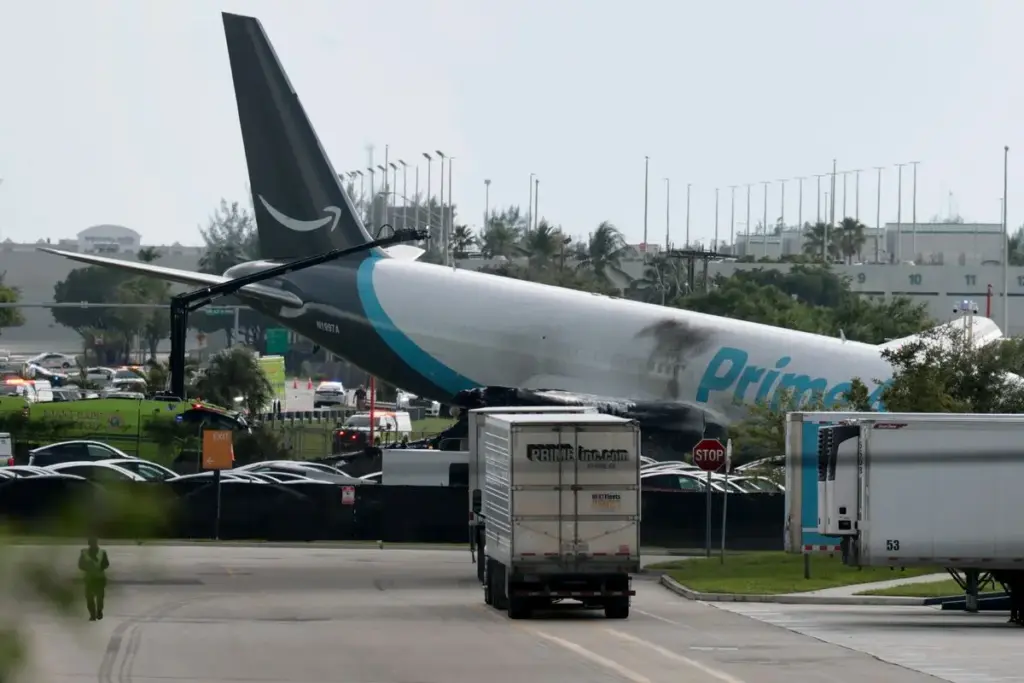
In what local officials have described as an "incredibly difficult day" for the aviation sector and the local community, a catastrophic aviation incident unfolded at Miami International Airport (MIA) on Sunday afternoon, September 6, 2026. Prime Air Flight 7598—a Boeing 767-300 cargo aircraft operated by 21 Air on behalf of retail giant Amazon—overran the airport’s diagonal runway during a routine landing sequence, breaching the perimeter and colliding with multiple vehicles on the ground.
The ensuing high-intensity fire and structural impact resulted in a tragic loss of life. Miami-Dade County Mayor Daniella Levine Cava confirmed during a televised evening press conference that at least five individuals lost their lives in the disaster, with an additional five people sustaining injuries of varying severity. Three victims remain in critical condition at local medical facilities, while two others were treated and hospitalized for less severe trauma.
The accident prompted an immediate, massive emergency response involving more than 60 units from Miami-Dade Fire Rescue. The incident paralyzed one of the nation’s busiest cargo and passenger aviation hubs, forcing a total ground stop and the closure of all runways and taxiways. While flight operations and departures have cautiously resumed following preliminary safety clearance, the accident has ignited intense scrutiny over runway safety margins, perimeter security, and the rapid expansion of corporate logistics fleets operating at major metropolitan airports.
Detailed Chronology of Events
The Approach and Landing
According to preliminary flight data and statements issued by the Federal Aviation Administration (FAA), Prime Air Flight 7598 departed from Luis Muñoz Marín International Airport in San Juan, Puerto Rico, earlier in the day. The aircraft, a wide-body Boeing 767-300 freighter, was executing a scheduled domestic cargo flight into South Florida.
At approximately 2:00 PM local time on Sunday, the aircraft approached Miami International Airport for landing. Weather conditions at the time of arrival are currently a central focus of investigators, though official meteorological assessments have yet to be finalized. As the heavy cargo jet touched down on the airport’s designated diagonal runway, it failed to decelerate within the standard threshold parameters.
The Runway Overrun and Ground Collision
Instead of safely taxiing off the active tarmac, the aircraft failed to stop, overrunning the northwest end of the runway. Aviation experts note that runway overruns—known in the industry as excursions—can be precipitated by a combination of factors, including mechanical brake failure, hydroplaning on wet surfaces, tailwinds, or delayed deployment of speedbrakes and thrust reversers.

Unlike standard runway excursions that merely end in grassy safety areas, Flight 7598’s momentum carried it past the paved limits of the airport infrastructure. The Boeing freighter breached the perimeter zone and struck multiple vehicles traveling near the airport boundary. The kinetic force of the heavy aircraft colliding with ground traffic, combined with the ignition of residual jet fuel, sparked a massive, volatile fire.
The Immediate Emergency Response
The visual footprint of the crash was visible for miles across South Florida, as thick, black plumes of smoke billowed into the afternoon sky. Within minutes of the impact, Miami-Dade Fire Rescue dispatched over 60 apparatuses and specialized hazardous materials and rescue units to the scene.
Firefighters faced a complex and hazardous multi-front battle: subduing the roaring inferno engulfing the wreckage, securing leaking aviation fuel, and rapidly triaging survivors from both the aircraft and the struck ground vehicles. First responders established a wide security cordon around the crash site, transforming the northwest quadrant of MIA into an active triage and recovery zone.
By late Sunday evening, the flames had been successfully extinguished, leaving the charred skeletal frame of the Boeing 767 exposed against the tarmac. Investigators from the National Transportation Safety Board (NTSB) and the FAA arrived on-site overnight to begin the painstaking process of recovering flight data recorders and mapping the debris field.
Supporting Context & Metrics
The Aircraft and Operator Profile
The aircraft involved in the incident was a Boeing 767-300, a widely utilized twin-engine wide-body jet that forms the backbone of many long-haul domestic cargo networks. While passenger variants of the 767 have a long and decorated safety history, converted freighters and dedicated cargo variants operate under grueling schedules, often flying overnight and repositioning heavy payloads across regional hubs.
The flight was operated by 21 Air, a North Carolina-based certified air carrier that provides ACMI (Aircraft, Crew, Maintenance, and Insurance) services, frequently flying routes on behalf of major logistics companies like Amazon Air (Prime Air).

- Flight Number: Prime Air Flight 7598 (operated by 21 Air)
- Aircraft Type: Boeing 767-300 (Cargo Configuration)
- Departure Point: Luis Muñoz Marín International Airport (SJU), San Juan, Puerto Rico
- Destination: Miami International Airport (MIA), Florida
- Date & Time of Incident: September 6, 2026, approximately 2:00 PM EDT
- Casualties: 5 confirmed dead, 5 injured (3 critical, 2 hospitalized with minor-to-moderate injuries)
Operational Impact on Miami International Airport
The accident brought the vital economic engine of Miami International Airport to an immediate halt. In response to the emergency, the Miami-Dade Aviation Department and federal transport authorities instituted a full ground stop, shutting down all arriving and departing flights.
All runways and taxiways were sealed off to preserve evidence and clear emergency lanes for fire and rescue vehicles. The closure stranded tens of thousands of passengers inside terminal buildings and diverted dozens of inbound international and domestic flights to alternative airports across Florida, including Fort Lauderdale-Hollywood International Airport (FLL) and Orlando International Airport (MCO).
By Sunday evening, transport officials confirmed that preliminary inspections of undamaged runways allowed for a gradual lifting of the ground stop. Departures resumed on a restricted basis late Sunday night, though lingering delays and schedule compression rippled through global supply chains and airline networks well into Monday morning.
Official Statements and Stakeholder Reactions
Local Government and Municipal Leadership
Miami-Dade County Mayor Daniella Levine Cava took to public platforms and held an emergency press conference to address the tragedy. Visibly shaken, she expressed her profound sorrow on behalf of the county.
"We can confirm that we have at least five deceased individuals," Mayor Levine Cava stated during the evening briefing. "Multiple individuals were transported to local hospitals with unknown injuries… This is an incredibly difficult day for our community, our emergency services, and everyone touched by this tragedy. Right now, our focus is on everyone involved and making sure our first responders have what they need."
Corporate Response from Amazon
As the owner of the Prime Air brand and logistics network, Amazon issued a formal statement acknowledging the incident and offering full cooperation to federal investigators. Kelly Nantel, Amazon’s Director of Corporate Global Media Relations, released the following statement:

"We can confirm that an Amazon Air plane operated by 21 Air experienced an incident while attempting to land at Miami International Airport today. This is a fast-moving situation and we’re still gathering details. We’re working closely with local authorities and officials to understand exactly what happened. Right now, our absolute priority is the safety, well-being, and care of everyone involved. We’re doing everything we can to support those affected."
Federal Aviation Administration (FAA) and Transport Authorities
The Federal Aviation Administration confirmed its direct involvement in the oversight and investigation of the crash. In an official bulletin released via social media and press channels, the agency noted:
"21 Air Flight 7598 overran the runway after landing at Miami International Airport around 2 pm local time on Sunday, September 6. The Boeing 767-300 cargo aircraft departed from Luis Muñoz Marín International Airport in San Juan, Puerto Rico. The FAA and the NTSB will investigate."
Future Outlook and Ongoing Investigations
As the smoke clears over Miami International Airport, the focus shifts decisively from emergency rescue operations to forensic investigation and regulatory accountability.
The NTSB Investigation
The National Transportation Safety Board (NTSB) has deployed a "Go-Team" to Miami to spearhead the safety investigation. Investigators will analyze several critical pillars:
- Human Factors: Pilot fatigue, training records, and crew resource management during the approach phase from Puerto Rico.
- Mechanical Systems: Detailed teardowns of the Boeing 767’s braking systems, thrust reversers, flight control surfaces, and engine telemetry.
- Environmental and Meteorological Data: Surface wind speeds, microburst activity, rainfall, and runway friction coefficients at the precise moment of touchdown.
- Air Traffic Control (ATC) Communications: Transcripts and radar logs of communications between the flight deck and MIA air traffic controllers leading up to the landing.
Policy and Infrastructure Implications
The disaster is also expected to renew legislative and industry-wide debates regarding airport safety zones. The phenomenon of runway overruns—particularly involving wide-body heavy freighters—has long troubled aviation safety advocates. The presence of public roads and non-aviation infrastructure within close proximity to runway safety areas (RSAs) at major urban airports like Miami will likely come under rigorous review by federal safety boards.

Furthermore, the rapid, pandemic-era explosion of corporate-branded logistics fleets—such as Amazon Air—has placed unprecedented pressure on traditional cargo hubs. Investigators and labor groups will likely scrutinize whether turnaround times, scheduling pressures, or maintenance backlogs contributed to the tragic events of September 6.
As families mourn the loss of loved ones and survivors begin the long road to recovery, the findings of the NTSB inquiry will be closely watched by the global aviation community, setting the tone for future safety protocols across commercial freight networks worldwide.