Executive Overview
Tucked away in the historic borough of Queens, New York, Forest Hills Stadium functions as an architectural anomaly. Its Tudor-style cottages, winding pathways, and intimate, bowl-shaped amphitheater evoke the feeling of stepping into a mid-century fairy tale hidden within the sprawling concrete grid of New York City. On a crisp September weekend, that timeless atmosphere served as the canvas for one of the most ambitious live music experiments of the year: Red Bull Chapters featuring Rauw Alejandro.
The two-night event—kicking off on Saturday, Sept. 5, before expanding to an equally demanded Sunday encore due to overwhelming public response—marked a major milestone for both artist and brand. For Red Bull, the production served as the inaugural music-centric installment of its Chapters series, expanding a long-standing cultural footprint built largely on extreme sports, action culture, and global showcases like the Red Bull Batalla freestyle competitions. For Rauw Alejandro, the production was far from a standard tour stop; it was a theatrical, three-act odyssey tracing his Puerto Rican roots, his meteoric global rise, and the uncharted creative territory that lies ahead.
Rather than relying on a chronological greatest-hits package, the concert treated Rauw’s catalog as a living, breathing narrative divided into distinct conceptual phases: Inspiration, Momentum, and Legacy. By weaving the adrenaline-fueled world of extreme sports—featuring stunt motorcyclists, skateboarders, and high-octane visual projections—with the rich, cross-generational tapestry of Caribbean music, Alejandro and Red Bull forged a new paradigm for live Latin performance. This was an investigation into risk, cultural preservation, and the relentless evolution of a modern superstar who refuses to be constrained by genre boundaries.
Detailed Chronology: A Three-Act Odyssey
The conceptual architecture of Red Bull Chapters relied on a dramatic shift in tone, costume, and physical staging. The production treated the stage not merely as a platform for a band, but as a transitional space where the past informed the present, and the present prepared to launch into the future.
Act I: Inspiration — Roots, Rhythms, and Generational Echoes
The evening commenced with an immersive audiovisual prologue. Giant screens flickered with sun-drenched footage of the Caribbean Sea, rolling mountains, and the vibrant urban landscapes of Puerto Rico. A poetic narration framed the island as a crucible of indigenous Taíno, African, and Spanish histories, out of which blossomed salsa, reggaetón, and rock.
This deep-rooted sense of place set the emotional foundation for Rauw Alejandro’s entrance. Emerging onto the stage in a sharp brown studded leather jacket, dark sunglasses, and matching pants, he opened with “Santa,” his hypnotic collaboration with Rvssian and Ayra Starr.
The first act was explicitly designed to honor the eclectic musical diet of his upbringing. Alejandro has frequently credited his family for his lack of dogmatism regarding genre. His grandfather was a traditional trovador, while his father, guitarist Raúl Ocasio, introduced him to classic American rock and roll acts like Elvis Presley and James Brown, all while the house echoed with the omnipresent rhythms of salsa.
“I grew up in an environment with a lot of musical variety,” Alejandro shared with Billboard ahead of the performance. “I think that marked me a lot, and it’s reflected in my art.”
The setlist gracefully balanced massive crowd-pleasers like “2/Catorce” with atmospheric mood pieces such as “Club El Calentero,” which bathed the stadium in neon hues. Yet, the emotional peak of Act I arrived when Alejandro paid direct homage to his cultural forebears. Backed by a full live band featuring intricate guitar work, keyboards, and driving percussion, he delivered a stirring cover of Frankie Ruiz’s classic salsa anthem, “Tú Con Él.” Rather than feeling like a nostalgic novelty, the rendition bridged generations, positioning Alejandro as a natural custodian of the Puerto Rican musical canon.

Act II: Momentum — Athleticism, Diaspora, and Adrenaline
If Act I was about looking backward to understand the self, Act II was about velocity and forward propulsion. The transition was signaled by a dramatic shift in stage production: a towering skateboarding half-pipe rolled onto the stage, where performers wearing Joker-style helmets executed gravity-defying tricks against a backdrop of controlled pyrotechnic fire.
Soon after, daredevil motorcyclists took over the arena floor, executing high-speed wheelies as Alejandro reappeared in a rugged, black leather rock-and-roll ensemble. Throughout the set, extreme sports imagery—snowboarders carving through fresh powder, ice skaters spinning on razor-thin blades, and surfers conquering massive swells—flashed across the digital monoliths behind him.
This was not superficial window dressing. The extreme sports motifs served as a physical metaphor for the precarious nature of artistic reinvention. The production’s overarching narration posed a central question: How does an artist maintain the raw hunger of their beginnings when they have already conquered the global stage? How does one leap into the unknown without knowing whether they will soar or crash?
This thematic drive underscored Alejandro’s musical evolution, particularly his exploration of theatrical world-building seen in albums like Cosa Nuestra and Cosa Nuestra: Capítulo 0. As the tempo accelerated, the crowd erupted for global anthems like “Todo De Ti” and “Carita Linda,” elevated by the muscular, concert-scale arrangements of his live band.
Crucially, Act II also provided a moment of profound sociopolitical gravity. Addressing the Forest Hills crowd, Alejandro turned his attention to the global Puerto Rican diaspora.
“There are approximately six million Puerto Ricans outside the island, while Puerto Rico itself has only three million,” he stated, his voice carrying clearly across the amphitheater. “Puerto Rico needs us—the people who are there every day, but also those of us who are here.”
Acknowledging the logistical and emotional complexities of maintaining ties to home while navigating the struggles of immigration and modern life, he issued a passionate call to action:
“We can’t allow them to slowly take away our beautiful island and keep what belongs to us—our culture, our identity. We have to take care of Puerto Rico together.”
Act III: Legacy — Futuristic Visions and Uncharted Horizons
For the final chapter of the evening, the visual and aesthetic language shifted once again. Alejandro emerged clad in an all-white 1970s-inspired leather ensemble complete with statement chains, a tailored vest, aviator sunglasses, and his signature reddish hair styled into a distinct new persona.
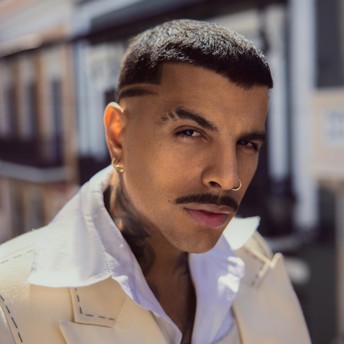
The final act was dedicated to the future. Producer and mastermind Tainy manned the decks behind a futuristic setup, while reggaetón icon Chencho Corleone joined Alejandro on stage for a euphoric, roof-raising rendition of “Desesperados.”
The music in Act III pushed boundaries, blending reggaetón foundations with shimmering R&B, pulsating electronic textures, and forward-thinking pop structures. It was a physical manifestation of Alejandro’s transitional state—an artist who has mastered the present while actively constructing tomorrow.
Supporting Context & Metrics
The Red Bull Chapters Milestone
To understand the cultural weight of the Forest Hills residency, one must examine the corporate and artistic partnership behind it. While brands frequently slap logos onto tour itineraries, Red Bull Chapters represented a structural departure. It was conceived as an artistic laboratory rather than a promotional tour.
By applying its extreme sports ethos—traditionally reserved for events like the Red Bull Rampage or Formula 1 exhibitions—to a major recording artist, Red Bull validated Alejandro’s reputation as one of Latin music’s most fearless risk-takers. The massive demand for the initial Sept. 5 date, which necessitated the immediate addition of a Sept. 6 show, proved that audiences are eager for hybrid artistic experiences that push past the boundaries of traditional concert-going.
Alejandro’s Commercial and Artistic Trajectory
Rauw Alejandro’s rise to global superstardom has been defined by his refusal to stay in one lane. Since breaking out with his debut studio album Afrodisiac and cementing his crossover dominance with Vice Versa (home to the multi-platinum global phenomenon “Todo De Ti”), he has consistently pushed Latin pop and urbano into cinematic territories.
Projects like Saturno embraced retro-futuristic synth-pop and alien aesthetics, while the Cosa Nuestra era leaned heavily into New York City’s rich Nuyorican history, bridging vintage 1970s salsa orchestration with modern trap and reggaetón beats. His streaming metrics place him consistently among the top tier of global Latin artists, but performances like Red Bull Chapters prove his ambitions lie far beyond chart positions and playcounts.
Official Statements & Artist Insights
In an exclusive Zoom interview with Billboard conducted just 24 hours before taking the Forest Hills stage, Rauw Alejandro detailed the philosophy driving the collaboration:
“We wanted to merge the world of extreme sports, the world of sports, with the world of art and music. It’s literally Rauw and Red Bull. It’s not like Rauw Alejandro and Red Bull separately — it’s a fusion between the two worlds.”
Elaborating further on how his familial roots continue to inform his eclectic musical palette, he told Billboard Español:

“My father taught me to be more open and to listen to more music. I grew up with a lot of musical variety, and I think that marked me a lot and is reflected in my art.”
Regarding his current creative headspace following the exhaustive global touring cycle for Cosa Nuestra, Alejandro emphasized that he is deliberately pacing his next moves:
“I’m still in a creative process after Cosa Nuestra, which was a huge tour. I’m taking my time to find that inspiration again, to keep studying and see what the muse tells me is next — which direction I should go.”
Future Outlook: What Lies Beyond 2026
As the dust settled on Forest Hills Stadium, the narrative surrounding Rauw Alejandro pivoted immediately toward the future. The live spectacle was not just a celebration of past achievements; it functioned as a sophisticated diagnostic tool for where his sound is heading next.
According to statements shared with Billboard Español, October will see a wave of strategic collaborative releases featuring both prominent Puerto Rican peers and international crossover acts. However, Alejandro made it clear that long-term fans should prepare for a deeply personal, singular artistic statement in the near future:
“2027 will be completely Raúl.”
This distinction—separating the global superstar "Rauw Alejandro" from the introspective creator "Raúl"—signals a coming era of heightened artistic autonomy. If Red Bull Chapters taught the music world anything, it is that Alejandro views his career not as a straight line, but as a series of calculated leaps. Whether he is diving into vintage Nuyorican salsa, futuristic electronic soundscapes, or high-octane stadium-scale theater, his North Star remains unchanged: artistic survival through perpetual reinvention.
At Forest Hills, under the autumn Queens sky, Alejandro proved that the most thrilling thing an artist can do is refuse to stand still, leaving fans eager to see where he leaps next.