Executive Overview
For over a century, the architectural and atmospheric canvas of Paris has been defined less by its physical monuments and more by the ephemeral poetry of its twilight. While millions look to the structural pyrotechnics of the Eiffel Tower or listen to the polyphonic murmur of global tourists along the Haussmann boulevards, true connoisseurs of the French capital recognize its most transformative emotional state in the sky. It is that brief, suspended moment between day and night when the sun’s hazy, burnt-orange descent bleeds into the encroaching indigo of evening.
Parisians call this meteorological and emotional phenomenon l’heure bleue—the blue hour.
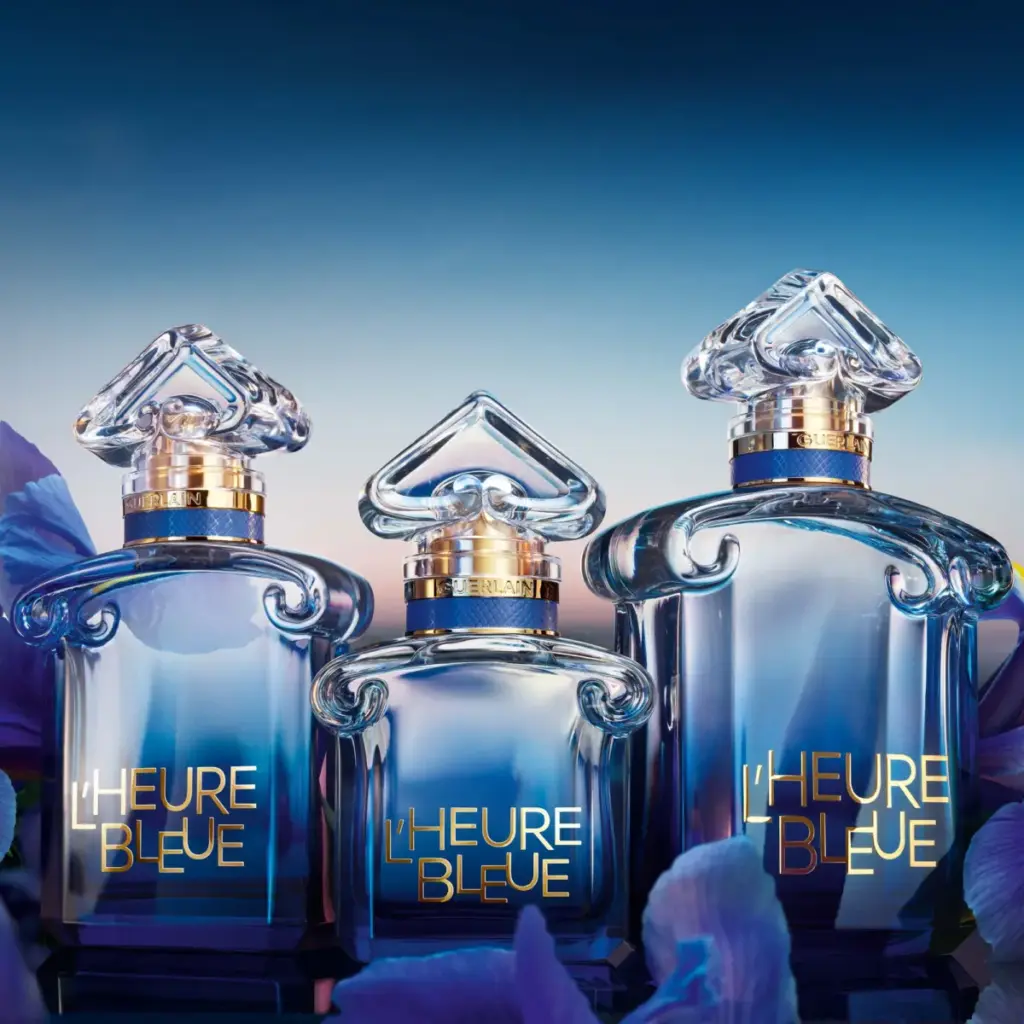
In 1912, legendary French perfumer Jacques Guerlain immortalized this fleeting transitional period during a contemplative evening walk along the banks of the Seine, bottling the atmospheric shift into one of the most iconic fragrances in olfactory history: L’Heure Bleue. More than a century later, the historic house of Guerlain stands on the precipice of its bicentennial anniversary, preparing to make a monumental statement in modern perfumery.
Delphine Jelk, perfumer and director of perfume creation at Guerlain, has taken on the daunting task of reinterpreting this 1912 icon. The resulting modern iteration of L’Heure Bleue represents far more than a simple formulation update; it marks Guerlain’s first explicitly feminine-focused flagship fragrance launch in a decade. Eschewing the historical precedent set by legendary houses where past masterworks like Shalimar and Mitsouko were purposefully designed as unisex entities, Jelk’s creation aims to reclaim the color blue—long coded as masculine within Western sartorial and aesthetic traditions—as a powerful, understated emblem of modern femininity.
This deep-dive feature explores the three-year creative journey behind the new L’Heure Bleue, examining how Jelk married historical reverence with contemporary audacity, revolutionized traditional raw materials like the precious iris, and redefined what it means for a fragrance to act as a woman’s personal armor.
Detailed Chronology: From the Banks of the Seine to the Modern Laboratory
1912: The Genesis of an Olfactory Icon
To understand the weight of Delphine Jelk’s recent undertaking, one must return to the Belle Époque. In 1912, Impressionist art dominated the cultural conversation, valuing blurred lines, emotional resonance, and atmospheric light over rigid realism. Jacques Guerlain was deeply moved by the psychological weight of twilight—a liminal space where the day’s obligations dissolved into the unwritten possibilities of the night.
By capturing the powdery, melancholic sweetness of orange blossom, iris, and vanilla, Jacques created a masterpiece that mirrored the romantic, impressionistic sensibilities of pre-World War I Europe. Yet, that original formulation was anchored in the chemistry and aesthetic expectations of its era. The "head" (top notes) and heavy, powdery dry-down carried a baroque complexity that, while revolutionary for its time, risked feeling disconnected from the realities of contemporary life if left untouched.
The Three-Year Modern Synthesis
Enter Delphine Jelk and a meticulous, multi-year creative process that spanned three years of intense formulation, mood-boarding, and emotional excavation. Jelk did not approach the project with the hesitation of a curator handling a museum artifact; rather, she treated Jacques Guerlain’s historic blueprint as a living, breathing composition waiting to be liberated from historical dust.
Operating as both a visual and olfactory artist, Jelk constructed comprehensive mood boards to translate her internal vision into tangible physical and chemical realities. Her reference points were deliberately tactile and multifaceted:
- Textiles: Blue velvet and sheer organza ribbons to signify softness, texture, and transparency.
- Sartorial Ciphers: Crisp blue poplin shirts, symbolizing effortless, lived-in comfort.
- Artistic Influences: Classic Parisian streetscapes, Impressionist paintings, and the vibrant contemporary works of modern painter Inès Longevial.
- Botanicals: Rich imagery of iris roots and blooming orange orchards.
This eclectic visual foundation birthed a non-stereotypical vision of womanhood. Jelk systematically rejected the hyper-commercialized, bubblegum-pink codes that have long dominated female-targeted marketing in the beauty industry. Instead, she championed an aesthetic of understated strength—evoking the image of a woman dancing barefoot through her apartment in an oversized, freshly laundered men’s poplin shirt.
Supporting Context & Metrics: The Anatomy of "Blue Gold"
To execute this radical shift in brand positioning, Jelk had to innovate at the molecular level, introducing raw materials and extraction techniques that were entirely unavailable to Jacques Guerlain in 1912. At the heart of this innovation lies the iris, universally revered in the industry as the "blue gold of perfumery."

The Alchemy of the Modern Iris Tincture
Traditionally, Guerlain has relied on iris butter for its formulations—a rich, buttery extract prized for its powdery sophistication. However, creating iris butter is an agonizingly slow and resource-intensive endeavor:
- Cultivation: The iris flower must spend three full years maturing in the ground.
- Drying: Once harvested, the roots require an additional three years of drying time before they can be processed.
- Processing: The dried roots are reduced to a powder and subjected to intricate distillation to yield the precious butter.
For the new L’Heure Bleue, Jelk wanted to strip away the "grandma iris" stereotype—the heavy, dated powderiness associated with vintage cosmetics—and introduce a cleaner, more vibrant vitality. Her solution was to invent a proprietary iris tincture.
By taking the powdered iris and steeping it directly in alcohol, Jelk coaxed out a fresher, crisper facet of the flower. This innovative tincture is paired with two modern synthetic and natural breakthroughs:
- Cascalone: An aquatic, airy note engineered to mimic the expansive, clean scent of the evening sky.
- Ambroxan and Vanilla: Woody and sensual base notes that meld with the wearer’s natural skin chemistry, ensuring extraordinary longevity and a rich, skin-like dry-down.
Industry Standing and the Bicentennial Horizon
As Guerlain approaches its monumental 200-year anniversary, the launch of this fragrance serves as a vital stress-test for the brand’s enduring ethos. Very few houses survive two centuries without either stagnating into heritage museums or losing their soul to mass-market trends. Guerlain’s survival has always relied on calculated audacity—introducing scandalous masterpieces like Shalimar when society least expected them.
By dedicating its first major feminine-focused fragrance in a decade to a color historically coded as masculine, the brand reaffirms its position as a fearless industry leader.
Official Statements & Insights from Delphine Jelk
In an exclusive, wide-ranging conversation, perfumer and director of perfume creation Delphine Jelk shared the philosophy, emotional architecture, and creative discipline behind her modern masterwork.
Defining Olfactory Excellence
When asked what elevates a fragrance from a pleasant aroma to a true masterwork, Jelk points to a specific set of rigorous criteria honed over hundreds of formulations:
"A good perfume is a recognizable perfume, and one that you want to go back to. When you wear it, you’re like, ‘I want to smell it again and again.’ And a good perfume is one that has a nice sillage—it creates an aura around you. It has to be long-lasting. Recognizable, long-lasting, good sillage, and addictive."
Honoring Heritage Without Industrial Nostalgia
Addressing the delicate balance of respecting a 112-year-old formula while speaking to a 21st-century audience, Jelk emphasizes intuition and emotional honesty over clinical replication:
"I really wanted to create a perfume for today, inspired by this beautiful idea of l’heure bleue, keeping the soul of what Jacques Guerlain did before and adding what I find very interesting. I don’t want the patrimony to be heavy or dusty. I wanted to keep the soul of the brand audacious and creative, using the most beautiful ingredients."
Jelk notes that her creative choices were driven by a deeply personal affinity for the original dry-down:

"When I smelled the original L’Heure Bleue, what I loved the most was not the head, but the dry down, which was orange flower, iris, and vanilla. For me, it smelled like a marshmallow. And how bold was it to create a marshmallow in 1912? So I absolutely wanted to keep this part."
Deconstructing "Blue Femininity"
Perhaps Jelk’s most revolutionary contribution to the brand is her ideological dismantling of gendered color codes in beauty marketing. She argues that true female empowerment in fragrance design rejects external male fantasies of seduction in favor of internal well-being and personal armor:
"I think blue for women means that, and we don’t need to shout our femininity. We can feel very feminine in a boyfriend blue poplin shirt. That was really the idea."
Elaborating on the psychological function of the scent, Jelk compares the daily application of perfume to putting on a protective garment:
"Perfume doesn’t just give you confidence, but it protects you. I love the gesture in the morning when you put your perfume on. It’s armor. It’s going to protect me and envelop me… As a woman creating for a woman, I can’t just be all about seduction. When a man is creating for a woman, it’s all fantasy because he’s not a woman—it’s a seduction story. What I create is about feeling good, your well-being. Bleue femininity is a true femininity."
Future Outlook: The Evolution of Luxury Fragrance
The strategic release of Delphine Jelk’s L’Heure Bleue signals a profound cultural shift within the high-end fragrance market. For decades, legacy houses have relied on safe, crowd-pleasing floral-fruity profiles or aggressively marketed gender-neutral juices designed to maximize demographic capture. Guerlain’s latest venture demonstrates that consumers—particularly women—are increasingly drawn to narratives rooted in intellectual depth, historical continuity, and emotional authenticity.
By positioning the color blue as a sanctuary of freedom and strength, Jelk has successfully bridged the gap between early 20th-century impressionistic romanticism and 21st-century self-possession. As the night descends and the boundaries of daily obligations fade away, the modern wearer of L’Heure Bleue is reminded of the profound truth embedded in Jelk’s creative philosophy:
"Blue hour, to me, means that the night is coming, so everything is possible. We can’t really choose what we do during the day if we have our duties. But at night, if you really accept the freedom you have, you can do whatever you want. You can be whatever you want."
As Guerlain marches toward its bicentennial celebration, this modern reimagining proves that true luxury is not about chasing the future at the expense of the past, but about having the audacity to rewrite history in your own shade of blue.