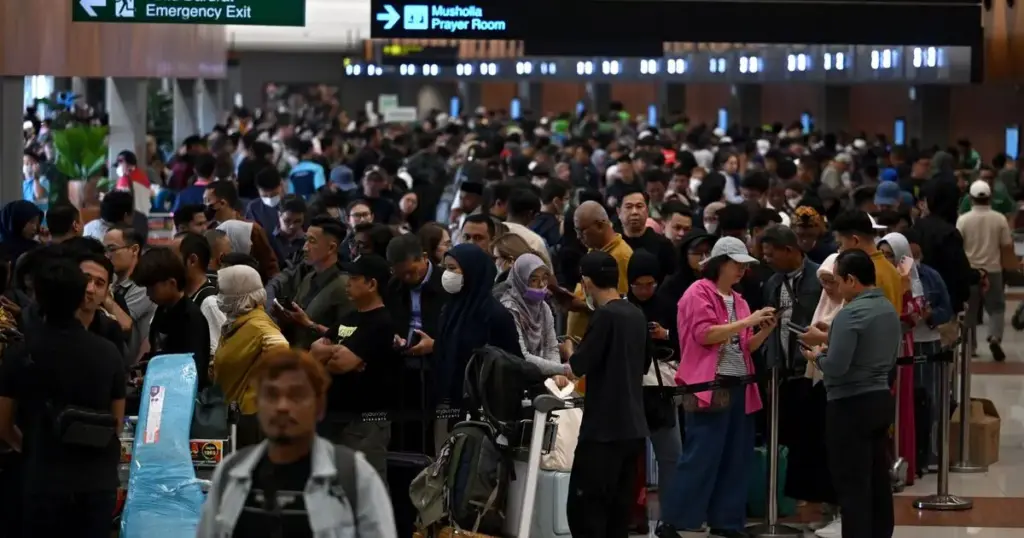
JAKARTA, INDONESIA — Air travel across parts of Southeast Asia was thrown into severe turmoil on Sunday, September 6, 2026, following a violent eruption of the notorious Indonesian volcano Mount Anak Krakatau. The cataclysmic event sent a colossal plume of ash soaring 50,000 feet into the stratosphere, heavily blanketing the airspace above western Indonesia and forcing the immediate shutdown of six major airports.
With key aviation hubs paralyzed—most notably Soekarno-Hatta International Airport serving the capital city of Jakarta—more than 150,000 travelers have been left stranded. Aviation authorities, emergency management teams, and regional governments are racing to manage the spiraling logistical crisis as scientists monitor the volcano for potential follow-up blasts.
Executive Overview: The Crisis at a Glance
The sudden eruption of Mount Anak Krakatau, which began building momentum late Friday night before culminating in powerful blasts through the weekend, has instantly exposed the vulnerability of regional transportation networks to geological hazards.
- The Event: A major volcanic eruption propelling an ash cloud up to 50,000 feet into the atmosphere.
- Aviation Impact: Six airports shuttered entirely, including Soekarno-Hatta International Airport and Halim Perdanakusuma Airport in Jakarta, alongside Radin Inten II Airport in Lampung. Hundreds of flights have been canceled or delayed.
- Passenger Disruption: Over 150,000 travelers stranded or affected nationwide, with tens of thousands facing immediate delays at primary terminals.
- Casualties & Safety: As of Sunday afternoon, no casualties or injuries have been reported, and no mandatory evacuation orders have been issued for nearby populations.
- Geographical Scope: The volcano is situated in the Sunda Strait—a volatile maritime corridor separating the densely populated islands of Java and Sumatra.
Detailed Chronology: How the Eruption Unfolded
Precursors and Initial Activity (Friday, September 4)
Indonesia’s Geological Agency first flagged anomalous seismic and surface activity at Mount Anak Krakatau late on Friday, September 4. Monitoring equipment picked up rhythmic tremor shifts and minor thermal anomalies, indicating that fresh magma was ascending through the conduit beneath the volcanic cone. While authorities kept a close watch, no immediate warnings were issued to the general public, as baseline activity for the restless volcano remains perpetually high.
The Paroxysmal Blast (Sunday, September 6)
The situation escalated dramatically in the pre-dawn hours of Sunday. At precisely 3:53 AM local time, Mount Anak Krakatau unleashed a violent, 30-second paroxysmal explosion.

Closed-circuit security cameras and remote satellite monitoring captured striking footage of brilliant lava flares erupting from the summit crater, accompanied by a deafening roar. The force of the detonation punched a dense, towering pillar of tephra, sulfur dioxide, and pulverized rock 50,000 feet into the sky. Prevailing high-altitude winds quickly caught the massive plume, shearing it across the Sunda Strait and directly into the primary flight corridors connecting Java and Sumatra.
Subsequent Eruptions and Daytime Progression
Following the primary pre-dawn explosion, the volcano rocked the surrounding coastal districts with two additional powerful blasts later Sunday morning. Thick, billowing clouds of ash continued to blanket the upper troposphere, creating zero-visibility conditions near the crater and raining fine particulate ash over nearby maritime sectors.
Supporting Context & Metrics: The Human and Economic Toll
The timing and scale of the eruption have triggered a cascading series of disruptions across Indonesia’s aviation and tourism sectors.
Airport Closures and Airspace Restrictions
AirNav Indonesia, the country’s air navigation service provider, acted swiftly to prevent catastrophic mid-air engine failures—a known hazard when aircraft ingest microscopic, abrasive volcanic glass particles. Total airspace closures were enforced around six key facilities:
- Soekarno-Hatta International Airport (Tangerang/Jakarta) – The nation’s primary international gateway, which absorbed the heaviest passenger impact.
- Halim Perdanakusuma International Airport (Jakarta) – Handling secondary commercial and VIP traffic.
- Radin Inten II Airport (Lampung, Sumatra) – Serving regional connections across the Sunda Strait.
- Three additional regional airstrips within the direct trajectory of the ash drift.
Passenger Impact Metrics
Initial tallies indicate that at least 22,800 passengers were directly stranded at Soekarno-Hatta International Airport alone within the first few hours of the morning shutdown. Across the broader network of six affected airports, the cumulative total of stranded and disrupted travelers has surpassed 150,000. Terminals that are usually bustling hubs of global commerce transformed overnight into crowded encampments, with travelers sleeping on terminal floors, queuing endlessly at airline service desks, and scrambling for alternative ground transportation.

Official Statements and Government Response
At an emergency briefing held in Jakarta on Sunday, Indonesian Transport Minister Dudy Purwagandhi addressed the media, outlining the government’s containment and mitigation strategies.
"We are facing an unprecedented atmospheric hazard stemming from the sudden intensification of Mount Anak Krakatau," Minister Purwagandhi stated. "Our absolute priority is the safety of the flying public. Hundreds of flights have already been affected, and we are working closely with domestic and international carriers to minimize long-term gridlock."
Purwagandhi urged airline operators to proactively explore flight diversions to unaffected regional airports further east, though he conceded that ground infrastructure constraints would limit how many aircraft could be successfully rerouted.
Meanwhile, Indonesia’s Geological Agency issued specific safety radiograms to local communities. Because Mount Anak Krakatau sits on an isolated volcanic island within the Sunda Strait, the nearest human settlements on the mainlands of Java and Sumatra are more than 10 miles away. Consequently, no emergency evacuations have been ordered. However, volcanologists have enforced a strict two-mile exclusion zone around the active marine crater, warning fishermen, tour operators, and curious onlookers to steer clear of the volatile danger zone due to the ongoing threat of sudden ballistic projectiles, pyroclastic surges, and localized tsunamis triggered by flank collapses.
Historical Context: The Shadow of Krakatoa
Mount Anak Krakatau—literally translating to the "Child of Krakatoa"—carries a heavy historical legacy. It emerged from the ocean in 1927 in the caldera left behind by the legendary, cataclysmic 1883 eruption of the original Krakatoa volcano, an event that killed tens of thousands and altered global weather patterns for years.

Because Anak Krakatau is an active, rapidly growing juvenile volcano, it experiences frequent eruptive phases. However, Sunday’s blast ranks among the most potent in recent memory, matching the scale of the late 2018 eruption that triggered a deadly tsunami in the Sunda Strait. Today’s event serves as a stark reminder of why Indonesia—situated squarely along the hyper-active Pacific "Ring of Fire"—remains one of the most geologically hazardous yet densely populated regions on Earth.
Future Outlook: What Lies Ahead?
As Sunday afternoon turned to evening, vulcanologists from the Center for Volcanology and Geological Hazard Mitigation (PVMBG) maintained a heightened alert level. Monitoring stations continue to track seismic tremor data, gas emissions, and satellite thermal imaging to determine whether Mount Anak Krakatau’s current eruptive phase will subside or escalate further.
For stranded travelers, the immediate future remains uncertain. Airlines have warned that flight suspensions at Jakarta’s major hubs will likely persist well into Monday, September 7, pending updated meteorological assessments of wind patterns and ash dispersion rates.
International carriers operating flights into and out of Jakarta are advising passengers to check flight status updates online before heading to the airport. As disaster management teams distribute emergency rations and water to stranded crowds inside the terminals, Indonesia braces itself for what could be a protracted recovery operation in the wake of nature’s raw fury.