Executive Overview
In an era where commercial aviation routinely contends with heightened passenger volatility, an American Airlines flight experienced a severe breach of cabin security that underscored the escalating challenges faced by flight crews worldwide. What was initially scheduled as a routine domestic service from Dallas, Texas, to Newark, New Jersey, rapidly descended into an environment of fear and confrontation on September 6, 2026.
Midway through the journey, an intoxicated passenger allegedly erupted into a violent, alcohol-fueled rampage, targeting fellow travelers with aggressive physical assaults, property destruction, and a barrage of racial and homophobic slurs. The severity of the disturbance forced the flight crew to make an emergency diversion, ultimately touching down at Baltimore/Washington International Thurgood Marshall Airport (BWI).
Thanks to the swift, decisive intervention of a retired law enforcement officer and fellow passengers—assisted by the prompt deployment of cabin restraints—the situation was contained before resulting in catastrophic harm. Local law enforcement took the suspect into custody immediately upon landing, while federal authorities, including the Federal Bureau of Investigation (FBI), began weighing federal charges. This incident highlights the ongoing crisis of unruly behavior in the skies, prompting renewed discussions regarding airline security protocols, alcohol service policies on domestic flights, and the legal frameworks governing mid-air crimes.
Detailed Chronology of Events
Flight Departure and the Escalation of Hostilities
The journey began under ordinary conditions at Dallas/Fort Worth International Airport, with passengers boarding the American Airlines service bound for Newark Liberty International Airport. Among them was an individual whose behavior would soon jeopardize the safety of everyone on board. According to preliminary accounts and eyewitness testimonies, the man appeared visibly inebriated prior to boarding or shortly after takeoff, though his state of intoxication quickly manifested in erratic and hostile behavior once the aircraft reached cruising altitude.
For the initial portion of the flight, the cabin remained relatively calm. However, the atmosphere shifted instantly. Witnesses described the transition from quiet routine to absolute chaos as occurring "just like a light switch."
Juan Mejia, a retired police officer who happened to be traveling on the aircraft, recounted the suddenness of the attack. "Just like a light switch, all of a sudden, it went from quiet to yelling and chaos," Mr. Mejia stated. "I turned around to look, and the poor gentleman that was sitting next to him in the aisle seat, the individual had his hands around his neck and was, like, assaulting him."
The Physical and Verbal Assault
The assailant did not limit his actions to a single altercation. Investigators and witnesses reported that the suspect escalated the confrontation by systematically targeting his seatmate. Beyond the physical choking, the man began hurling a torrent of vitriolic language, featuring explicit racial epithets and homophobic slurs directed at both the person next to him and surrounding passengers.
In addition to the physical and verbal abuse, the unruly passenger targeted personal property. During the melee, he reportedly attacked his neighbor’s electronic equipment, smashing and destroying a laptop computer in a display of unprovoked destruction. The erratic violence created immediate panic within the cabin, as passengers realized that the physical safety of those seated in the vicinity was severely compromised.
Passenger Intervention and the Use of Restraints
Recognizing the imminent danger, passengers near the disturbance realized that waiting for standard protocol might result in severe injury. Stepping forward to restore order, retired officer Juan Mejia, alongside at least one other courageous traveler, intervened to physically subdue the attacker.
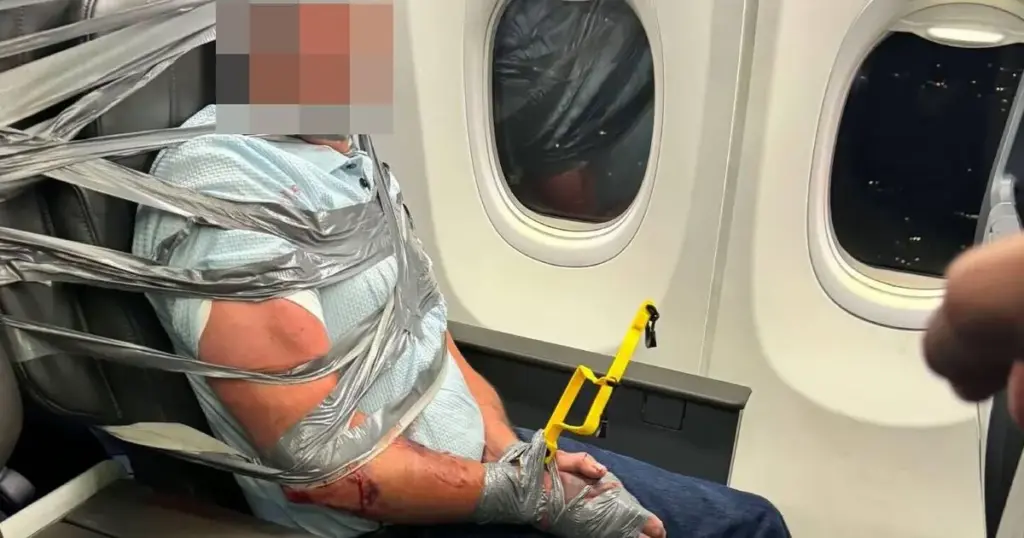
Working quickly to neutralize the threat, the Good Samaritans pinned the aggressive passenger down, effectively ending his physical assault on the cabin. Recognizing the necessity of securing the suspect for the remainder of the flight, flight attendants rushed to assist, providing commercial airline-approved duct tape. In a dramatic scene captured in part by shocked onlookers, the disruptive traveler was bound by his wrists, head, and torso, effectively immobilizing him to his seat to prevent any further attempts at violence.
Emergency Diversion and Law Enforcement Response
With the suspect secured, the flight crew faced a critical operational decision. Given the severity of the security breach, the captain elected to divert the aircraft away from its original destination of Newark.
The plane altered course toward Baltimore/Washington International Thurgood Marshall Airport (BWI), descending rapidly to prioritize safety and law enforcement intervention. The aircraft touched down safely at BWI approximately 15 minutes after the decision to divert was finalized.
Law enforcement personnel and airport security teams were waiting on the tarmac as the aircraft taxied to a secure gate. Officers boarded the plane, took the restrained suspect into custody, and escorted him off the aircraft. Following the removal of the disruptive individual, the aircraft underwent a brief security check before resuming its journey to Newark, allowing the remaining shaken passengers to finally reach their destination hours behind schedule.
Supporting Context and Metrics: The Rising Tide of Unruly Passengers
A Post-Pandemic Legacy of Aviation Disruptions
While the dramatic use of duct tape to secure unruly passengers often captures viral attention on social media platforms, incidents of severe in-flight disruption have transitioned from isolated anomalies to a persistent systemic issue within global commercial aviation.
Data collected by international aviation authorities and national transport agencies indicates that passenger misconduct surged dramatically during the COVID-19 pandemic—largely driven by disputes over mask mandates—and has failed to return to pre-2020 baselines. Even as mask requirements became a relic of the past, baseline rates of air rage have remained elevated, fueled by a potent mix of high travel volumes, airport congestion, passenger anxiety, and, crucially, alcohol consumption.
The Alcohol Factor in Cabin Disturbances
Industry analysts and cabin safety experts have long pointed to alcohol consumption as a primary catalyst for violent in-flight incidents. In this specific Dallas-to-Newark flight, witnesses explicitly noted that the suspect appeared inebriated before unleashing his racist and homophobic tirade.

Airlines face a delicate economic and operational balance: the sale of food and beverages, including alcohol, represents a significant ancillary revenue stream. However, combining high-altitude pressure, confined spaces, and readily available spirits frequently creates a volatile environment. Although federal regulations strictly prohibit passengers from consuming alcohol brought on board that was not served by the airline—and prohibit flight crews from serving visibly intoxicated individuals—enforcement at boarding gates and high-turnaround schedules often leaves gaps, occasionally resulting in tragedies of escalation like the one witnessed on this American Airlines service.
Legal Ramifications and Federal Prosecution
Unruly behavior aboard a commercial aircraft operating within United States airspace is not merely a breach of airline policy; it constitutes a serious federal offense. Under United States federal law (specifically 49 U.S.C. § 46504), interfering with flight crew members and attendants by assaulting or intimidating them carries severe penalties, including substantial financial fines and lengthy prison sentences.
Furthermore, when incidents involve physical assault, hate speech, or the destruction of property, federal prosecutors possess broad jurisdiction to bring multiple felony charges. Legal experts monitoring the case noted that the involvement of the FBI strongly suggests that the suspect will face federal prosecution rather than being processed solely through local municipal courts. This federal oversight serves as a deterrent intended to signal that violence in the skies will be met with the full weight of federal law enforcement.
Official Statements and Institutional Response
American Airlines’ Corporate Position
In the wake of the incident, American Airlines released a formal statement acknowledging the disruption while praising the composure of its frontline employees. The airline reiterated its zero-tolerance stance toward violence, harassment, and discrimination of any kind within its cabins.
A representative for American Airlines stated:
"The safety and security of our customers and team members is our top priority, and we do not tolerate violence."
The airline further emphasized its gratitude toward those who managed the crisis, adding:
"We thank our team members for their professionalism and our customers for their understanding."
The statement underscores the growing operational burden placed on flight attendants, who are increasingly required to act as first responders in high-stress, dangerous environments thousands of feet in the air.
Law Enforcement and Federal Involvement
Local authorities at Baltimore/Washington International Thurgood Marshall Airport confirmed that the suspect was processed immediately following the aircraft’s unscheduled landing. According to reports from legal and media outlets such as TMZ, federal law enforcement agencies, including the FBI’s Baltimore field office, quickly coordinated with local police to review video evidence, interview eyewitnesses, and examine the statements provided by flight crew members and passengers like Juan Mejia.
Federal prosecutors are currently reviewing the case file to determine the precise composition of the indictment. Given the nature of the outburst—combining physical battery, destruction of private property, and explicit hate speech—legal analysts anticipate that the suspect will face multiple federal counts, which could severely restrict his freedom for years to come and place him on the federal "No-Fly" list permanently.
Future Outlook: Industry Reforms and Passenger Safety
Reinforcing Cabin Security and Crew Training
As commercial aviation continues to navigate the complexities of passenger behavior, airlines and regulatory bodies are under mounting pressure to implement structural changes that go beyond reactive measures like duct-restraints.
- Enhanced De-escalation Training: Flight attendant unions have repeatedly called for more comprehensive, mandatory training focused on tactical de-escalation, physical self-defense, and psychological management of highly aggressive individuals.
- Pre-Flight Screening and Alcohol Monitoring: Airports and airlines are exploring tighter coordination at departure gates to intercept visibly intoxicated passengers before they ever step foot onto an aircraft. Increased collaboration between airport bar staff, gate agents, and flight crews is viewed as a vital first line of defense.
- Information Sharing and No-Fly Lists: Law enforcement and airline coalitions are advocating for a unified federal database that shares real-time information regarding banned passengers across all domestic and international carriers, ensuring that individuals who commit violent infractions cannot simply book a ticket on a competing airline.
The Changing Psychology of Air Travel
The psychological landscape of modern air travel remains fractured. High passenger densities, cramped seating configurations, and frequent flight delays create an underlying tension that can be easily triggered by minor provocations.
Incidents like the American Airlines flight from Dallas to Newark serve as a stark reminder of the fragile social contract that governs commercial aviation. Passengers share a closed environment where mutual respect and adherence to basic social norms are essential for collective safety. When those norms are shattered by bigotry, intoxication, and unprovoked violence, the reliance on the courage of everyday citizens—and the professionalism of flight crews—becomes our ultimate safeguard.
As this case moves through the federal judicial system, it will undoubtedly serve as a benchmark for how aggressively law enforcement intends to prosecute air rage, sending an unequivocal message to the traveling public: the skies are not a lawless frontier, and violence aboard commercial aircraft will be met with swift, severe, and enduring consequences.