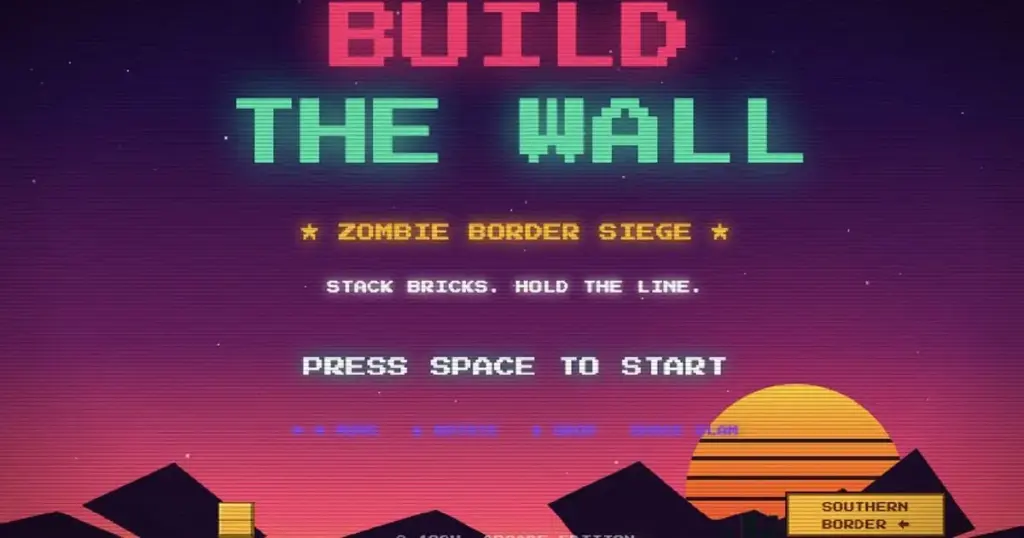
WASHINGTON — In an unprecedented fusion of digital gaming culture, internet meme politics, and official government communications, the White House has unveiled a suite of retro, arcade-style video games designed to celebrate President Donald Trump’s second-term immigration agenda.
The digital rollout, which went live on a newly minted White House microsite, reinterprets classic 1980s and 90s arcade formats through a decidedly populist and nationalist lens. Featuring titles like Rio Run and Build the Wall, the interactive platform invites web users to physically engage with some of the administration’s most polarizing policy pillars—specifically, mass deportations, enhanced border security, and executive economic initiatives.
While the administration defends the unconventional strategy as an innovative, culturally resonant method of communicating executive accomplishments to a digital-native electorate, civil rights organizations and political opponents have sharply condemned the initiative. Critics argue that gamifying human displacement and border enforcement is dehumanizing, trivializes complex humanitarian realities, and degrades the gravity of federal policymaking.
Executive Overview
The launch of the White House’s arcade portal marks a distinct escalation in the administration’s reliance on internet culture, gamification, and provocative digital media to shape public discourse. Released on Thursday, the website features titles clearly styled after coin-op classics, complete with chiptune soundtracks, vibrant color palettes, and explicit policy messaging.
The platform includes three primary games:
- Rio Run: A modernized, MAGA-themed iteration of the classic arcade snake game. Players control a digital likeness of Border Czar Tom Homan as he pursues migrants along the Rio Grande.
- Build the Wall: A block-stacking puzzle challenge modeled after Tetris, where players must rapidly stack structural barriers to "protect the border from the coming horde."
- Trump Accounts: An interactive collection game where users gather nets to fill investment accounts seeded with $1,000 for children born between 2025 and 2028.
The official White House account on X (formerly Twitter) aggressively promoted the launch with a Sega-inspired visual motif, accompanying the trailer with the defiant slogan: “CAN’T STOP WINNING. Build the wall. Deport. Fill a Trump Account.”
Administration defenders maintain that the games represent a creative leap forward in public outreach, bridging the gap between traditional governance and modern entertainment. However, the release has ignited a firestorm of ethical debate, drawing swift condemnation from immigrant advocacy groups, civil liberties watchdogs, and congressional Democrats who view the campaign as a disturbing trivialization of state-sponsored enforcement actions.
Detailed Chronology: From Campaign Trail to Digital Arcade
The genesis of the White House gaming platform can be traced directly through the evolution of President Trump’s second-term communications strategy, which has consistently blurred the lines between political entertainment and official state messaging.
January – August 2026: Accelerating the Enforcement Machine
Upon returning to the Oval Office, President Trump moved with unprecedented speed to fulfill his central campaign pledge: executing the largest domestic deportation operation in American history. Over the first eight months of his second term, federal agencies rapidly expanded interior arrests, increased the frequency of deportation charter flights, and tightened cross-border protocols.

Despite official reports indicating that unauthorized border crossings had dropped precipitously from previous multi-year peaks, the administration faced fierce pushback in multiple sanctuary states and cities. Interior enforcement sweeps drew immediate legal challenges, intense local protests, and mounting logistical hurdles regarding detention capacity.
September 2026: The Digital Pivot
Recognizing the friction between federal goals and state-level resistance, White House communications strategists sought alternative channels to maintain public enthusiasm and dominate the news cycle. Drawing inspiration from previous viral social media campaigns—which frequently leveraged provocative imagery, internet memes, and unauthorized pop-culture audio tracks—the digital team conceptualized an interactive portal.
By early September, developers working with the administration finalized the arcade suite. The objective was clear: circumvent traditional journalistic filters, engage younger demographics via nostalgia-driven gaming formats, and cement core policy priorities into the national cultural consciousness. On Thursday, September 5, 2026, the site officially went live, instantly drawing millions of impressions across social media channels and setting off a multi-day political controversy.
Supporting Context & Metrics: Immigration, Enforcement, and Digital Strategy
To fully understand the cultural and political shockwaves generated by the White House arcade games, it is necessary to examine the underlying operational metrics and historical context of the administration’s immigration policies.
The Enforcement Landscape in 2026
Federal data released by the Department of Homeland Security indicates a profound shift in U.S. border management protocols over the past twenty months:
- Border Apprehensions: Southwest land border encounters have fallen by roughly 60% compared to the peak averages recorded in 2023 and 2024, driven by strict asylum restrictions and expanded expedited removal authorities.
- Interior Removals: Deportation flights and administrative expulsions have increased by over 45% year-over-year, supported by emergency funding packages passed by Congress earlier in the legislative session.
- Detention Footprint: Federal immigration detention populations have swelled to near-record capacities, prompting ongoing federal lawsuits from civil rights groups challenging detention conditions and due process access.
The Evolution of Political Gamification
The use of video games and interactive media in American politics is not entirely new, but its adoption by an official presidential administration marks a watershed moment. Historically, political campaigns—most notably the Obama 2008 campaign’s integration into virtual worlds like Burnout Paradise—have utilized commercial gaming spaces for targeted advertising.
However, the direct creation and publication of proprietary, arcade-style video games by the Executive Branch to celebrate punitive enforcement policies represents an aggressive expansion of digital propaganda. By transforming complex geopolitical and humanitarian issues into simple reflex-based challenges (such as chasing human figures or stacking physical border barriers), the administration has pioneered a new frontier in executive branch public relations.
Official Statements and Diverging Perspectives
The rollout of the White House gaming platform has exposed a deepening chasm between executive leadership and civil society regarding the boundaries of official government communication.
The White House Defense
In an official statement defending the launch, White House communications officials emphasized the need to modernize how government achievements are presented to the public:

"This release was designed to innovate and tell the story of the President’s many accomplishments in a way that resonates with every American. It further creates a stark contrast between a culture of fun and winning and the dark socialist vision Democrats have for America."
Administration surrogates doubled down on television and social media appearances over the weekend, arguing that humor, irony, and interactive media are legitimate tools to combat what they characterize as overly sterile bureaucratic communication. Officials stressed that the games reflect genuine popular support for robust border security and economic nationalism.
Condemnation from Civil Rights and Advocacy Groups
Conversely, immigrant rights organizations, humanitarian groups, and civil liberties watchdogs reacted with profound dismay. In joint statements, leaders from organizations such as the American Civil Liberties Union (ACLU) and the National Immigration Law Center condemned the initiative as dehumanizing.
"Turning human suffering, family separations, and mass workplace raids into a high-score arcade game is a new low for public discourse," said a senior policy analyst at an immigrant advocacy coalition. "Immigration enforcement is not a game; it involves real human lives, constitutional rights, and profound humanitarian consequences. Trivializing these actions normalizes cruelty under the guise of entertainment."
Legal scholars have also begun examining whether the use of official government resources to develop and host partisan, ideologically charged video games violates traditional anti-lobbying statutes or ethical guidelines governing executive branch communications, though no formal injunctions have been filed as of yet.
Congressional Opposition
Democratic lawmakers joined in the chorus of criticism, arguing that the administration’s focus on digital arcade games demonstrates a gross misallocation of federal attention and resources at a time of pressing domestic and international challenges.
“While families across the country struggle with inflation, housing costs, and healthcare access, this administration is spending taxpayer-funded hours building flash-based propaganda games that mock human misery,” said a senior Democratic member of the House Oversight Committee. “It is juvenile, divisive, and entirely beneath the dignity of the office.”
Future Outlook: What Lies Ahead for Digital Governance?
As the political fallout from the White House arcade launch reverberates through Washington, analysts are left pondering the long-term implications for political communications and executive branch transparency.
- Escalation of Meme Politics: The success of the microsite in generating massive online engagement—regardless of whether that engagement is positive or negative—suggests that the administration is unlikely to retreat from provocative digital strategies. Future policy rollouts may incorporate even more immersive technologies, including augmented reality (AR) or virtual reality (VR) applications.
- Potential Legal and Ethical Pushback: While immediate injunctions are unlikely to halt the website’s operation, watchdogs are expected to file Freedom of Information Act (FOIA) requests to uncover the exact taxpayer costs associated with the development, coding, and hosting of the gaming portal. This could set up future congressional hearings regarding the appropriate use of executive branch communications budgets.
- Polarization of Public Culture: The incident highlights an ongoing cultural bifurcation in the United States, where political ideology increasingly dictates not only news consumption and social values, but leisure and entertainment habits as well.
For now, the White House digital arcade remains online, logging scores, sparking heated debate across cable news networks, and cementing a controversial new chapter in the intersection of modern video gaming and American presidential politics.