The global fashion landscape has a new luminary. In a high-stakes ceremony held at the Frank Gehry-designed Fondation Louis Vuitton in Paris, Antwerp-based visionary Julie Kegels was crowned the winner of the prestigious 2026 LVMH Prize for Young Designers. Presented by actress Jennifer Lawrence, the accolade firmly plants Kegels into the upper echelons of contemporary fashion, transitioning her from a critically praised cult favorite to a globally recognized powerhouse.
Launched merely two years prior in 2024, Kegels’ eponymous label has rapidly captivated the industry with its uncanny ability to balance pragmatic tailoring with subverted, surrealist whimsy. Her victory at the 2026 LVMH Prize—selected from a fiercely competitive cohort of nine international finalists—underscores a broader industry shift toward conceptual depth, narrative-driven design, and uncompromising craftsmanship.
As the reigning laureate, Kegels secures a €400,000 financial endowment alongside a bespoke, year-long mentorship program overseen by the unrivaled network of experts at LVMH. She steps into a prestigious lineage of past innovators, including Grace Wales Bonner, Marine Serre, and Ellen Hodakova Larsson. Alongside Kegels, the ceremony celebrated the ingenuity of Chinese-born New York designer Zane Lii, who captured the Karl Lagerfeld Prize, and Anil Padia of Yoshita 1967, who claimed the Savoir-Faire Prize.
This year’s competition stood as one of the most geographically diverse and conceptually daring editions in the history of the prize. Featuring a jury panel comprising some of the most influential creative directors and executives in modern luxury, the event offered a definitive barometer for the future trajectory of global fashion.
Detailed Chronology: The Road to the Paris Podium
The journey to the 2026 LVMH Prize podium was characterized by months of rigorous evaluation, artistic vulnerability, and high-pressure presentations before the fashion world’s ultimate gatekeepers.
The Semifinals and the Global Cull
The process began months prior with hundreds of applicants spanning continents, representing the next generation of creative leadership. Through a meticulous screening process, a panel of industry experts narrowed the field down to a diverse semi-finalist roster. These designers were tasked with showcasing their physical collections, manufacturing capabilities, and brand ethos to a digital and in-person voting body composed of international buyers, journalists, and consultants.
By early spring, the field was distilled down to nine stellar finalists:
Julie Kegels (Antwerp)
Zane Lii / Lii (New York / China)
Anil Padia / Yoshita 1967 (India)
Colleen Allen (North America)
Institution by Galib Gassanoff (Europe)
De Pino by Gabriel Figueiredo (Brazil / Europe)
Petra Fagerström (Scandinavia)
Ponte by Harry Pontefract (UK)
The Vxlley by Daniel del Valle Fernandez (Spain / International)
The Final Showdown in Paris
On the final evaluation day, the nine finalists gathered in Paris to present their complete Fall/Winter collections to the grand jury. The room was heavy with anticipation, populated by a jury whose creative footprints define modern luxury: Jonathan Anderson, Phoebe Philo, Nicolas Ghesquière, Maria Grazia Chiuri, Pharrell Williams, and LVMH Prize founder and Dior CEO Delphine Arnault.
Unlike static lookbooks or runway shows geared purely toward entertainment, the LVMH Prize presentation serves as a technical interrogation. Designers must defend their business models, sustainability practices, material sourcing, and creative vision face-to-face with industry titans.
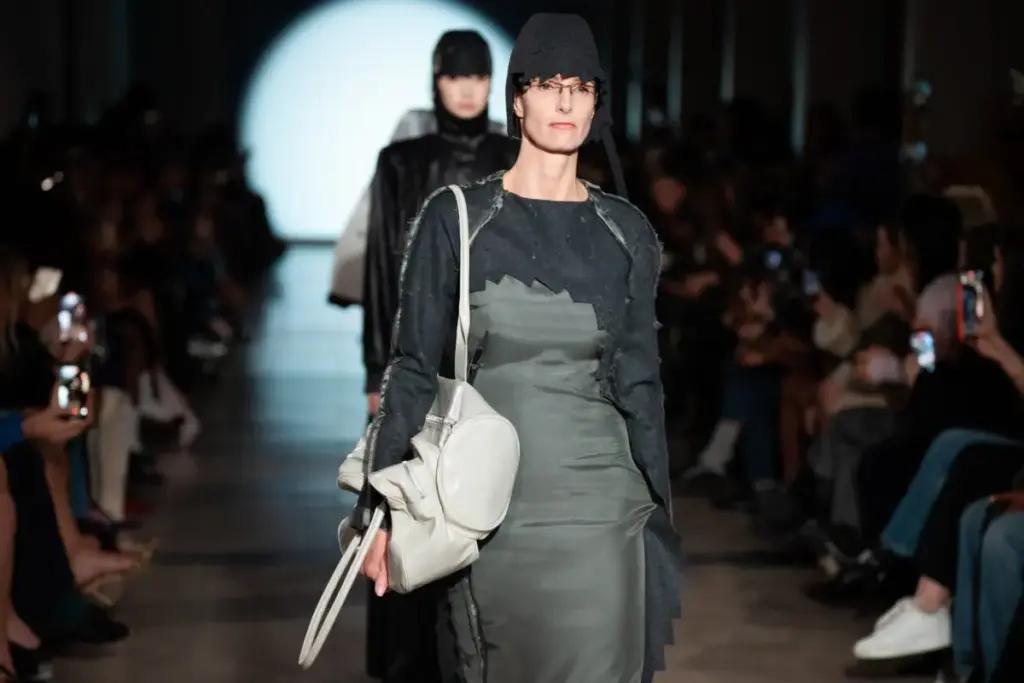
Kegels’ presentation stood out for its theatrical yet grounded storytelling. Rather than presenting static garments, her collection came alive through staging that reflected the complex interior lives of her imagined muses. When Jennifer Lawrence opened the golden envelope at the Fondation Louis Vuitton on Friday afternoon, calling out Julie Kegels’ name, it marked the culmination of a meteoric rise for the Belgian designer.
Supporting Context & Metrics: The Anatomy of a Winning Aesthetic
To understand why Julie Kegels captured the unanimous respect of a jury as diverse as Phoebe Philo and Pharrell Williams, one must examine the philosophical and technical DNA of her work.
The Duality of the Modern Woman
At the beating heart of Kegels’ design philosophy is a deceptively simple premise: no woman is ever just one thing. In an era where micro-trends often reduce consumers to fleeting archetypes, Kegels approaches garment construction through the lens of psychological complexity.
Her collections are populated by imagined characters caught in moments of internal friction—individuals with competing impulses, contradictory desires, and unexpected daily habits. This philosophical stance manifests in clothing that feels simultaneously practical and uncanny. Signature pieces from her recent catalogs include:
A classic, structured tweed knit top unexpectedly juxtaposed against a breezy, tropical aloha-print miniskirt.
A meticulously tailored corporate suit featuring functional shorts subtly hidden away in the back panels.
Playful accessories, including sculptural purple shoes, asymmetrical gloves, and saturated belts that interrupt clean sartorial lines.
The LVMH Prize is much more than a vanity trophy; it is a critical institutional engine designed to secure the financial independence of emerging labels.
The Main Prize (Julie Kegels): €400,000 endowment + 1 year of bespoke mentoring.
The Karl Lagerfeld Prize (Zane Lii): €200,000 endowment + 1 year of mentoring.
The Savoir-Faire Prize (Anil Padia): €200,000 endowment + 1 year of mentoring.
For a young label like Kegels’—founded only two years ago in Antwerp—a €400,000 injection acts as a transformative capital resource. It allows the brand to scale production, secure independent manufacturing channels, expand its wholesale footprint into major international luxury stockists, and invest in sustainable material innovation. Furthermore, the twelve-month mentorship program grants direct access to LVMH’s internal specialists across supply chain logistics, legal compliance, intellectual property, and global marketing.
Official Statements and Industry Reception
The announcement sent immediate ripples of excitement throughout the international fashion press and executive boardrooms alike.
Delphine Arnault, founder of the LVMH Prize and CEO of Christian Dior, reflected on the exceptional caliber of the 2026 participants:
"This year’s edition has demonstrated an extraordinary level of international vision and technical maturity. Julie Kegels represents the very best of contemporary design—she challenges our expectations of what clothing should do while maintaining a profound respect for craftsmanship. Her ability to translate complex psychological narratives into wearable, highly desirable garments is remarkable."
Hollywood icon and cultural tastemaker Jennifer Lawrence, who had the honor of handing over the trophy, praised the emotional resonance of Kegels’ creations:
"Wearing fashion should feel like stepping into a character. Julie’s clothes have an attitude, a sense of humor, and a sharp intelligence that you don’t often see in new labels. It is an absolute thrill to see her hard work recognized on this global stage."
Zane Lii, speaking after accepting the Karl Lagerfeld Prize for his boundary-pushing New York-based label, emphasized the communal spirit among the finalists:
"Being in this room with designers from every corner of the world—from Antwerp to China to India—proves that fashion’s future belongs to those who dare to cross cultural and conceptual borders. This prize gives us the runway we need to build sustainable, independent houses for the future."
Future Outlook: What Lies Ahead for Julie Kegels and the Industry
As the dust settles on the Fondation Louis Vuitton ceremony, the luxury sector shifts its focus to the long-term implications of Kegels’ victory.
The Antwerp Renaissance
Antwerp has long held a legendary status in fashion history as the incubator of the "Antwerp Six" in the late 1980s, followed by generations of avant-garde disruptors. With Kegels bringing the LVMH Prize home to Belgium, the city’s storied academies and independent studios are once again under the global microscope. The victory reinforces Antwerp’s reputation as a sanctuary for intellectual, conceptual design that refuses to pander strictly to commercial algorithms.
Scaling the Brand
The immediate challenge for Kegels will be managing the "LVMH bounce"—the sudden, explosive surge in global demand, press attention, and retail inquiries that follows a major win. With the financial backing of the €400,000 endowment and the strategic guidance of LVMH mentors, the brand is uniquely positioned to transition from an insider cult label into an internationally distributed luxury house.
Industry analysts predict that over the next twelve to twenty-four months, we will see:
Strategic Retail Expansion: Key placement in tier-one luxury department stores across Paris, London, New York, and Tokyo.
Category Diversification: Potential expansion into luxury leather goods, footwear, and bespoke tailoring lines, building upon the striking accessories seen in her Fall/Winter collections.
Sustainable Infrastructure Upgrades: Investing in eco-conscious textile sourcing to align with tightening European environmental regulations and consumer demand for transparency.
Ultimately, Julie Kegels’ triumph at the 2026 LVMH Prize serves as a powerful reminder that the heart of fashion still beats for originality, narrative depth, and technical ingenuity. As she embarks on her year of mentorship and international expansion, the fashion world will be watching closely to see which characters she brings to life next.