By the Editorial Board
Published by Special Arrangement with Film & Fashion Insights
Executive Overview
When the cinematic landscape welcomes a visionary director like Yorgos Lanthimos, audiences learn to expect the unexpected. With his 2023 masterpiece Poor Things, adapted from Alasdair Gray’s landmark 1992 postmodern novel, Lanthimos transported viewers into a surreal, steampunk-adjacent late-19th-century universe. At the center of this gothic-meets-futuristic pastiche is Bella Baxter—played with fearless, physical brilliance by Emma Stone—a young woman brought back to life through an unorthodox brain-transplantation experiment orchestrated by the eccentric scientist Godwin Baxter (Willem Dafoe).
While the literary and cinematic traditions of Frankenstein typically evoke monochromatic laboratories, decaying flesh, and industrial ugliness, Poor Things subverts this legacy entirely. The film’s aesthetic universe is a riot of vibrant hues, impossible textures, and hyper-imaginative silhouettes. Spearheaded by costume designer Holly Waddington, the wardrobe of Poor Things does not merely dress the actors; it serves as a primary narrative vehicle, charting Bella’s psychological evolution from a restricted, infantile subject to a self-actualized, intellectually liberated woman waging war against patriarchal constraints.
This comprehensive report examines the meticulous design philosophy behind Waddington’s work, tracing how historical Victorian silhouettes were radically re-engineered for a futuristic gothic fable. Through detailed analyses of character progression, exclusive design insights, and cultural impact metrics, we explore how Poor Things established a new benchmark for cinematic costume design, ultimately earning widespread critical acclaim and cementing its place in modern cinematic history.
Detailed Chronology: The Evolution of Bella Baxter’s Wardrobe
To understand the genius of Holly Waddington’s costume design, one must trace the visual trajectory of Bella Baxter alongside her psychological awakening. Waddington worked closely with Lanthimos to ensure that every garment mirrored Bella’s expanding consciousness, her interactions with the outside world, and her eventual rejection of societal norms.
Phase 1: The Genesis of Innocence (The Early Laboratory Days)
When viewers first encounter Bella, she possesses the cognitive and motor skills of a child housed within an adult body. Confined to the walled sanctuary of Godwin Baxter’s estate, her clothing reflects this arrested development and sheltered existence.
Waddington introduced Bella in dramatic, voluminous tops paired with playful pump trousers. These garments were designed to look effortless, chaotic, and organically untamed. "Lanthimos didn’t want me to remain historically accurate," Waddington explains, noting her initial research into the exaggerated sleeves and rigid structures of the 1890s. Instead of historical replication, Waddington sought to capture an unpolished impulsivity. Because Bella had spent years shielded from the real world, her earliest outfits possess a raw, unstructured lightness that highlights her childlike wonder and unpredictable movements.
Phase 2: The Satorial Explosion of Exploration
As Bella breaks free from her surrogate father’s home and embarks on a globe-trotting odyssey of self-discovery alongside the hedonistic lawyer Duncan Wedderburn (Mark Ruffalo), her wardrobe undergoes a dramatic metamorphosis. The loose, casual garments of her youth give way to avant-garde, boundary-pushing ensembles that could easily grace the digital pages of contemporary fashion blogs or a London Fashion Week street-style report.
- The Rüched Top & Yellow Shorts Ensemble: In one of the film’s most striking visual moments, Bella pairs a crisp white ruffled top with canary-yellow shorts, accessorized with tiny black sunglasses, a cropped blue jacket, and sturdy ankle boots. The juxtaposition of Victorian construction with modern color blocking underscores her timeless, genre-defying nature.
- The Transparent Pink Statement: Another pivotal look features a high-collared white ruffled top matched with a flowing, translucent pink skirt. As Bella navigates foreign cities, encounters systemic poverty for the first time, and reckons with her own class privilege—often manifested in elaborate Victorian dresses adorned with stark white puff sleeves—her clothing becomes increasingly complex and layered. Every new environment leaves a stylistic imprint on her expanding persona.
Phase 3: Confronting the Patriarchy and Forced Confinement
Later in the narrative, the film explores fragments of Bella’s past life before the experiment—a reality governed by strict, suffocating patriarchal conventions that she ultimately flees. To visually symbolize this profound sense of entrapment, Waddington drew inspiration from 19th-century mourning and high-society photography.
During these sequences, Emma Stone is encased in structured, armor-like garments. Notable pieces include a striking deep-blue gown paired with a rigid, traditional overcoat, and a copper-toned dress featuring intricate golden metallic detailing that mimics defensive armor. "I wanted a stark contrast to the looks she wears after the experiment," Waddington notes. "These outfits are impressive, beautiful, profoundly serious, and heavy with narrative weight." They serve as wearable prisons, physically manifesting the societal expectations that sought to crush her autonomy.
Phase 4: Self-Actualization and Liberation
The culmination of Bella’s journey arrives in the film’s poignant final act. Having dismantled the expectations of Victorian society and forged an identity entirely on her own terms, her wardrobe strips away all theatricality and artifice.
In the concluding scenes, Bella is seen wearing a simple, understated cream-colored knit pullover paired with a copper maxirosk. "At that point, those are just clothes," Waddington reflects. "I wanted her outfit to look as though she had finally found herself—as if she knew exactly who she was." Gone are the ballooning sleeves, the architectural corsets, and the ironic accessories; what remains is pure, unadulterated authenticity.
Supporting Context & Metrics: Crafting the World of Poor Things
The success of Poor Things rests heavily on its world-building, a collaborative triumph involving director Yorgos Lanthimos, production designers Shona Heath and James Price, and costume designer Holly Waddington. While the visual language of the film feels entirely unified, the underlying metrics of its creation reveal a staggering level of artisanal craftsmanship.
Reimagining the 1890s Silhouette
Historians of fashion frequently point to the 1890s as a decade of extreme silhouettes—particularly characterized by the "gigot" or "leg-of-mutton" sleeve, which peaked in popularity around 1895. Waddington used these historical parameters not as a cage, but as a launchpad for surrealism.
- Textural Innovation: Standard Victorian textiles—heavy brocades, stiff silks, and rigid wools—were systematically replaced with unexpected fabrics, lightweight synthetics, and organic weaves that allowed for fluid physical movement, accommodating Emma Stone’s highly physical, uninhibited comedic and dramatic choreography.
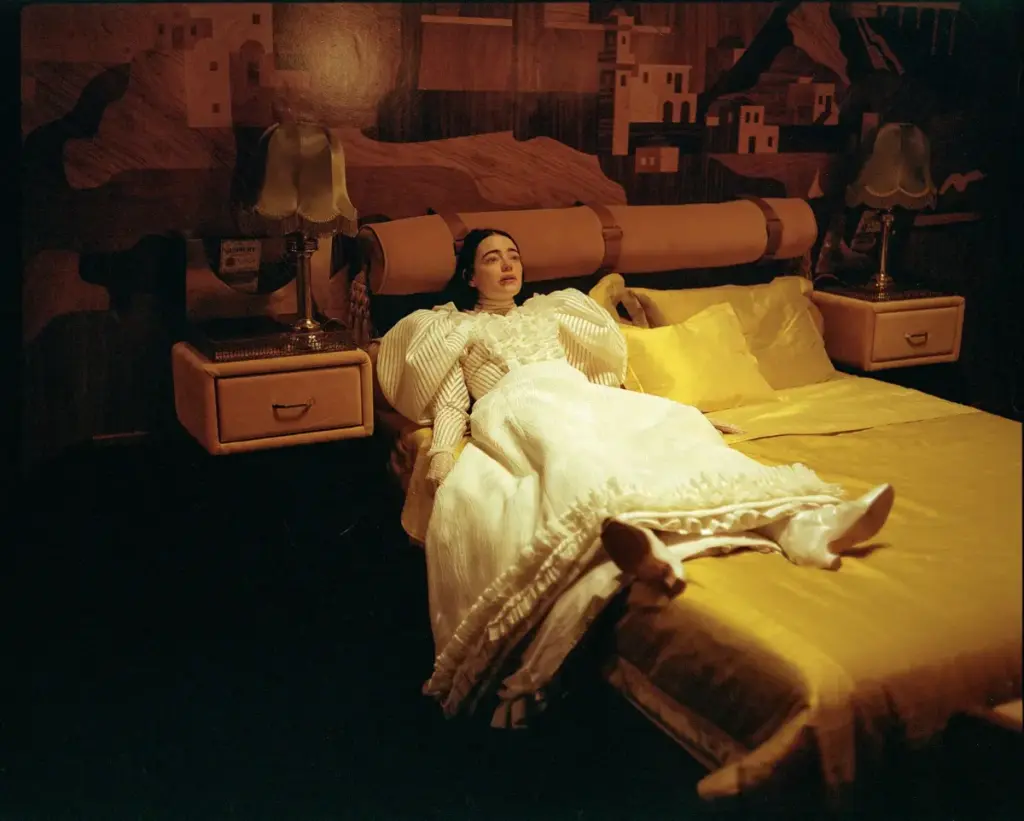
- The Bridal Subversion: One of the most discussed design elements is Bella’s unconventional wedding gown. Waddington spent days debating whether a traditional white bridal dress and veil belonged in the film. Ultimately, she decided to wrap the traditional veil tightly across the lower half of Stone’s face—a gesture that bridged bridal orthodoxy with bizarre, silencing symbolism. This impromptu modification became Stone’s favorite costume piece in the entire production.
Juxtaposition of Male and Female Aesthetics
While Bella’s wardrobe explodes with color, texture, and psychological evolution, the male characters in Poor Things largely serve as sartorial anchors representing the rigid, unyielding structures of the era.
Godwin Baxter, played with tragic grandeur by Willem Dafoe, is draped in muted, monochromatic tones and traditional late-19th-century tailoring. Referred to by Bella simply as "God," his wardrobe emphasizes his role as a weary, scarred creator trapped within his own scientific hubris. This stark dichotomy between Godwin’s faded, conventional attire and Bella’s vibrant, ever-evolving garments heightens the thematic tension between traditional authority and chaotic rebirth.
Official Statements & Design Philosophy
In interviews surrounding the release and subsequent award season run of Poor Things, Holly Waddington and the core creative team elaborated extensively on the philosophical underpinnings of the film’s visual identity.
"Yorgos [Lanthimos] was adamant that I shouldn’t feel bound by historical accuracy," Holly Waddington stated during a press roundtable. "We looked at the 1890s for inspiration, particularly the exaggerated proportions, but the mandate was always to make it feel wild, chaotic, and organic. Bella’s brain is newly formed; her mind is a blank slate encountering the world without preconceived notions. Her clothes had to breathe that exact same air of unrestrained discovery."
Discussing the psychological weight of the costumes, Waddington emphasized that clothing in Poor Things acts as an externalized nervous system for the protagonist:
"When she is trapped by her past, the clothes are armor. They weigh her down, signaling the oppressive weight of the patriarchy. But when she steps into her true power at the end of the film, all of that falls away. The cream knit sweater isn’t a statement; it’s an exhale. It represents total freedom from performance."
Director Yorgos Lanthimos similarly praised the collaborative environment that allowed the costume department to push past conventional period-piece boundaries, treating the 19th-century setting as an alternative reality where human biology, architecture, and fashion bend to the psychological realities of the characters.
Future Outlook: The Cultural Legacy of Poor Things Fashion
As Poor Things continues to be analyzed by film scholars, fashion historians, and cinephiles worldwide, its influence on contemporary design and visual storytelling is already becoming apparent.
- The Revival of Avant-Garde Period Pieces: The film has proven that audiences crave historical dramas that reject strict academic reenactment in favor of expressionist world-building. Future productions are expected to lean further into anachronistic styling, blending historical silhouettes with modern street-style sensibilities.
- Award Season Dominance: Holly Waddington’s work on Poor Things has established her as a preeminent voice in modern costume design, securing critical accolades and setting a high watermark for upcoming fantasy and period projects.
- Fashion Runway Inspirations: The vibrant color palettes, voluminous sleeves, and playful juxtapositions popularized by Bella Baxter’s wardrobe have already begun trickling into high-fashion collections, signaling a renewed appetite for theatrical, narrative-driven dressing in everyday consumer culture.
In conclusion, Poor Things transcends the boundaries of standard cinematic adaptation, offering a brilliant testament to the power of costume design. Through Holly Waddington’s visionary creations, Bella Baxter’s journey from a scientific experiment to an autonomous, self-realized icon is rendered visible, tactile, and unforgettable.
Poor Things is currently available to stream on digital platforms and view in select international cinemas.