In the modern landscape of fitness, where high-tech home gym equipment and complex training regimens often dominate the discourse, the humble kettlebell remains a masterclass in minimalist efficiency. Requiring minimal floor space and a modest financial investment, a single cast-iron or steel bell possesses the capacity to transform physical conditioning.
According to leading industry professionals, a properly structured 20-minute kettlebell routine can deliver a trifecta of fitness benefits: muscular hypertrophy, cardiovascular conditioning, and long-term joint and bone health.
This comprehensive analysis examines a dynamic, total-body kettlebell circuit designed by Lacee Lazoff, an expert trainer at New York City’s renowned Fhitting Room. By leveraging the unique physics of the kettlebell—specifically its offset center of gravity—this routine challenges the body across multiple planes of motion.
Unlike traditional dumbbells, which distribute weight evenly across the hand, the kettlebell’s weighted sphere hangs beneath the handle. This creates continuous instability, demanding rapid recruitment of core stabilizers, forearm endurance, and deep neuromuscular coordination.
Designed around functional movement patterns that mirror everyday human mechanics, this four-circuit, interval-based protocol prioritizes movement quality over sheer repetition. By integrating bodyweight interludes to mitigate grip fatigue, Lazoff’s programming allows practitioners to sustain elevated heart rates and reap the compounding benefits of combined resistance and aerobic training.
Detailed Chronology: Anatomy of the 20-Minute Routine
To maximize physiological adaptation while minimizing the risk of injury, Lazoff’s workout follows a precise, phased progression. The session begins with a targeted bodyweight mobility warmup, transitions through four distinct, high-efficiency kettlebell circuits governed by time rather than rep counts, and concludes with structured recovery intervals.
Before a single ounce of external load is introduced, the body requires neural priming, synovial fluid distribution, and dynamic tissue lengthening. The warmup utilizes four bodyweight movements executed sequentially:
World’s Greatest Stretch: A multi-joint movement targeting the thoracic spine, hip flexors, hamstrings, and ankles. It opens up restricted pathways and prepares the lower extremities for deep flexion.
Alternating Lateral Lunge: Focuses on the frontal plane, gently stressing the adductors and abductors while reinforcing unilateral leg drive and stability.
Cat-Cow: Promotes spinal articulation, relieving tension along the erector spinae and encouraging lumbar-thoracic dissociation.
Hip Switches: Enhances internal and external hip rotation, priming the gluteal complex and acetabular joints for multi-directional loading.
Phase 2: The Kettlebell Circuits (Execution and Design)
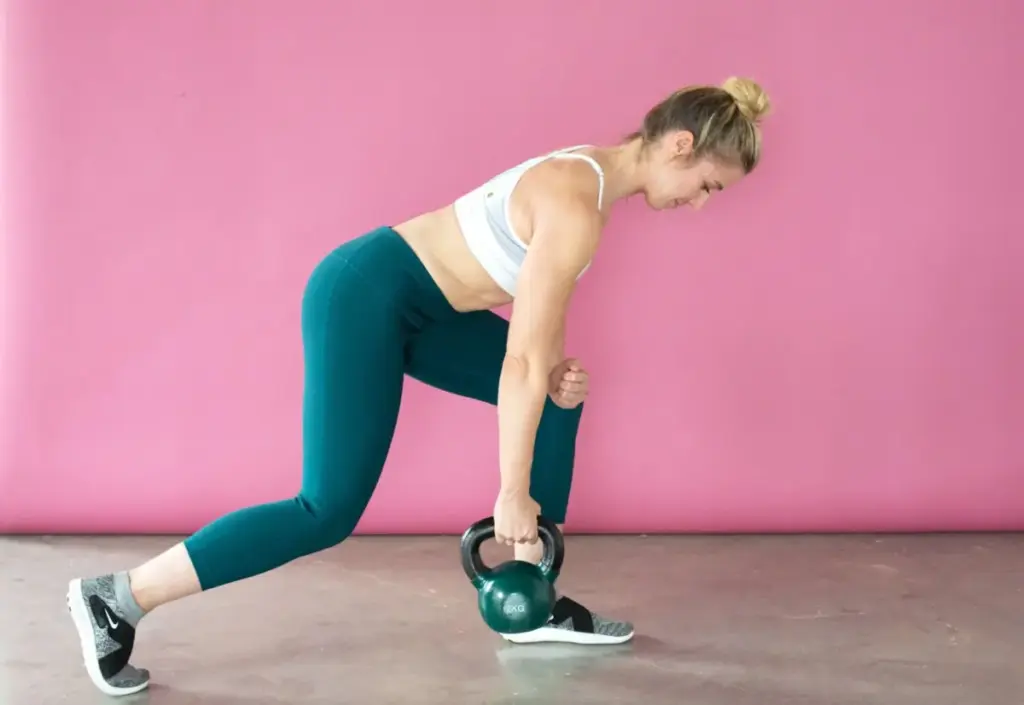
The core of the workout consists of four progressive circuits. Practitioners select a single kettlebell that feels "medium-to-hard" for the assigned tasks, keeping a lighter backup bell nearby in case technical breakdown threatens form.
Rather than chasing an arbitrary number of repetitions, participants work through time-based intervals. This structural shift is paramount: it removes the temptation to rush through movements with compromised posture, aligning output with physiological capacity.
Strategic Bodyweight Integration: Throughout the circuit sequence, bodyweight movements are intentionally interspersed. This is not merely a method of varying the stimulus; it is a vital recovery mechanism. It grants the grip, forearms, core, and shoulder stabilizers a temporary reprieve from sustained isometric and dynamic loading, ensuring that fatigue does not compromise safety during subsequent weighted sets.
Inter-Circuit Recovery: Upon completing a circuit, practitioners take between 30 seconds and two minutes of rest, depending on their current conditioning level. This timeframe allows for partial phosphocreatine replenishment, keeping the metabolic demand high while preserving cardiovascular capacity for the rounds ahead.
Supporting Context & Metrics: The Science of Offset Loading
To truly appreciate the value of a 20-minute kettlebell session, one must examine the biomechanical and physiological mechanisms that differentiate it from other forms of resistance training.
The Physics of the Offset Center of Gravity
When an individual holds a dumbbell, the weight is balanced symmetrically across the palm. The load vector runs directly through the center of the hand and wrist, minimizing torque on the distal joints.
A kettlebell fundamentally alters this equation. With the load positioned beneath or beside the handle, any deviation from neutral alignment creates a significant rotational force.
When holding a kettlebell in the "bottoms-up" position (with the weighted sphere oriented upward), the nervous system must instantly recruit high-threshold motor units across the entire upper extremity. The wrist extensors and flexors, the rotator cuff complex, and deep core stabilizers (including the transversus abdominis and obliques) must co-contract to resist the natural tendency of the bell to tip. This creates an environment of loaded stability that enhances functional joint integrity.
Metabolic Impact and EPOC
By stringing together dynamic, compound movements into short, continuous intervals, the routine triggers significant metabolic stress. Training large muscle groups simultaneously—such as the glutes, hamstrings, back, and shoulders—demands high cardiac output.
The heart rate remains elevated throughout the working intervals, bridging the gap between traditional resistance training and cardiovascular conditioning. This style of training promotes Excess Post-Exercise Oxygen Consumption (EPOC), meaning the body continues to consume elevated levels of oxygen and expend energy long after the final circuit is completed.
Bone Density and Long-Term Structural Health
As individuals age, maintaining structural integrity—particularly bone mineral density—becomes a paramount concern. Mechanical loading through weight-bearing exercises stimulates osteoblast activity, the cellular process responsible for building new bone tissue.
Because kettlebell movements frequently involve deceleration, changing directions, and axial loading (such as carrying, holding, and swinging), they apply safe, progressive stress to the skeletal system. Over time, this supports structural resilience, reducing the risk of osteopenia and osteoporosis.
Official Statements & Expert Insights
Industry professionals and movement specialists increasingly advocate for minimalist, functional training protocols that respect human biomechanics. Lacee Lazoff’s philosophy centers on bridging the gap between gym-based strength and real-world utility.
"Kettlebells are versatile, portable, and taxing on the entire body during most movements and movement patterns," Lazoff explains. "Just holding a heavy bell at the chest is an effective way to strengthen the core, back, arms, and shoulders."
This observation underscores the isometric value of kettlebell training. Even static holds require systemic tension. When a practitioner cleans a kettlebell to the rack position, the anterior core and upper back must engage intensely to maintain an upright posture against an anteriorly displaced load.
Lazoff further emphasizes the intentional design behind her time-based interval sequences:
"This workout is focused on total-body movements in functional patterns—a.k.a. ways we move in everyday life. I created short intervals with various movements in sequences to keep the body moving, increase heart rate, and balance upper- and lower-body work."
By focusing on functional patterns—pushing, pulling, hinging, squatting, and carrying—the routine trains the nervous system to coordinate complex motor patterns efficiently. This translates directly to improved physical performance outside the gym, whether an individual is carrying groceries, lifting heavy objects, or maintaining balance on uneven terrain.
Future Outlook: The Evolution of Minimalist Fitness
As fitness consumers increasingly seek efficient, science-backed solutions that fit into busy schedules, the popularity of single-implement training is poised to expand. The cultural shift away from hyper-specialized, multi-machine gym environments toward functional, space-saving methodologies highlights a growing appreciation for fundamental human movement.
The 20-minute kettlebell blueprint exemplifies this paradigm shift. By demonstrating that profound physiological adaptations—ranging from improved cardiovascular capacity to enhanced bone mineral density—can be achieved with a single piece of cast iron, routines like Lazoff’s challenge the notion that effective workouts require vast arrays of equipment.
Furthermore, as populations age and the focus of fitness shifts increasingly toward longevity and functional independence, exercises that challenge stability, core strength, and grip endurance will take center stage. Grip strength, in particular, is frequently cited by geriatricians and exercise physiologists as a vital biomarker for overall health and life expectancy. Regular kettlebell training naturally tests and improves grip endurance, offering secondary health benefits that extend far beyond aesthetic gains.
Recommendations for Implementation
For those looking to integrate this 20-minute routine into their weekly schedule, adherence to proper progression is essential:
Master the Basics: Spend adequate time in the warmup phase and practice individual movements without speed before attempting full interval flows.
Prioritize Form Over Load: If technique begins to degrade due to fatigue, drop down to a lighter bell or take extended rest periods.
Frequency: Integrating a high-efficiency kettlebell circuit 2 to 3 times per week provides an optimal balance of stimulus and recovery for most fitness enthusiasts.
Ultimately, the enduring appeal of the kettlebell lies in its brutal simplicity. In an industry saturated with complexity, the single bell stands as a testament to an enduring truth: when applied with intelligence and intent, a single piece of iron is all you need to build a resilient, powerful body.



.gif)