Executive Overview
In an era dominated by relentless hustle culture and the glorification of extreme athletic output, the modern fitness landscape often preaches a gospel of exhaustion. We are conditioned to believe that true transformation requires waking up at 4:30 AM, punishing the body with unrelenting high-intensity regimens, and sacrificing comfort in the pursuit of marginal gains. Yet, a quiet counter-revolution is taking place on the sun-dappled paths of Berlin’s urban parks. It is spearheaded by individuals who refuse to choose between personal well-being and high-level athletic achievement.
Hong, a Berlin-based graphic designer, international flight attendant, and veteran endurance athlete, embodies this paradigm shift. Once convinced that she was fundamentally "not a runner," Hong is now actively preparing for her seventh marathon. Her approach to endurance training dismantles the myth that competitive running demands misery. By fusing a demanding travel schedule with a holistic, comfort-first philosophy, Hong has curated a blueprint for sustainable fitness that proves consistency and coziness are not mutually exclusive.
This in-depth feature explores Hong’s weekly training regimen, examining how she balances a chaotic professional life, community building, injury prevention, and mental well-being on her journey to the starting line of her next 42-kilometer race. Through a granular examination of her weekly schedule, we uncover the physiological and psychological strategies that allow a modern urban professional to thrive in the high-stakes world of endurance sports.
Detailed Chronology: A Week in the Life of an Urban Marathoner
To understand how an amateur athlete prepares to run marathons while maintaining a demanding dual-career lifestyle, one must look closely at the architecture of their week. Hong’s schedule is a masterclass in time management, cyclical recovery, and psychological self-preservation.
Monday: The Sonic Lifeline and Canine Pacers
The workweek begins with the inevitable friction of transitioning from weekend leisure to professional obligations. As both a visual designer and a long-haul flight attendant, Hong’s weeks are structurally unpredictable.
"I am a designer and I also work as a flight attendant. Together with my training volume, my weeks are pretty packed," Hong notes. "I can’t lose the joy of running, or I won’t stay consistent. What I absolutely need for that is my running playlist."
On Mondays, when motivation occasionally lags behind ambition, music serves as an essential neurological anchor. Moving through genres ranging from propulsive house and disco to hypnotic techno, her playlist acts as an external pacemaker.
When cardiovascular fatigue sets in during a strenuous effort, Hong employs a unique physiological hack: she sings. Rather than gasping for air or pushing through dangerous spikes in heart rate, she begins to vocalize melodies. This forces her respiratory system to regulate, compelling her to drop her pace, regain control of her breathing, and transform a grueling physical hurdle into a moment of levity. It is a strategy that routinely elicits smiles from bewildered passersby on the Berlin pavement.
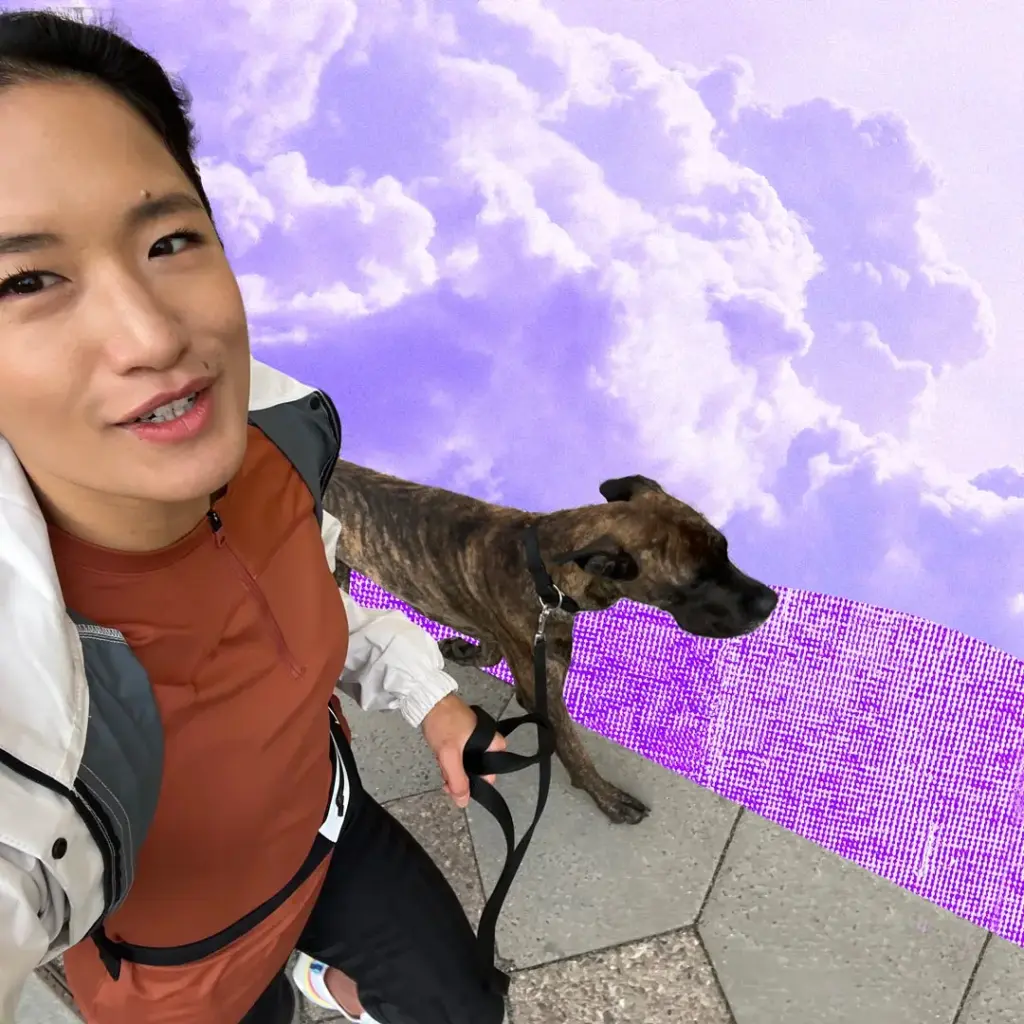
Monday’s mileage is further enlivened by canine companionship. By borrowing a friend’s energetic dog, Mia, Hong injects a social dynamic into her training. The partnership operates on a symbiotic exchange of pacing: Mia pulls aggressively during the initial kilometers, injecting explosive velocity into the opening stretch, while Hong’s diesel-engine endurance takes over in the latter half of the route, sustaining a steady, reliable rhythm long after the canine’s sprint energy has been depleted.
Tuesday: The Architecture of Resilience
Running is fundamentally an act of linear repetition, which makes the human body notoriously vulnerable to overuse injuries. Recognizing this, Tuesday is strictly designated as a non-running day, dedicated instead to structural integrity.
Hong’s Tuesday protocol centers around two non-negotiable pillars: yoga and strength training, supplemented by regular physiotherapy sessions. This triad forms the protective armor that allows her to push her limits later in the week without courting catastrophic injury.
- Yoga: Enhances joint mobility, encourages active recovery, and builds deep core stability.
- Strength Training: Targets the posterior chain, hip abductors, and stabilizing muscles essential for maintaining upright posture over 42 kilometers.
- Physiotherapy: Addresses micro-traumas before they manifest as clinical injuries.
This holistic scaffolding ensures that when Hong steps outside her comfort zone during intense workouts, she does so from a position of absolute physical security. Consequently, she finishes her heavy training blocks without feeling utterly depleted, allowing the vital recovery phase to work its magic.
Wednesday: Mid-Week Decompression and Social Integration
For the long-distance runner, psychological burnout is often more dangerous than physical fatigue. Mid-week, Hong deliberately steps away from athletic metrics and data tracking.
As a flight attendant who crosses time zones regularly, her local social network in Berlin is precious. Wednesday is reserved for human connection and cultural engagement rather than mileage accumulation. Whether visiting a contemporary art exhibition or simply sitting in a café with peers, Hong understands that psychological nourishment is a performance-enhancing variable. By tending to her social life, she inoculates herself against the mental isolation that frequently plagues high-mileage athletes.
Thursday: Pushing the Envelope on the Track
If Monday and Tuesday are about balance and preservation, Thursday is where raw athletic ambition takes center stage. Marathon preparation demands physiological adaptation, which can only be achieved by flirting with anaerobic thresholds.
"Some people think marathon runners tumble out of bed at 5:00 AM and run 20 kilometers without any issues. In reality, I sometimes need an extra dose of motivation. That’s why comfort is so important to me, whether I have an easy run or a hard track workout ahead."
Thursday’s agenda is a high-intensity track session designed to test velocity maintenance and lactate threshold capacity. To mitigate the brutal impact forces associated with fast intervals on synthetic tracks, Hong relies on specific gear engineering—specifically, the Nike Invincible 3. Featuring a high-stack, highly resilient "bouncy" foam midsole, the footwear provides a forgiving landing platform while returning explosive energy with every toe-off, ensuring psychological confidence on unforgiving surfaces.
Friday: Active Rest and Urban Exploration
Following the neurological and muscular strain of Thursday’s speedwork, Friday mirrors the restorative themes of mid-week. Aside from a restorative, low-intensity yoga flow, the day is intentionally low-impact.
Hong leverages her time back in Berlin to immerse herself further in the city’s vibrant cultural offerings. This rhythm of high output followed by absolute license to rest is the engine of her longevity in the sport.
Saturday: The Meditative Urban Long Run
Saturday morning marks the execution of her signature endurance route along the historic Landwehrkanal. This run is a masterclass in terrain variation and sensory mindfulness.
Shifting seamlessly from hard urban asphalt to soft grass and muddy footpaths, the Saturday run serves as a moving meditation. With an engaging podcast in her ears—or occasionally running in absolute silence to absorb the ambient acoustic footprint of the city—Hong treats this session as psychological decompression.
The run concludes with a sacred post-workout ritual: a specialized culinary reward. Stopping at a local market stall in Kreuzberg, she caps off the morning with artisanal coffee and a carefully chosen snack, proving that the psychological payoff of a run often begins long before the first step is taken.
Sunday: Collective Endurance and the Joy Run Collective
While mid-week runs are frequently solitary affairs, Sunday belongs to the community. As a proud member of the Joy Run Collective, Hong tackles her long-distance weekend mileage surrounded by a synchronized peloton of running peers.
Running long distances in the crisp Berlin air requires meticulous preparation, especially during the colder months. Layering appropriately to combat thermal loss, the collective covers expansive territory through the expansive landscape of the Tiergarten.
The physical challenge of the Sunday long run is invariably matched by the social reward that follows: a communal brunch. On this particular weekend, the post-run gathering features homemade dumplings—a culinary carrot that Hong admits to anticipating throughout the entirety of her training week.
Supporting Context & Metrics: The Evolution of an Athlete
Hong’s journey challenges deeply ingrained stereotypes within the running community. Having only taken up the sport four years ago at the age of 26, her athletic trajectory highlights a fascinating physiological truth: endurance capability is remarkably plastic across the lifespan.
Now thirty years old, Hong reports feeling healthier, more robust, and biologically fitter than she ever did throughout her entire twenties. This transformation defies the antiquated athletic dogma that peak physical output belongs exclusively to early youth.
Key Performance Pillars of Hong’s Routine:
- Consistency Over Intensity: By prioritizing runs that feel manageable and enjoyable, she avoids the burnout cycle that sidelines so many novice runners.
- Multidisciplinary Cross-Training: Allocating nearly 40% of her weekly movement to yoga, strength work, and physiotherapy protects her joints against the repetitive strain of high-mileage blocks.
- Nutritional and Social Rewards: Pairing grueling physical tasks with immediate, highly anticipated rewards (coffee in Kreuzberg, Sunday dumplings) exploits psychological conditioning to reinforce positive behavioral loops.
Official Insights & Athlete Philosophy
Reflecting on her four-year transformation from a reluctant runner to a seasoned marathon veteran, Hong emphasizes that the true victories achieved on the road extend far beyond cardiovascular improvements.
"Losing my breath? I slow down and start singing. It makes the run so much more fun, and I notice people smiling as I run past them singing."
This philosophy underscores a critical missing element in contemporary fitness culture: joy. For Hong, the moment running ceases to be an enjoyable, self-affirming practice is the moment the training loses its efficacy.
"I’ve gained a lot of self-confidence as a runner because now I know how hard I can push myself, even when I’m feeling a bit low. I’ve learned that consistency and comfort do not have to exclude each other. I can set new boundaries for myself and feel comfortable doing it."
Her narrative provides a vital counter-weight to the "no pain, no gain" orthodoxy. By honoring her need for comfort, protecting her mental space, and leaning into community structures, she has forged an antifragile athletic identity.
Future Outlook: Setting Sights on the 7th Marathon
As Hong laces up her shoes for the upcoming weeks of training, her immediate horizon is dominated by a single, tangible milestone: her seventh marathon.
In an endurance community constantly chasing hyper-optimized, data-driven perfectionism, Hong’s methodology offers a refreshing, human-centric alternative. Her journey demonstrates that high athletic performance does not require the eradication of pleasure, the sacrifice of a social life, or the abandonment of self-care.
For aspiring runners intimidated by the daunting distance of 42.2 kilometers, Hong’s trajectory serves as both an invitation and a blueprint. With a reliable playlist, a supportive community, a comfortable pair of shoes, and a plate of dumplings waiting at the finish line, the road from the snooze button to the starting corral is entirely within reach.
Hong’s 3 Golden Rules for Maximum Running Enjoyment
- Prioritize Footwear Integrity: Invest in comfortable, supportive running shoes (such as models equipped with high-rebound cushioning) to protect your joints and provide psychological confidence across changing urban surfaces.
- Curate a Sonic Shield: Build a dynamic playlist spanning high-energy genres like disco, house, and techno to rescue your motivation during low-energy slumps.
- Design the After-Party: Pair every significant running route with a deliberate, enjoyable reward—whether it is a local artisanal coffee, a bustling market snack, or a celebratory meal with friends.