Executive Overview
For fans seeking a high-stakes binge-watch, Netflix’s current Top 10 list offers a whirlwind of captivating options. From gripping true-crime docuseries like Death of the Pastor’s Wife to the nostalgic final season of Outer Banks, the streaming giant continues to dominate weekend culture. Yet, amid a crowded field of new releases, theatrical hits, and teen dramas, one specific title continues to anchor itself firmly in the cultural zeitgeist: Tyler Perry’s glittering, cutthroat drama, Beauty in Black.
Boasting the coveted number two spot on the platform—just behind the aforementioned true-crime phenomenon—Beauty in Black has proven that its explosive blend of corporate corruption, familial warfare, and haute couture drama is far from running out of steam. The series, led by a powerhouse performance from Taylor Polidore Williams, recently debuted its third season to a flurry of fan excitement. However, the path to Season 3 has been nothing short of a roller coaster for both the audience and its creator.
Originally slated to conclude with its third outing, the dramatic saga of the Bellarie family has experienced an unexpected, highly celebrated resurrection. In a stunning reversal of corporate strategy, Netflix and Tyler Perry announced that the series has officially been renewed for a fourth season. This comprehensive report delves into the mechanics of the renewal, examines the structure of the current season, evaluates the viewership metrics that forced Netflix’s hand, and explores what the future holds for the inhabitants of the Bellarie empire.
Detailed Chronology: The Journey from Cancellation to Surprise Revival
To fully understand the weight of the Season 4 renewal, one must examine the timeline that brought Beauty in Black to this precarious yet triumphant juncture.
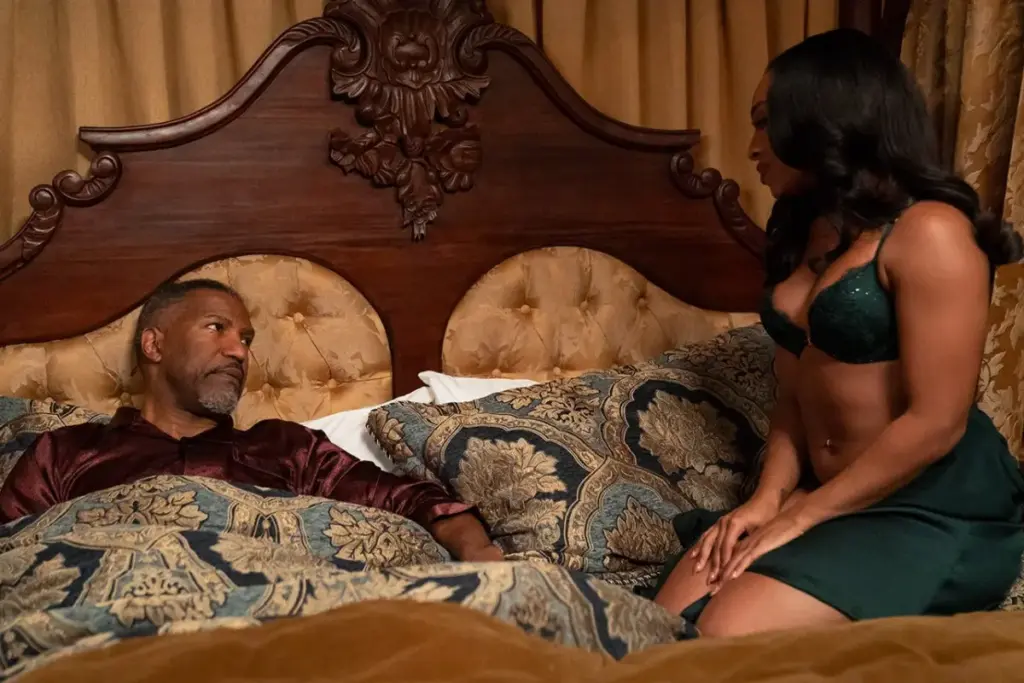
When Tyler Perry first partnered with Netflix to bring Beauty in Black to screens, the series immediately established a distinct identity within his expansive television catalog. Centered around the intersecting lives of Kimmie (played by Taylor Polidore Williams), a young woman struggling to survive, and Mallory Bellarie (played by Crystle Stewart), a fiercely intelligent businesswoman at the head of a massive hair-care conglomerate, the show quickly built a dedicated, vocal fanbase.
The Split-Season Model of Seasons 1 and 2
During its initial broadcast lifecycle, Beauty in Black adopted a distinct distribution strategy. Seasons 1 and 2 were each constructed around a sprawling 16-episode arc, strategically split into two distinct parts. This episodic pacing allowed viewers to digest the densely plotted betrayals, corporate espionage, and domestic intrigue in chunks, keeping the social media discourse alive for months at a time. The strategy worked brilliantly, turning the show into a reliable ratings engine for the platform.
The "Final Season" Announcement
Despite the show’s undeniable traction, the landscape of streaming television is notoriously volatile. In December 2025, a wave of disappointment rippled through the fandom when industry trades and Netflix announcements confirmed that the upcoming third season of Beauty in Black would be its last. The creative team was reportedly informed that the narrative paths of Kimmie, the Bellarie family, and the various corrupt power brokers populating their world would be neatly wrapped up within an abbreviated eight-episode run. For all intents and purposes, the death knell of the series had been sounded, and fans prepared to bid farewell to the glitz and grit of Perry’s universe.
The July 2026 Reversal
As the old adage goes, numbers talk. Following the conclusion of its phenomenal second season, Beauty in Black demonstrated a rare form of streaming longevity, clinging fiercely to the global viewership charts for an astonishing six consecutive weeks. This sustained engagement caught the attention of Netflix executives who evaluate content not just on initial premiere-weekend spikes, but on long-tail consumption and retention.
Sensing that the narrative well was far from dry, negotiations quietly shifted behind the scenes. In July 2026, the narrative completely flipped. Netflix officially rescinded its previous cancellation decree, announcing to a stunned and ecstatic audience that Beauty in Black would officially return for a fourth season. What was once pitched as a definitive series finale for Season 3 was suddenly recontextualized as merely the penultimate chapter in a much larger, ongoing saga.
Supporting Context & Metrics: Decoding the Numbers Behind the Success
The decision by a major streaming platform to reverse a cancellation order is a rare occurrence in the modern television landscape. Such moves are almost exclusively driven by hard data, algorithmic performance, and undeniable cultural footprint.
The Power of the Global Top 10
In the streaming era, Nielsen ratings have been largely replaced by proprietary metrics released weekly by platforms like Netflix, measuring hours viewed, completion rates, and weeks spent in the Global Top 10. Beauty in Black excelled particularly in the latter metric.
While many series experience a sharp viewership drop-off after their opening weekend—often referred to as the "front-loaded" phenomenon—Beauty in Black retained a remarkably stable audience base. Its ability to command global attention for six consecutive weeks during its second-season run signaled to executives that the show possessed cross-demographic appeal and high "rewatchability." Furthermore, the show consistently dominated social media platforms like X (formerly Twitter) and TikTok, where fans dissected every twist, meme-ified character reactions, and debated the moral ambiguity of the Bellarie family’s business practices.
Production Efficiency and Creative Control
Tyler Perry is legendary within the entertainment industry for his unprecedented production speed and cost-efficiency. Operating out of Tyler Perry Studios in Atlanta, Georgia, Perry famously shoots entire seasons in a fraction of the time and budget required by traditional Hollywood studio models.
This operational model gives his projects an inherent financial advantage. When a series like Beauty in Black generates high engagement numbers coupled with remarkably low production overhead relative to prestige sci-fi or fantasy epics, the return on investment for Netflix is exceptionally high. Extending the series for a fourth season was not merely an artistic choice; it was a sound business decision rooted in reliable profitability and guaranteed audience retention.
Official Statements and Creative Vision
The shockwaves of the Season 4 announcement reverberated across the industry, accompanied by heartfelt statements from the creative minds steering the ship. Chief among them was the show’s creator, writer, and director, Tyler Perry, whose enthusiasm for the extended narrative was palpable.
Tyler Perry Speaks to Tudum
In an exclusive statement provided to Netflix’s official companion site, Tudum, Perry expressed his deep gratitude to the fanbase and his excitement for the creative territory yet to be explored:
“Beauty in Black is back for Season 4 and the Bellarie family’s story is far from finished,” Perry stated. “There was so much more I wanted to explore and I’m grateful I get to keep telling this story. To the audience that has been on this ride with us from day one, thank you for watching and sharing it with the world. More episodes are on the way!”
This sentiment underscores a common creative friction in modern television: the tension between corporate constraints—such as predetermined episode counts or premature end dates—and the expansive vision of a creator. For Perry, the decision to wrap up the show in Season 3 felt increasingly restrictive as characters evolved and new subplots took on lives of their own. The greenlighting of Season 4 provides him with the runway necessary to land the narrative planes precisely on his own terms, ensuring that character arcs are given the depth and resolution they demand rather than being rushed to an artificial finish line.
Cast members, including Taylor Polidore Williams and Crystle Stewart, have similarly echoed these sentiments in interviews, expressing relief and excitement that they get to inhabit their complex, glamorous, and dangerous characters for at least one more season.
Season 3 Breakdown: What to Watch Right Now
While anticipation for Season 4 builds, viewers currently diving into the platform have a dense, highly charged batch of episodes to consume.
Understanding the Season 3 Structure
For fans wondering how Season 3 stacks up against its predecessors, there are a few structural differences to keep in mind:
- Episode Count: Season 3 consists of eight total episodes.
- Release Format: Unlike Seasons 1 and 2—which were split into two separate 16-episode blocks—Season 3 drops as a single, cohesive eight-episode installment.
- Narrative Tone: Free from the burden of having to stretch a narrative across a massive 16-episode order, Season 3 operates at a noticeably accelerated pace. Betrayals arrive faster, corporate maneuvers are executed with razor-sharp precision, and the emotional stakes for Kimmie and the Bellarie family are ratcheted up to a fever pitch.
The Broader Netflix Ecosystem
For those who finish Season 3 and find themselves hungry for additional viewing, Netflix’s current content slate offers robust counter-programming. Alongside Beauty in Black, the platform is heavily promoting the sports documentary Untold: The Testimony of Vince Young, which explores the meteoric rise and heartbreaking struggles of the legendary college football star. Additionally, the musical teen drama Don’t Say Good Luck has been generating significant buzz among younger demographics, while the domestic sitcom Leanne continues to draw steady traditional comedy viewers.
However, for fans of melodrama, high-fashion villainy, and unpredictable corporate warfare, Beauty in Black remains the undisputed crown jewel of the current streaming rotation.
Future Outlook: What Lies Ahead for the Bellarie Empire?
With Season 4 officially locked in by Netflix, the speculative machinery of the fandom has shifted into high gear. What can audiences expect when the series eventually returns for its fourth installment?
Narrative Trajectories
Without spoiling the cliffhangers of Season 3, the expansion into Season 4 guarantees that several lingering plot threads regarding the Bellarie family’s corporate empire and Kimmie’s ongoing quest for autonomy will be explored in microscopic detail. Perry has historically used his extended runs to dive deeper into systemic corruption, loyalty, and the price of ambition. As the power dynamics between the matriarchs, rivals, and underlings continue to shift, Season 4 is expected to deliver higher stakes, more elaborate set pieces, and the signature twists that have become the hallmark of the series.
The Streaming Landscape and Tyler Perry’s Partnership
The resurrection of Beauty in Black also speaks to the evolving relationship between prolific creators and streaming services. In an era where platforms are increasingly trigger-happy with cancellations—often pulling the plug on shows before they can build a sustainable audience—Netflix’s willingness to listen to data, observe long-tail viewing habits, and reverse course is a notable precedent.
If Season 4 continues to perform at the stratospheric levels set by its predecessors, it may cement Beauty in Black not just as a hit drama, but as a foundational pillar of Netflix’s ongoing partnership with Tyler Perry. For now, the message to the audience is clear: the Bellaries are not going anywhere anytime soon.
How to Stream Beauty in Black on Netflix
Beauty in Black Season 3 is currently streaming in its entirety on Netflix. For new viewers looking to jump into the phenomenon, subscription options begin at $8.99/month with ad-supported tiers. Ad-free monthly options are also available for $19.99 (Standard plan) or $26.99 (Premium plan). Please note that Netflix does not currently offer a free trial period, meaning new subscribers must select a paid plan to access the platform’s extensive library.