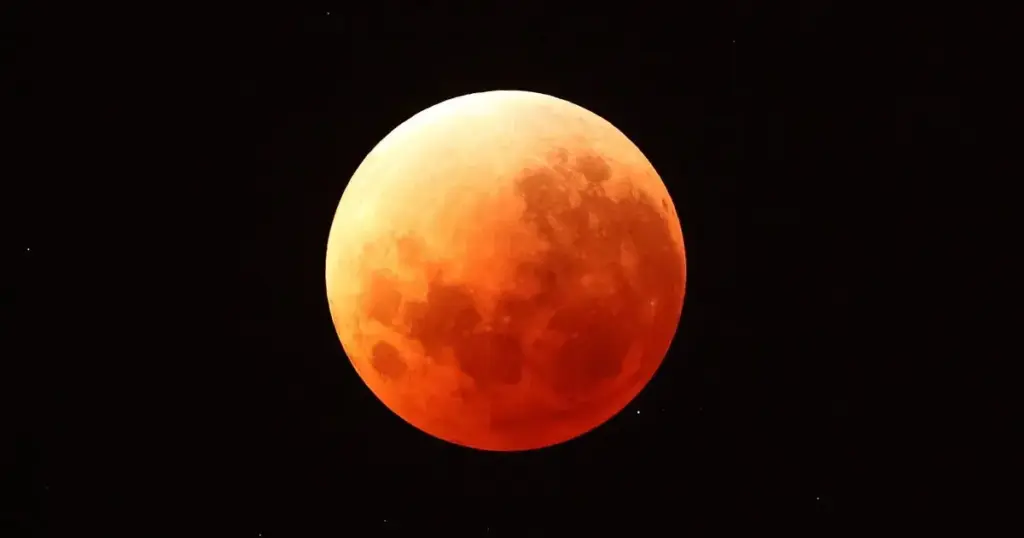
In the early hours of Friday morning, millions of astronomy enthusiasts across the globe turned their gazes upward to witness a breathtaking celestial alignment: a rare partial lunar eclipse that cast a dramatic rusty-red and copper glow across the lunar surface. Observers spanning from the United Kingdom and Western Europe to parts of the United States, Turkey, and South America tracked the progression of the Earth’s shadow as it slowly crept across the Moon’s illuminated disk.
The astronomical event, commonly popularized as a "Blood Moon," occurs when our planet positions itself directly between the Sun and the Moon. Rather than plunging into total darkness, the lunar surface catches filtered sunlight bending through the edges of Earth’s atmosphere. The resulting optical phenomenon— Rayleigh scattering—filters out shorter blue light waves while allowing longer, warmer red wavelengths to illuminate the lunar landscape.
While the spectacle offered a stunning visual display for astrophotographers and casual stargazers alike, visibility varied wildly due to localized weather patterns. In regions blessed with clear skies, such as parts of southern England, Turkey, and Italy, observers were treated to a mesmerizing view of the shadowed lunar disk hanging low on the western horizon. Conversely, unsettled meteorological conditions and stubborn cloud cover presented significant challenges for spectators across portions of the UK and northern Europe, turning the event into a tense race against the elements.
Detailed Chronology: The Anatomy of the Eclipse
The partial lunar eclipse unfolded in distinct, precisely timed stages over the course of several hours on Friday, August 28, 2026. Understanding the progression of the event highlights the intricate mechanics of orbital mechanics and planetary shadows.
The Penumbral Phase Begins (2:23 AM BST)
The astronomical sequence officially commenced at 2:23 AM British Summer Time (BST). At this juncture, the full Moon began its gentle drift into the penumbra—the lighter, outer fringe of Earth’s shadow. Because the penumbra only partially blocks the sun’s rays, this initial phase produced a very subtle, easy-to-miss dimming of the lunar surface. To the casual observer glancing out a window, the Moon appeared largely normal, yet sensitive photographic equipment and attentive astronomers noted the gradual loss of brilliance.
The Partial Eclipse Commences (3:33 AM BST)
The visual drama escalated significantly at 3:33 AM BST as the leading edge of the Moon formally crossed into the umbra—the dark, central core of the Earth’s shadow. This marked the start of the partial lunar eclipse phase. Observers watching with the naked eye could suddenly perceive a sharp, dark indentation forming along the lunar disk, resembling a dark bite taken out of the bright white sphere. As more minutes ticked by, the crisp shadow advanced steadily across the craters and maria of the Moon.
Maximum Eclipse and Peak Obscuration (5:12 AM BST)
The climax of the celestial event occurred at precisely 5:12 AM BST. At this moment, approximately 90 to 93 percent of the Moon’s surface was fully immersed within the Earth’s deep umbral shadow. Stargazers were treated to the quintessential "Blood Moon" aesthetic: a deeply muted, copper-red hue draped over the majority of the lunar disk, contrasting sharply against the fading backdrop of the pre-dawn sky.
The Race Against Moonset (6:15 AM – 6:51 AM BST)
For observers in the United Kingdom and Ireland, the final acts of the eclipse played out in a dramatic race against dawn and the horizon. Because the Moon was sinking progressively lower into the western sky, it dipped below the horizon before the umbral phase could fully conclude. In London, moonset occurred at approximately 6:15 AM BST, just as the final stages of the shadow’s retreat were underway. The complete partial eclipse officially ended globally at 6:51 AM BST, by which time daylight had broken across Western Europe.
Supporting Context & Metrics: The Science of "Eclipse Season"
To fully appreciate the significance of Friday’s event, one must examine the broader orbital dynamics governing solar and lunar alignments. Astrocytes and researchers emphasize that eclipses are governed by strict geometric parameters rather than mere coincidence.
Why Eclipses Happen in Pairs
Speaking on the mechanics of the event, Emma Alexander, an astrophysicist and research fellow at the University of Leeds School of Physics and Astronomy, explained the concept of the "eclipse season."
"There are opportunities to see a lunar eclipse only twice a year, in a so-called ‘eclipse season’," Alexander noted.
Because the plane of the Moon’s orbit is tilted by approximately five degrees relative to the Earth’s orbital plane around the Sun (the ecliptic), the Moon typically passes safely above or below the Earth’s shadow during a standard full moon. However, twice a year, the orbital nodes align favorably with the Sun, creating a narrow window where eclipses become possible.
Furthermore, lunar eclipses rarely travel alone. "It is not a coincidence this happened so soon after the solar eclipse," Alexander added, noting that solar and lunar eclipses generally occur in tandem during an eclipse season, separated by roughly two weeks—the span of half a lunar cycle. Solar eclipses exclusively occur during a New Moon when the Moon passes between the Earth and Sun, while lunar eclipses strictly coincide with a Full Moon.
Categorizing Lunar Eclipses
Astronomers classify lunar phenomena into three distinct categories based on the depth of the Moon’s passage through Earth’s shadow:
Total Lunar Eclipse: The entire lunar disk passes completely into the dark inner umbra. Totality can endure for up to one hour and 40 minutes, bathing the Moon in a brilliant crimson light.
Partial Lunar Eclipse (Friday’s Event): Only a portion of the Moon enters the umbra, creating the signature "bitten" or shadowed appearance across the lunar topography.
Penumbral Lunar Eclipse: The Moon brushes exclusively through the faint outer penumbra, resulting in a minimal, often imperceptible dimming that requires specialized observation to detect.
Official Statements and Meteorological Challenges
While the geometry of the solar system cooperated perfectly to deliver the eclipse, the Earth’s lower atmosphere proved to be a fickle gatekeeper. Meteorological conditions played a defining role in determining who enjoyed a front-row seat to the cosmos and who was left staring at a blank, gray blanket of clouds.
The Met Office Forecast and Regional Divides
Ahead of Friday morning’s spectacle, the UK Met Office issued cautionary forecasts highlighting that visibility would face considerable challenges due to unsettled weather systems.
Niamh Murray, an operational meteorologist at the Met Office, detailed the regional outlook prior to the event:
"The majority of the UK is going to be quite cloudy, particularly anywhere north of the M4 corridor, and even below that, there’s quite a lot of cloud around."
According to forecasters, the southern and eastern stretches of England—particularly coastal regions in Devon, Dorset, and parts of Kent—held the highest statistical probability of enjoying unhindered breaks in the cloud cover during the early stages of the event around 2:00 AM to 3:00 AM.
However, as the night wore on and the eclipse advanced toward its 5:12 AM peak, cloud cover steadily expanded northward and eastward. For millions of residents living north of the M4 corridor, lingering rain and dense cloud banks obscured the view entirely, frustrating early-rising stargazers. Additionally, because the Moon sat remarkably low in the western sky during the peak hours, even regions with otherwise clear skies had to contend with urban obstructions, tree lines, and low-horizon haze.
International Sightings
While UK weather proved temperamental, international observers enjoyed vastly different fortunes. High-resolution imagery captured from Ankara, Turkey, and Rome, Italy, showcased the partial eclipse unfolding against crisp, clear urban skylines. In Rome, photographers managed to frame the reddish lunar disk hovering near historical landmarks like the Colosseum. Meanwhile, across the Atlantic Ocean, stargazers along the East Coast and parts of the Midwest of the United States experienced favorable viewing windows to track the celestial event from dusk through the progression of the eclipse phases.
Future Outlook: When is the Next Major Lunar Event?
For those who missed Friday morning’s partial eclipse due to unfavorable weather or oversleeping, astronomers offer reassurance: the cosmos operates on a reliable, predictable clock.
While Friday’s event marked the sole lunar eclipse visible to large population centers in the UK and parts of North America for this segment of the year, subsequent eclipse seasons will bring new opportunities. Stargazers are advised to consult local astronomical societies and planetary tracking applications to prepare for upcoming penumbral and total lunar alignments.
Experts emphasize that witnessing a lunar eclipse requires no specialized gear, expensive telescopes, or protective solar eyewear—unlike solar eclipses, which demand certified safety filters. Naked-eye observation is entirely safe, allowing anyone with a clear horizon and cooperative weather to experience firsthand the dynamic interplay of planetary shadows across our solar system. As research and public interest in astronomy continue to surge, events like the 2026 Blood Moon serve as a powerful reminder of humanity’s shared connection to the wider universe.