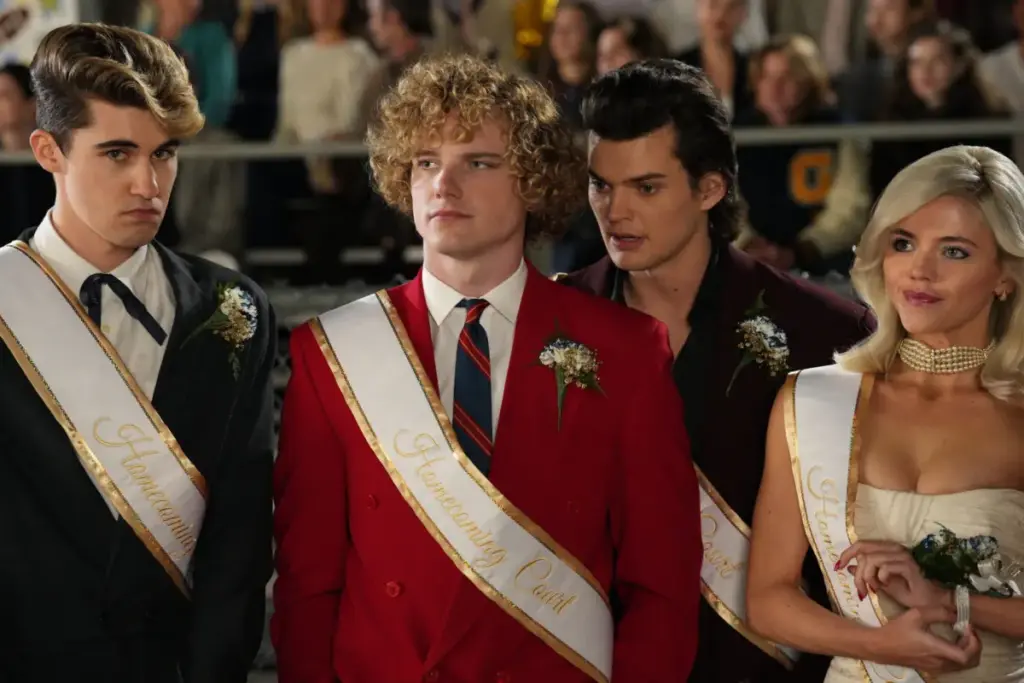
Ryan Murphy’s fever-dream adaptation of Bret Easton Ellis’s chilling novel The Shards has captured the cultural zeitgeist, functioning as much as a psychological thriller as it does a meticulous time capsule of early-1980s Southern California. Set against the sun-baked, yet perpetually shadowy backdrop of 1981 Los Angeles, the FX series is dense with the requisite signifiers of the era: absent parents, early-MTV bangers, a pervasive Satanic Panic, and high-stakes social engineering within the gilded halls of Buckley Prep.
Beneath the narrative suspense and neo-noir atmospheric dread, however, lies an equally compelling triumph of world-building executed by the hair and makeup department. Led by nine-time Emmy nominee Valerie Jackson, the styling team bypassed lazy, caricature-driven shortcuts—eschewing shellacked claw bangs and aggressive perms in favor of a nuanced, historically precise aesthetic. Drawing inspiration from cinematic icons like Michelle Pfeiffer and Debbie Harry, as well as the real-life progeny of 1980s royalty—including Kaia Gerber and Homer Gere—Jackson’s character-driven hair design dictates emotional shifts, social standing, and psychological fracturing across the show’s core ensemble.

Detailed Chronology: The Evolution of 1981 Style in The Shards
Episode 6 & 7: The Homecoming Metamorphosis and the "Scarface" Nod
The intersection of plot mechanics and period-accurate beauty reaches a fever pitch in episodes six and seven. In the storyline titled "Homecoming Part One," aspiring actress Debbie (Hayes Warner) and her high-achieving best friend Susan (Kaia Gerber)—the presumed homecoming queen—conspire to divert the prestigious title to Rhonda (Ivy Wolk). Rhonda, a well-liked classmate and recently escaped kidnap victim, represents a free-spirited foil to the ultra-polished Buckley elite.
Before the shocking homecoming court coronation, Rhonda undergoes a quintessential 1980s teen-movie makeover. Armed with Miss Breck and Rave hairsprays and an array of curling irons from Debbie’s ornate pink vanity, the best friends soften Rhonda’s straight-as-a-board bangs and long dark hair into a tumble of bouncy curls.

As Jackson clarifies, no modern hot curling irons were deployed on set. Modern heat closes the hair cuticle, preventing the natural, fluffy textures iconic to the era from shining through. Instead, Jackson utilized period-authentic tools:
- Conair Hot Sticks: Flexible electric rollers popular in the 1980s and ’90s, used to give Rhonda her softer curls and feathered bangs.
- Traditional blow-drying: Utilizing round brushes to achieve volume and movement without sacrificing historical integrity.
Meanwhile, Evan Rachel Wood’s character, former Indiana beauty queen Liz Schaffer, delivers backhanded approval to her lookalike daughter Debbie. Sporting straight bangs and a blonde lob that nods directly to Michelle Pfeiffer’s Elvira Hancock in the 1983 crime epic Scarface (a direct request from Ryan Murphy), Wood’s severe, high-glam styling anchors the generational tension of the series.

Supporting Context & Metrics: Decoding the Principal Cast
Jackson’s approach to character design relies heavily on hair as a visual manifestation of internal psychology and socio-economic privilege.
Susan: The Golden Girl (Kaia Gerber)
As the self-assured valedictorian and class president, Susan walks the halls of Buckley Prep with long, lush, side-parted waves that are always precise. Jackson looked to Gerber’s supermodel mother, Cindy Crawford, for inspiration. By studying Crawford’s historical looks and utilizing New York City salon products from Stephen Knoll—a brand Crawford has patronized since the 1990s—Jackson achieved a "silky," ambiguous texture.

- Psychological Shift: Susan’s side part represents a polished, uniform perfection. When she alters her part to a middle part for a televised dance-off, it signals a quiet rebellion, mirroring her unspoken ambitions to pursue a career in the legal arts beyond the confines of her elite high school.
Debbie: The Blonde Bombshell (Hayes Warner)
Described in voice-over by her boyfriend, budding author Bret (Igby Rigney), as a rule-breaker whose platinum hair was inspired by Blondie, Debbie’s styling reflects inherited wealth and cutthroat ambition.
- The Technique: Jackson adjusted Warner’s pre-bleached hair to icy platinum tones, cutting front layers to feather out naturally. References were drawn not just from Debbie Harry, but from Diane Lane and Brooke Shields.
- Emotional Pivots: When Debbie feels neglected or threatened by the L.A. serial killer, she temporarily adopts a softer side part, exposing her vulnerabilities before reverting to high-volume styles when chasing fame on a Dance Party USA-esque show.
Robert: The Enigma (Homer Gere)
Entering senior year as a mysterious new classmate, Robert (played by Homer Gere, son of 1980s icon Richard Gere) triggers paranoia in Bret and captures Susan’s attention. Robert’s hair evolves alongside his ambiguous motivations:
.jpg)
- Initial Appearance: A slicked-back look evoking mysterious villains and synth-pop groups like A-ha, introduced during a screening of Stanley Kubrick’s The Shining.
- School Evolution: A feathery side part that blows in the wind to project vulnerability, eventually transforming into a high-volume, mousse-and-hairspray-fortified mullet as he integrates deeper into the social circle.
Official Statements and Industry Insights
The production of The Shards required rigorous historical research paired with a collaborative spirit between Ryan Murphy, Valerie Jackson, and the actors.
Addressing internet speculation regarding the use of ultra-heavy product formulations, Jackson noted with a laugh that Aquanet super-hold hairspray was kept off the styling table for daily use, though she worked closely with the props department to ensure Debbie’s vanity was stocked with period-accurate bottles.

"We start off with the quintessential, slicked-back look, which almost has that mysterious villain quality to it," Jackson explains regarding Robert’s character arc. "As he starts to become more immersed into the group, his slicked-back hair looks like he’s taking a little more time. It’s feathered. It’s got the volume."
Furthermore, the collaboration with second-generation actors like Kaia Gerber and Homer Gere bridged real-world generational beauty lineages with fictionalized drama. By tapping into the personal grooming regimens of Cindy Crawford and Richard Gere, the styling team bypassed synthetic approximations of the 1980s, securing a tactile authenticity that resonates with modern viewers.

Future Outlook
As The Shards continues to unspool its labyrinthine narrative across its inaugural season, the meticulous attention paid to hair and makeup sets a new benchmark for period television production design. The department’s avoidance of tired tropes—opting instead for a textural, character-led philosophy—proves that historical aesthetic accuracy can elevate psychological tension rather than merely decorate the background.
With future episodes promising escalating danger, moral compromise, and societal breakdown among Los Angeles’s affluent youth, audiences can expect the hair design to track these dark narrative developments. Whether through failing curls, darkening roots, or the relentless application of modern-classic styling agents, Jackson’s work on The Shards ensures that every strand of hair tells a story of an era hurtling toward its own undoing.